
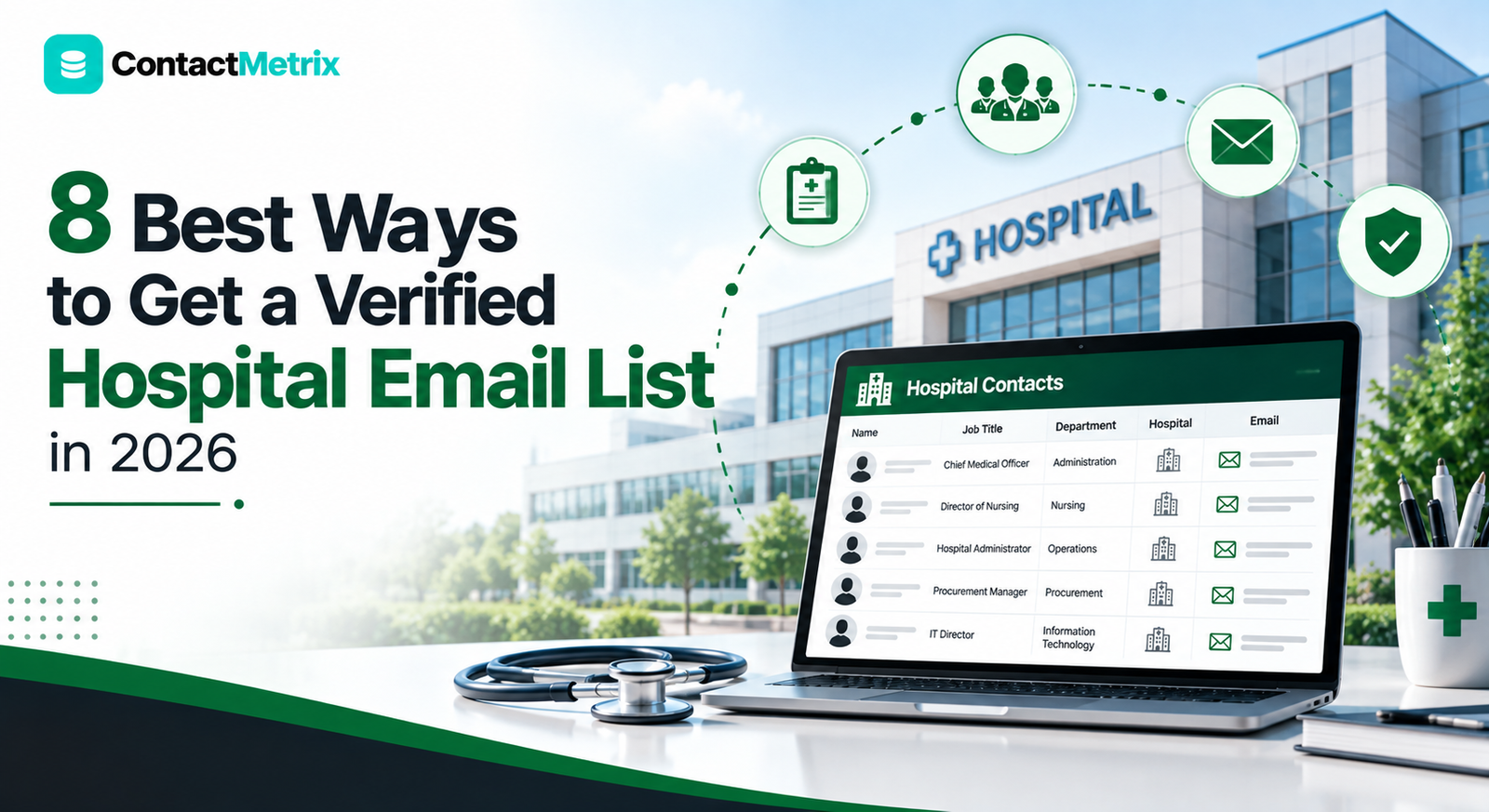
Do your emails to hospitals land in a shared inbox no one checks? Or even worse, do they bounce back because the person no longer works there?If you do business with hospitals, you probably know this situation well. It is difficult to find the right person and even harder to get their actual work email.
That’s why a good hospital email list matters. Rather than having to guess which people to contact or picking names at random from a website, a verified hospital email database provides you with real individuals, such as administrators, department heads, and decision-makers, complete with working emails. Whatever term you use, hospital contact list, hospital mailing list, or simply your outreach list, the objective remains the same.
This blog explains what a hospital email list is, how to get the best database, and more. Let’s get started.
What is a Hospital Email List
A hospital email list is a business-to-business contact database. It gives details on hospital executives, managers, leaders, department heads, and other key decision-makers. It usually includes work email addresses, phone numbers, job titles, and hospital details. Some people call it a hospital contact list, hospital contact emails, or hospital email addresses.
Who Should Buy a Hospital Email List
A hospital email list isn’t for everyone. It works best for businesses that sell products or services hospitals genuinely need. Medical equipment companies use it to reach buyers directly instead of guessing who to contact. Pharmaceutical and healthcare product companies use it to reach decision-makers quickly. Staffing agencies use it to fill open roles fast, and healthcare software companies use it to reach IT leaders and administrators. In short, if your customer works inside a hospital, buying, hiring, or approving budgets, a verified hospital contact list saves you from hunting down each email address one by one
Why Should One Buy a Hospital Email List
Contacting hospitals individually takes a lot of time. You need to find the right person, get their contact details, and check if the email address works. A hospital email list saves you time by giving you hospital contacts with names, job titles, and verified email addresses.
It also lowers the cost of building a hospital mailing list from scratch.A reliable hospital email database also reduces undelivered emails and increases your chances of reaching the right person at the right hospital.
How Verified Are Those Hospital Email Addresses
A good hospital email database needs regular checks and updates rather than being collected once and forgotten. Trusted providers use tools to confirm each hospital email address is real and still in use. Regular checks matter because hospital workers often change jobs or roles, which quickly makes old contact details inaccurate.
A trustworthy hospital contact database should clearly explain how it checks the data and how often it updates the information. Before you buy a hospital mailing list, ask the provider how it checks the data, how often it updates the list, and how accurate it is.
When comparing providers, look for:
- Verified business email addresses only, with no personal or patient information
- Decision-maker contacts such as administrators, medical directors, procurement managers, CIOs, and CFOs
- Segmentation by job title, hospital type, location, department, and hospital size
- Clear data-collection and compliance practices
The 8 best ways to get Verified Database of a Hospital Email List
For healthcare marketers, pharmaceutical companies, medical device manufacturers, and B2B service providers, reaching the right hospital personnel is essential to successful outreach.
A reliable database of hospital email addresses can help you reach the right people while reducing bounced emails, outdated contacts, and unnecessary outreach. However, to build a dependable list, you need to combine trustworthy data sources with verification tools and regular maintenance.
Here are 8 effective ways to build or access a reliable hospital email database.
1. Work With Healthcare Email Database Providers
Experts in business-to-business data can provide access to large databases of healthcare organizations and professionals. For example, ContactMetrix can help you identify contacts by considering factors such as organization, location, job title, and department.
ContactMetrix offers:
- Regularly updated contact information
- Email verification and validation
- Filters for hospital type, size, specialty, and location
- Decision-maker information and job titles
- CRM-friendly data in CSV or XLSX format
- Compliance with applicable data privacy laws and regulations
Most suitable for: Companies that need customized data matched to their exact target criteria.
2. Use Hospital Directories and Healthcare Associations.
Healthcare directories and industry associations can help you find hospitals and obtain the contact details they provide.
Potential sources include:
- American Hospital Association (AHA) resources
- State Department of Health websites
- CMS healthcare databases
- State and local hospital associations
- Medical and healthcare professional associations
They are especially useful for verifying a hospital’s presence, confirming its location and organizational details, and finding publicly listed administrative contacts.
Best for: Building a foundation of hospital organizations from authoritative sources.
3. Search LinkedIn and Sales Intelligence Platforms
You can use LinkedIn to find professionals in charge of purchasing, administration, IT, procurement, marketing, clinical operations, and other areas within hospitals.
You can search by:
- Hospital or healthcare organization
- Job title
- Department
- Geographic location
- Seniority level
- Professional background
Once you find the right person, check whether their professional email address is publicly available or whether you can obtain it legally through legitimate business contact information or verification tools.
Best for: Identifying specific decision-makers and understanding roles within an organization.
4. Research Hospital Websites
Hospital websites are one of the most direct sources of publicly available contact details.
Look for pages such as:
- Contact Us
- Leadership
- Administration
- Procurement
- Information Technology
- Media Relations
- Vendor or Supplier Information
- Department directories
You can confirm whether a particular department or contact is still active by calling the hospital’s main number.
Best for: Highly targeted research and verifying organization-specific information.
5. Use Data Enrichment and Verification Tools
Data enrichment tools can help fill gaps in a database. With certain services, you can enter details like a person’s name, organization, or domain and then obtain additional business information.
Tools such as RocketReach, Apollo, and similar B2B data platforms can assist with:
- Enriching incomplete contact records
- Identifying professional email addresses
- Matching contacts to organizations
- Checking data quality
- Integrating information with CRM systems
Before using the information for outreach, check the provider’s data-collection practices and relevant privacy requirements.
Best for: Improving incomplete or fragmented contact databases.
6. Attend Healthcare Events and Conferences
Healthcare conferences, trade shows, and other professional events can provide many new business contacts.
You can connect directly with healthcare professionals at events run by organizations such as HIMSS, ASHP, and state hospital associations.
Instead of simply collecting contact information, consider using these events to:
- Build professional relationships
- Exchange business cards or contact details
- Identify relevant departments and decision-makers
- Follow up with people who express interest
- Develop permission-based business relationships
Best for: Creating contact lists based on genuine relationships.
7. Check Business Registries and Local Directories
You can use business registries and local directories to find hospitals and healthcare organizations in specific geographic markets.
Potential sources include:
- Chambers of Commerce
- State business registries
- Dun & Bradstreet
- Better Business Bureau directories
- Local healthcare directories
They are useful when you prepare regional databases or check basic company information.
Best for: Geographic targeting and organization-level verification
8. Tap Into Public Records and Government Sources
For government-run and publicly operated hospitals, government records can provide useful information about organization and administration.
Depending on the jurisdiction and applicable access rules, public records may include:
- Administrative information
- Procurement contacts
- Public organizational directories
- Board or leadership information
- Government purchasing information
For U.S. government records, apply relevant public-records and FOIA procedures where appropriate. However, access varies by agency and jurisdiction, and not all employee contact details are publicly available.
Best for: Investigating public and government-linked healthcare organizations.
Is a Hospital Email List HIPAA-Safe
HIPAA (the Health Insurance Portability and Accountability Act) protects patients’ private health information, not the work contact details of hospital staff. That means a properly built hospital email list doesn’t raise HIPAA concerns.
A hospital email list contains only professional contact information, such as names, job titles, hospital names, work email addresses, and business phone numbers. It does not include patient names, medical records, diagnoses, treatment information, or other PHI.
For marketing emails, businesses should also follow laws like CAN-SPAM and, when needed, state privacy rules and other data protection laws. CAN-SPAM makes no exception for B2B email, and each violating email can cost up to $53,088 in penalties, so compliance matters even when you’re emailing hospital staff at work.
Want a Verified Hospital Email List
Conclusion
An accurate hospital email list saves you time, reduces unnecessary outreach, and helps you reach the right person in a hospital without guessing. Whether you market equipment, recruit staff, or form partnerships, accuracy and verification matter more than list size. Before you buy any hospital email database, check how the provider verifies the data and how often it updates the list. ContactMetrix verifies and regularly updates hospital contact information, so you reach out with confidence instead of hoping for the best each time you send a message.
Ready to reach the right hospital decision-makers? Request a free sample of the ContactMetrix hospital email list and see the data quality for yourself.
Frequently Asked Questions
1. What is a hospital email list?
A hospital email list is a collection of verified email addresses belonging to hospital staff, administrators, and decision-makers, used to reach the right people for sales, partnerships, or hiring.
2. Is buying a hospital email list legal?
In the U.S., generally yes, as long as the list contains business contacts, not patient data, and your outreach follows CAN-SPAM rules: accurate sender info, a physical postal address, and a working unsubscribe link in every email. If you email contacts outside the U.S., laws like GDPR (Europe) and CASL (Canada) set stricter consent rules.
3. How accurate is a hospital email database?
Providers should verify the data regularly, ideally every few months, since hospital staff change roles often. Always ask a provider for their accuracy rate before buying.
4. Who typically uses a hospital contact list?
Medical equipment companies, healthcare product vendors, staffing agencies, and software companies selling to healthcare commonly use a hospital contact list to reach hospital buyers and decision-makers directly.
5. Can I filter a hospital mailing list by department or specialty
Yes, most providers let you filter a hospital mailing list by department, such as radiology, administration, or nursing, so your outreach reaches the right contact within the hospital.