
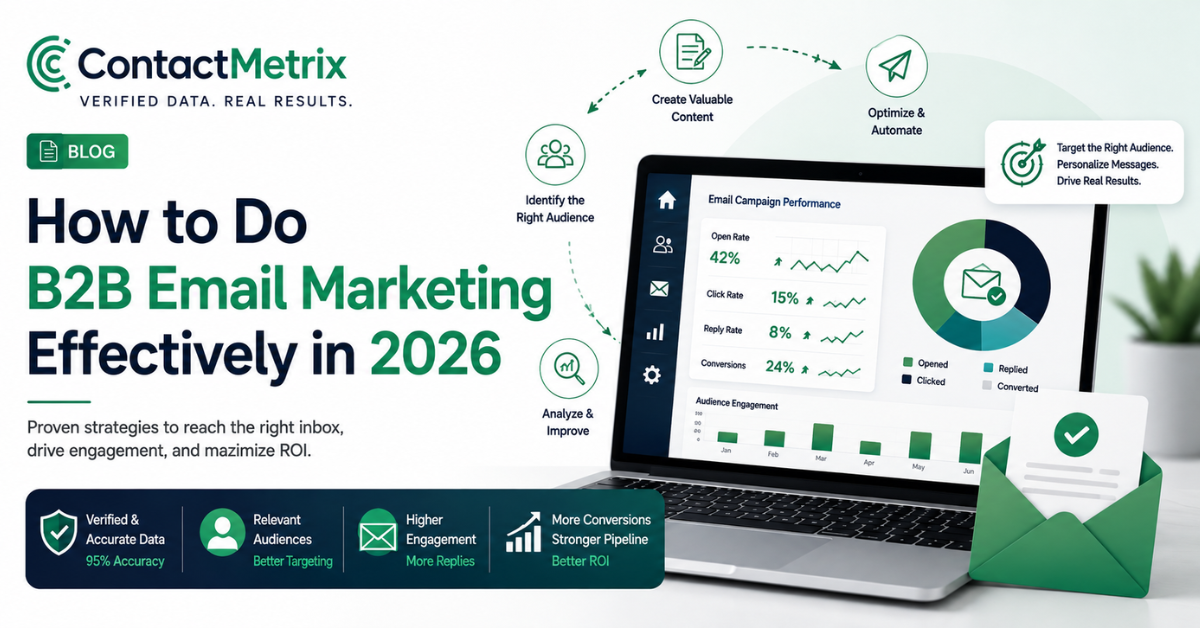
Email marketing continues to thrive in 2026, proving once again that predictions of its demise were greatly exaggerated. With over 4.8 billion email users worldwide and B2B buyers preferring email contact over any other channel by a margin of 77%, the channel remains the backbone of successful digital marketing strategies. But the landscape has evolved dramatically. Between stricter authentication requirements from major providers, AI-powered spam filtering, and increasingly sophisticated buyers, the old playbook no longer delivers results.
The good news? Email marketing still generates an impressive average ROI of $36 for every $1 spent. The challenge is that getting there requires a fundamentally different approach than even two years ago. Success in 2026 hinges on three critical pillars: building the right list, crafting compelling content with strategic variations, and mastering deliverability through proper technical infrastructure.
Building Your Foundation with the Right List
Your email campaign success is determined before you write a single word. The quality and relevance of your list directly impacts every downstream metric from open rates to revenue. In 2026, segmentation isn’t just a best practice; it’s the difference between inbox placement and the spam folder.
Strategic Segmentation Drives Results
Data from across B2B email programs reveals that segmented campaigns generate 760% more revenue than unsegmented blasts. The reason is simple: relevance beats volume every time. When you send the right message to the right audience, engagement follows, and engagement signals to email providers that your messages deserve inbox placement.
Effective segmentation in 2026 operates across multiple dimensions. Behavioral segmentation tracks how prospects interact with your content and product, from pricing page visits to feature usage patterns. AI increasingly powers this approach, surfacing intent signals before human marketers would notice them. Firmographic segmentation tailors messaging based on company size, industry, and revenue, ensuring your value proposition speaks to the specific challenges of SMBs versus enterprises. Technographic segmentation allows you to reference the specific tools and systems your prospects already use, making your outreach immediately relevant.
The most sophisticated programs layer intent-based segmentation on top, identifying prospects showing active buying signals through website behavior, content consumption, or third-party intent data. This creates audiences primed for conversion rather than cold outreach.
Defining Your Ideal Customer Profile
Your ICP should evolve beyond demographic checkboxes into a data-driven framework that identifies accounts most likely to convert and deliver long-term value. The process starts with interviewing current customers, reviewing successful sales calls, and analyzing CRM data to identify patterns among your best accounts.
Multi-stakeholder mapping matters more than ever, with 60% of B2B sales involving 2 to 4 decision makers. Your segmentation needs to account for different roles within target accounts, from technical evaluators to economic buyers. Equally important are negative personas, the characteristics of accounts that consistently churn, require excessive support, or never convert. Excluding these segments protects your sender reputation and focuses resources where they’ll generate returns.
List Quality Over Quantity
The foundation of deliverability is list hygiene. In 2026, roughly 17% of cold emails never reach the inbox due to poor authentication, high bounce rates, or spam-triggering factors. Before touching a single segment, verify your entire list. If a quarter of your addresses are invalid, no amount of personalization will save you.
Best practice calls for quarterly list cleaning at minimum. Remove hard bounces immediately and suppress contacts with zero engagement over 90 days. Low engagement is a primary spam signal to mailbox providers, particularly given Apple’s Mail Privacy Protection and aggressive filtering by Google. A clean list means better deliverability, lower costs, and more accurate metrics.
Crafting Compelling Content and Strategic Variations
Once your list is segmented and verified, content becomes your conversion lever. The highest-performing B2B emails in 2026 share a common trait: simplicity. When emails are easy to skim and quick to understand, engagement follows.
Subject Line Mastery
Your subject line determines whether your message gets opened or ignored. Analysis of 5.5 million B2B emails reveals clear patterns. Keep subject lines under 33 characters, the only length that displays fully across all mobile clients. Personalized subject lines using company-specific details achieve 46% open rates versus 35% for generic versions, with reply rates more than doubling from 3% to 7%.
Avoid spam triggers like excessive punctuation (more than 3 marks makes emails appear spammy), all caps, or urgency words that sound like clickbait. Specificity outperforms hype in B2B contexts. A subject line like “Reducing compliance costs for mid-market CFOs” beats “Amazing cost savings inside!” every time.
The data on tactics like emojis and numbers has shifted. While numbers in subject lines boosted opens by 45% in 2021 datasets, 2024 analysis of 5.5 million emails found they actually hurt performance slightly. What worked three years ago is now noise. Focus on genuine relevance over gimmicks.
Personalization Beyond First Names
Surface-level personalization can actually reduce trust. Merging in a first name doesn’t fix a weak value proposition or mismatched offer. True personalization in 2026 means understanding buying context and tailoring messages based on job role, urgency, and likely objections.
Personalized emails deliver 29% higher open rates and 41% higher click-through rates compared to generic versions. Hyper-personalized B2B emails achieve 41.9% open rates and 6.7% CTR. But this performance comes from dynamic content blocks that change based on recipient industry, company size, or behavior, not just token replacements.
The most effective approach combines firmographic data from your CRM with behavioral signals and intent data into one usable profile. Reference specific challenges facing their industry or company size. Mention tools they’re likely using. Demonstrate you’ve done your homework.
Pitch Variation and Testing
Never send the same email to your entire list. At minimum, segment by lifecycle stage (prospect versus customer) and engagement level (active versus inactive). The revenue difference is dramatic. Create multiple angles for the same offer, testing different value propositions and messaging approaches.
For complex offerings, develop a template library covering different buyer personas, industries, and use cases. Test subject line variations, body copy alternatives, and different CTAs. Track click-to-open rate rather than raw open rates, as Apple Mail Privacy Protection inflated open rates by roughly 18 points across accounts by pre-fetching emails.
Mastering Deliverability Through Technical Infrastructure
Even brilliant copy lands in spam if your technical foundation is broken. Email deliverability in 2026 is fundamentally different from two years ago. A convergence of enforcement actions by major mailbox providers has created what industry experts call the “2026 Email Deliverability Crisis,” where legitimate business communications face rejection at unprecedented rates.
Authentication Is No Longer Optional
In February 2024, Google and Yahoo began requiring SPF, DKIM, and DMARC for any domain sending more than 5,000 emails per day. By 2026, enforcement is tighter and tolerance is lower. According to research monitoring over one million domains globally, only 10.7% have full protection with strict DMARC policies at 100% enforcement. An additional 18.4% have partial protection, while 70.9% have no effective DMARC protection.
SPF (Sender Policy Framework) authorizes which servers can send email for your domain. It fails most often when businesses keep adding tools without cleaning up old records, creating bloated or duplicated SPF records that cause authentication failures.
DKIM (DomainKeys Identified Mail) verifies that messages haven’t been altered and genuinely come from your domain using cryptographic signatures. If you set up DKIM before 2022 and haven’t touched it since, you may be running 1024-bit keys. In 2026, 2048-bit is the minimum acceptable standard. Rotate DKIM keys at least annually.
DMARC ties SPF and DKIM together and tells inbox providers how to handle messages that fail authentication. For most SMBs, the correct starting point is monitoring (p=none), not enforcement. Once you’ve verified legitimate mail authenticates properly, move to quarantine (p=quarantine) or reject (p=reject) policies.
Fully authenticated domains (SPF plus DKIM plus DMARC) achieve 2.7 times higher likelihood of inbox placement compared to unauthenticated senders.
Email Warmup for New Domains
New domains need a minimum of 30 days of warmup before campaign sends. Email warmup is the process of gradually building sending reputation by increasing volume incrementally while generating positive engagement signals.
The proliferation of AI-generated cold email in 2025 to 2026 has raised spam filter sensitivity across every major provider. Simulated warmup networks that generated adequate signals in 2022 are increasingly ineffective against current AI-assisted filtering. Peer-to-peer networks with genuine engagement behavior, meaning real companies opening, replying, and filing emails, are the only mechanism that reliably works.
Platforms like SmartLead and Instantly automate this process by exchanging emails between accounts in their warmup pools, with accounts opening, replying, and marking messages as important to signal legitimacy to email providers. SmartLead’s warmup infrastructure gradually increases volume from about 5 emails on day one to 33 plus emails by day 14, using AI-powered natural conversations and custom identifier tags.
Critical to understand: warmup doesn’t stop at launch. Run it in parallel with campaigns indefinitely. Teams that turn off warmup after launch see deliverability erosion within 6 to 8 weeks.
Ongoing Reputation Management
Monitor sender reputation continuously using Google Postmaster Tools and Microsoft SNDS. Track inbox placement testing, bounce rates, complaint rates, and blacklist status. Even a small percentage of recipients marking messages as spam can push future mail out of the inbox.
Maintain complaint rates below 0.3% and implement one-click unsubscribe functionality. Email platforms and CRMs must agree on who is eligible to receive mail. Never purchase lists or scrape contacts. Build your list through ethical first-party data collection and verified third-party providers.
Execution and Optimization
With infrastructure in place, execution becomes about continuous improvement. B2B companies implementing strategic email nurturing sequences report 451% increases in qualified leads, with nurturing generating 20% more sales opportunities than non-nurtured leads.
Plan campaigns around buyer journey stages. Top-of-funnel gets education. Mid-funnel gets validation. Bottom-of-funnel gets business case support. Never mix the three in the same message. Deliver value in emails one, two, and three. Only then does your conversion ask land with credibility.
Test continuously but measure what matters. In an era where Apple Mail Privacy Protection has broken open tracking, focus on click-to-open rate (CTOR), reply rates, and conversion metrics rather than vanity metrics. Send Tuesday through Thursday, 9 to 11 AM in the recipient’s time zone, based on consistent performance data.
Scale what works while respecting compliance requirements. Every email needs a clear unsubscribe mechanism, a physical mailing address, honest sender identification, and verifiable consent records. Teams that build programs on ethical foundations have healthier long-term list engagement because subscribers trust them and choose to stay.
Conclusion
B2B email marketing in 2026 is no longer about sending more emails. It’s about sending smarter, more targeted emails to the right audience at the right time. Businesses that succeed with email marketing focus on precision targeting, audience segmentation, personalization, and data accuracy rather than mass outreach.
The highest-performing email campaigns are built on clean, verified contact databases combined with relevant messaging and strategic audience segmentation. Successful teams continuously test campaigns, monitor engagement metrics, and optimize performance based on real data instead of assumptions. Most importantly, they prioritize delivering value to prospects through relevant and meaningful communication rather than generic sales pitches.
As inbox competition continues to increase and buyer expectations become more sophisticated, businesses need stronger targeting and better-quality data to stand out. Companies that invest in accurate contact data, segmentation, and personalized outreach strategies will continue to achieve stronger engagement, higher conversions, and better long-term marketing performance.
Businesses looking to improve their B2B email marketing with verified contact data, advanced audience segmentation, and targeted outreach strategies can explore ContactMetrix for contact data solutions designed to support modern sales and marketing campaigns in 2026 and beyond
