
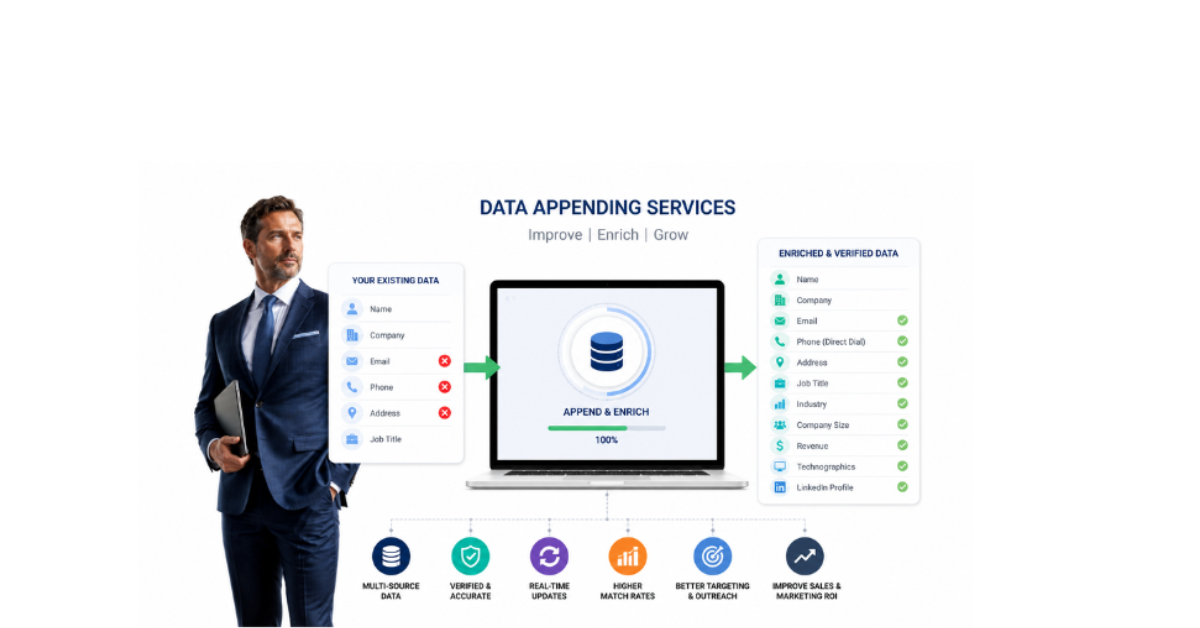
Every B2B database gradually loses accuracy. Leads collected from trade shows, webinars, website forms, and CRM systems become outdated as employees change jobs, companies relocate, business emails expire, phone numbers change, and company information evolves.
These gaps affect every revenue-generating activity. Sales teams waste time researching contacts, email campaigns see higher bounce rates, lead scoring becomes less accurate, and direct mail campaigns suffer from outdated business addresses.
This is where Data Appending Services become essential.
Instead of replacing your CRM or buying a new database, B2B Data Appending Services enhance the records you already own by appending verified business emails, direct dial phone numbers, mailing addresses, firmographic data, technographic information, LinkedIn profiles, and other missing business intelligence.
However, not all Data Appending Services are the same. Some focus on Email Appending, others specialize in enterprise data or API integrations, while some offer one-time CRM cleanup projects. Data quality, pricing, coverage, and compliance can vary significantly between providers.
So, where should you get Data Appending Services?
The right provider depends on your business goals, budget, database quality, industry, and the data fields you need appended. This guide explains how to evaluate your requirements, compare different provider types, and choose a solution that delivers long-term value for your business.
Start by Defining Your Data Appending Needs
Before comparing providers, take a step back and evaluate what your business actually needs. Choosing a provider without understanding your own data challenges often leads to unnecessary costs or disappointing results. The best Data Appending Services are those that solve your specific problem rather than offering features you may never use.
Identify the Missing Information
Start by reviewing your CRM or existing contact database and asking a few honest questions. Are business email addresses missing? Do your records lack direct dial phone numbers? Are mailing addresses incomplete? Is company information outdated? Are industry classifications inconsistent? Does your sales team need technology stack information? Are customer records missing demographic or geographic details?
Different providers specialize in different append types. Some only append contact information, while others can enrich company profiles with firmographic and technographic intelligence. For example, if your outbound sales team struggles to reach decision-makers, Email Appending Services and Phone Number Appending may deliver the highest return. If your marketing team relies on segmentation, Firmographic Data Appending may be more valuable. Understanding these priorities helps narrow your search before comparing vendors.
Determine the Size of Your Database
Project size also plays an important role. A company looking to append data for 5,000 contacts may have different options than an enterprise managing several million CRM records. Common project types include one-time CRM cleanup, legacy database updates, customer database refreshes, event attendee list enhancement, ongoing monthly appending, and API based real-time updates.
Some providers specialize in enterprise-scale projects with dedicated account managers, while others focus on self-service platforms designed for smaller businesses. Choosing a provider with experience handling databases similar to yours often leads to better match rates and smoother project delivery.
Understand Which Fields Matter Most
Not every missing field has the same business impact.
Business email appending is essential for email marketing, outbound sales, marketing automation, and customer communications. Phone number appending helps sales representatives connect directly with prospects instead of navigating switchboards. Mailing address appending supports direct mail campaigns, event invitations, product shipments, and customer correspondence. Firmographic data appending adds company revenue, employee size, industry, SIC codes, NAICS codes, ownership type, and headquarters information for improved segmentation and lead scoring. Technographic appending provides insight into technologies already used by target companies, helping SaaS providers personalize outreach.
Understanding which fields create the greatest business value helps you avoid paying for information your organization may never use.
Set Your Budget and Expectations
Budget naturally influences where you obtain Data Appending Services, but it should never be the only consideration. Lower pricing does not always translate into better value. Some providers charge very little because they rely on a single data source or offer minimal verification. Others invest heavily in multi-source matching, manual quality checks, ongoing refresh cycles, and compliance processes, resulting in higher match rates and greater long-term accuracy.
When comparing providers, consider the total value rather than the lowest price. Worthwhile questions include: What percentage of records are typically matched? How frequently is the database refreshed? Are emails verified before delivery? Is there a replacement policy for hard bounces? Are records formatted for CRM import? Does pricing include all requested fields?
The cheapest option may require additional cleanup later, ultimately increasing the total project cost.
Where Can You Get Data Appending Services?
Once you have identified your requirements, the next step is choosing the right type of provider. The market offers several options, ranging from specialized Data Appending Services providers to enterprise data companies and sales intelligence platforms. Each serves a different purpose, so the best choice depends on your budget, project size, and the type of data you need appended.
1. Specialized B2B Data Appending Providers
If your goal is to improve an existing CRM rather than purchase a new database, a specialized B2B Data Appending Services provider is often the best fit.
These providers work directly with your existing records, identifying missing information and appending verified business emails, phone numbers, mailing addresses, firmographic data, technographic insights, and other business attributes. Unlike self-service platforms, specialized providers typically customize projects based on your CRM, target audience, and required fields.
ContactMetrix offers customized Data Appending Services designed around each client’s database rather than selling pre-built contact lists. Businesses can request email appending, phone number appending, firmographic data, technographic data, mailing address appending, and CRM-ready delivery as part of a single project.
This type of provider is generally best suited for CRM cleanup projects, legacy database updates, enterprise CRM enrichment, marketing database improvements, customer database maintenance, and large-scale B2B appending projects.
2. Enterprise Data Providers
Enterprise organizations often require more than contact information. They may need business identifiers, corporate hierarchies, financial intelligence, supplier information, and risk analysis. Providers such as Dun & Bradstreet specialize in this type of business intelligence.
Dun & Bradstreet maintains one of the world’s largest commercial business databases and is widely used for company verification, firmographic data, supplier management, risk assessment, compliance, and enterprise account management. Although D&B offers extensive company intelligence, businesses seeking customized CRM data appending projects may still require additional services depending on their objectives.
This option is best suited for large enterprises, global organizations, corporate data management, and financial or supplier intelligence.
3. Sales Intelligence Platforms
Sales intelligence platforms are designed primarily for prospecting rather than bulk CRM improvement. Companies such as ZoomInfo provide searchable databases that help sales teams discover prospects, identify decision-makers, and build outbound lists. Typical capabilities include business contact information, organizational charts, company profiles, intent data, and sales prospecting tools.
These platforms work well for finding new opportunities, but organizations looking to append thousands of existing CRM records often prefer dedicated Data Appending Services, where the provider processes the database on their behalf.
This option is best suited for sales prospecting, outbound SDR teams, new lead generation, and individual contact research.
Self-Service Contact Data Platforms
Platforms such as Apollo.io, Lusha, and Cognism allow users to search for contacts, export prospect lists, and enrich individual records. These tools are popular among startups and growing sales teams because they offer self-service access without requiring a custom project.
However, updating large CRM databases manually through these platforms can become time-consuming when dealing with tens or hundreds of thousands of records. This option is best suited for small businesses, startup sales teams, individual prospect research, and smaller CRM updates.
Which Option Is Right for You?
There is no universal answer, since every business has different requirements. The table below maps common needs to the provider type most likely to deliver results.
Bulk CRM Cleanup
Email & Phone Appending
Enterprise Company Intelligence
Sales Prospecting
Individual Contact Lookup
Firmographic & Technographic Appending
Customer Database Maintenance
The key is matching the provider’s strengths to your project rather than simply choosing the most recognizable brand.
What to Look for in a Data Appending Provider
Not all providers deliver the same level of quality. Before making a decision, compare vendors using objective criteria instead of marketing claims.
Multi-source verification: Many vendors rely on a single database to append missing information. While this may work for straightforward projects, it often results in lower match rates. Providers that use multi-source verification compare records across multiple trusted data sources before appending information, helping improve both accuracy and field completion.
Data accuracy: Ask providers how they validate the information they deliver. Are business emails verified? How are phone numbers validated? How often is company information refreshed? What quality assurance process is followed? No provider can honestly guarantee 100 percent accuracy because business data changes continuously. A trustworthy company will explain its verification process instead of making unrealistic promises.
Match rates: Match rates depend on the quality of your existing database. Records containing verified company names, domains, or websites typically produce stronger results than records containing only a person’s name. Rather than asking for the highest advertised match rate, ask what factors influence project success.
CRM compatibility: A good provider should deliver data ready for direct import into your CRM, whether that is Salesforce, HubSpot, Microsoft Dynamics, Pipedrive, or Zoho CRM. Proper formatting reduces manual cleanup after delivery.
Compliance: If your organization operates internationally, compliance should be a priority. Ask providers whether their data practices align with GDPR, CCPA, and CAN-SPAM. Understanding how data is sourced and maintained helps reduce compliance risks.
Customer support: Support is particularly important for large or customized projects. Dedicated account managers, clear communication, and post-delivery assistance often distinguish premium providers from low-cost alternatives.
Questions to Ask Before Hiring a Data Appending Company
Before signing a contract, prepare a list of practical questions. These conversations often reveal more about a company’s capabilities than a marketing brochure.
Consider asking: What match rates should I realistically expect? How do you verify business emails? Can you append direct dial phone numbers? Which fields can you append? How frequently is your database refreshed? Do you provide sample data? What file formats do you deliver? Which CRM platforms do you support? What happens if records cannot be matched? Is there a replacement policy for invalid records?
Providers willing to answer these questions transparently generally inspire greater confidence than those making broad marketing claims without supporting details.
Red Flags to Watch Out For
Choosing the wrong provider can result in poor-quality data, wasted budget, and additional cleanup work. Be cautious if a provider guarantees a 100 percent match rate, does not explain where the data comes from, cannot describe its verification process, refuses to provide a sample project, offers pricing that seems unrealistically low, has no replacement or credit policy, does not mention compliance practices, cannot deliver CRM-ready files, or provides no customer support after delivery.
Taking time to evaluate these factors can prevent costly mistakes later
Data Appending vs. Buying a New Database
Many organizations assume they need to purchase a completely new database when existing records become outdated. In reality, Data Appending Services are often a more practical and cost-effective solution.
If your CRM already contains valuable customer relationships, historical interactions, and account ownership, appending missing data is usually more efficient than starting over.
When Does a Specialized Provider Make Sense?
Not every organization requires the same level of service. Businesses with relatively small databases and basic contact requirements may find a simple self-service platform sufficient.
However, specialized providers become valuable when a project requires multiple append types, large CRM databases, custom field mapping, global B2B coverage, dedicated project support, CRM-ready delivery, multi-source verification, or ongoing database maintenance.
For businesses evaluating customized B2B Data Appending Services, they can consider ContactMetrix alongside established enterprise solutions like Dun & Bradstreet. Comparing providers based on data quality, match rates, verification methods, delivery timelines, support, and pricing will help determine which option aligns best with your business objectives.
Rather than offering a one-size-fits-all database, ContactMetrix builds projects around each client’s existing CRM, target industries, required fields, and business goals.
Final Thoughts
Choosing where to get Data Appending Services is not simply about selecting the biggest brand or the lowest price. It starts with understanding your own database, identifying which fields are missing, defining your budget, and selecting a provider whose capabilities match your requirements.
Whether you need Business Email Appending, Phone Number Appending, Firmographic Data Appending, or a complete CRM cleanup, requesting a sample project is one of the best ways to evaluate match rates, data quality, and overall value before committing to a larger engagement.
The right provider should help you maximize the value of the data you already own, enabling better marketing, stronger sales outreach, more accurate reporting, and improved customer engagement.
Frequently Asked Questions
1. Where can I get Data Appending Services?
You can obtain Data Appending Services from specialized B2B data providers like ContactMetrix, enterprise data companies like Dun & Bradstreet, sales intelligence platforms such as ZoomInfo, or self-service platforms like Apollo.io, depending on your business needs.
2. How much do Data Appending Services cost?
Pricing depends on record volume, fields requested, geographic coverage, verification requirements, and project complexity. Most providers offer custom quotes based on project scope.
3. What types of information can be appended?
Common append types include business email addresses, direct dial phone numbers, mobile numbers, mailing addresses, company information, industry classification, employee size, revenue, technology stack, LinkedIn profiles, and geographic information.
4.How accurate are Data Appending Services?
Accuracy varies by provider and the quality of your existing database. Providers using multi-source verification generally achieve better match rates and more reliable results.
5. Can I append only business email addresses?
General B2B databases are built for broad industry categories and rarely account for the niche specificity of the beauty sector. Skincare brands contacts are curated with beauty-specific roles, categories, and procurement contexts in mind, making them significantly more relevant and actionable for beauty-focused campaigns.
6. Which CRM platforms are supported?
Most providers deliver CRM-ready files compatible with Salesforce, HubSpot, Microsoft Dynamics, Pipedrive, Zoho CRM, and other popular platforms.
7. Is Data Appending GDPR compliant?
Many providers maintain compliance with GDPR, CCPA, and CAN-SPAM, but businesses should verify the provider’s sourcing and compliance practices before purchasing.
