
According to a Mordor Intelligence report, the electronics manufacturing service market is projected to reach USD 663.34 billion in 2025 and USD 909.32 billion by 2031, growing at a CAGR of 6.51%.
Generic email does not work in electronics. Decision-makers in this sector are highly technical and do not respond to generic sales pitches. The right approach, backed by verified contact data, makes the difference between a campaign that converts and one that gets ignored.
In this article we will cover what an electronics mailing list is, why verified data matters, who benefits from it, and what separates a quality list from an unreliable one.
What Is an Electronics Mailing List?
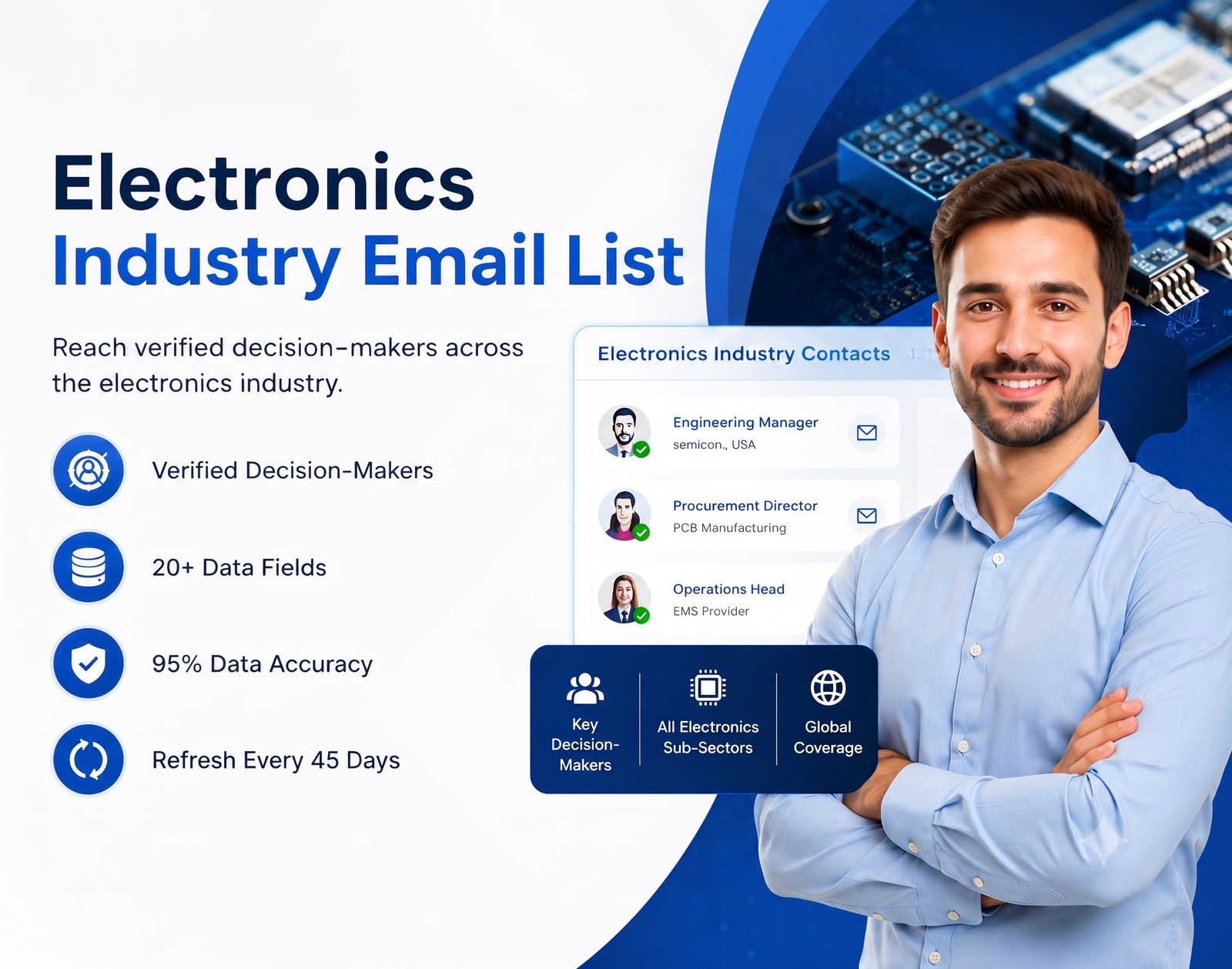
An electronics mailing list is a specialized B2B contact database of professionals and key decision-makers across the electronics sector. It includes full name and job title, business email address, direct phone number, company phone, and physical mailing address.
Reputable vendors also provide sub-sector segmentation covering semiconductors, PCB manufacturing, EMS providers, component distribution, OEM operations, and test equipment companies.
Key professionals included are plant managers, procurement heads, operations directors, and technical leads. A verified Electronics Industry Email List is sourced from electronics industry associations such as IPC, SEMI, and ECA — alongside trade show attendee databases, regulatory filings, manufacturing directories, and professional networking platforms.
Why Electronics Marketers Need a Verified Electronics Industry Email List
B2B marketers often overlook a critical issue that quietly degrades campaign performance before a single email is opened.
Low deliverability and hard bounces
Electronics manufacturers and engineering firms frequently restructure. Key decision-makers leave their roles, supply chain leads shift into procurement functions, and companies merge — all of which cause contact data to become outdated rapidly.
HubSpot research indicates that B2B data degrades by approximately 2.1% per month — resulting in an annualized decay rate of 22.5%. For a list of 10,000 contacts, that means 2,250 records become unreliable within a year.
The fix — choose a data vendor who updates records frequently. The ideal refresh timeline is every 30–45 days.
Low response rates from key decision-makers
Electronics decision-makers are experienced enough to identify low-value sales pitches immediately. A generic message sent to an entire electronics contacts database will be ignored.
The fix — do not treat every electronics professional the same. Segment contacts into specific categories such as military electronics, 5G infrastructure suppliers, or medical electronics — and tailor messaging to each.
Inadequate data fields
An email address alone is not enough to reach a decision-maker effectively. Without firmographic and technographic context, outreach lacks the relevance needed to generate a response.
The fix — Use an Electronics Industry Email Database that combines firmographic data such as company size, revenue, and sub-industry with technographic data such as operating systems, cloud infrastructure, and supply chain platforms.
Who Uses an Electronics Industry Email Database?
Electronic Component and Material Suppliers
Businesses active in hardware, raw materials, and semiconductors use this data to pitch procurement heads and production managers at electronics manufacturers directly.
B2B Marketers and Lead Generation Agencies
Marketing agencies use the Electronics Industry Email Database to run targeted campaigns, analyse market shifts, and secure high-value commercial connections on behalf of their clients.
Industrial Technology Vendors
CAD software providers, automation controls companies, and logistics platform vendors use the database to reach engineers and technical directors evaluating new tools.
Recruiters
Recruitment firms use electronics contact data to find qualified professionals — electrical engineers, PCB designers, and quality control specialists — across active electronics operations.
Consulting and Compliance Services Firms
Consulting firms target operations directors and regulatory compliance heads at electronics companies navigating RoHS, REACH, ISO 9001, and IPC standards requirements.
Connect With Electronics Industry Decision Makers
Electronics Sub-Sectors Covered in a Quality Electronics Mailing List
A quality electronics mailing list does not treat the entire sector as one category. The electronics industry spans multiple distinct sub-sectors — each with different decision-makers, purchasing cycles, and operational priorities.
Key Decision-Makers in the Electronics Industry — Who You Should Be Reaching
Electrical Engineers
Core functions include designing schematics, schematic capture, and printed circuit board design. They evaluate technical tools, components, and materials at the ground level of product development.
Chief Technology Officers
CTOs are involved in overarching architectural decisions and maintain vendor relationships at the technology strategy level. They also evaluate and approve technology stacks across the organization.
Chief Procurement Officers
CPOs oversee overall vendor spend and negotiate enterprise-wide supply contracts. They are the primary decision-maker for high-value, long-term supplier relationships.
Chief Executive Officers
In small-sized companies, CEOs make the final vendor selection decision. In larger corporations, they focus on broad-scale revenue growth and approve strategic vendor partnerships at the organizational level.
Operations Managers
Operations managers manage relationships with Contract Electronics Manufacturers and Electronics Manufacturing Services providers — making them a key contact for operational vendors and service providers.
What Makes a Quality Electronics Mailing List?
Not all electronics contact data is equal. These five criteria separate a reliable electronics mailing list from one that wastes your budget.
1. Deliverability Rate
Deliverability below 90% is not worth considering. A high bounce rate damages sender reputation and risks getting your domain flagged by email service providers.
Key consideration — always look for a provider who guarantees more than 90% deliverability.
2. Refresh Cycle
Customer churn in the electronics industry is higher than most sectors. Supply chain restructuring, company mergers, and role transitions happen frequently — making a stale list a campaign liability.
Key consideration — a reputable provider refreshes data every 30–45 days to prevent decay.
3. Sub-Sector Segmentation
An electronics mailing list is not a single broad category. Missing sub-sectors such as semiconductor, consumer electronics, electrical equipment, and industrial electronics means missing significant portions of your total addressable market.
Key consideration — look for providers who segment by technology sector, manufacturing category, and professional function.
4. Compliance Verification
GDPR, CAN-SPAM, and CASL compliance are not optional — they are legally mandatory. Every contact should be opt-in sourced and verifiable.
Key consideration — confirm whether the provider’s data is properly documented or scraped from public sources without consent.
5. Data Field Depth
A limited set of unrelated fields is not enough for effective outreach. A quality Electronics Industry Email Database includes 20+ structured fields — covering sub-sector classification, technology use, ERP and manufacturing systems, and more.
Key consideration — the more context each record provides, the more personalized and relevant your outreach can be.
Build Your Electronics Industry Prospect List
Final Thoughts
The electronics sector is one of the most technically sophisticated and fastest-moving markets in B2B, and reaching its decision-makers requires more than a generic contact list.
A verified electronics mailing list solves the three most common campaign failures in this sector: high bounce rates from decaying data, low response rates from untargeted messaging, and inadequate field depth that prevents meaningful personalization.
The five quality criteria covered in this article, deliverability rate, refresh cycle, sub-sector segmentation, compliance verification, and data field depth, are the benchmark any reliable electronics industry email list should meet.
ContactMetrix’s Electronics Industry Email List is built to meet all five. If you are evaluating contact data for your next electronics sector campaign, a free sample is available to review the data structure, field completeness, and segmentation quality before you commit.
Frequently Asked Questions
1. What is an electronics mailing list?
An electronics mailing list is a verified B2B contact database of professionals and decision-makers across electronics manufacturers, semiconductor companies, component distributors, EMS providers, and consumer electronics brands — including verified email addresses, direct phone numbers, and firmographic data.
2. Why does B2B data in the electronics industry decay so fast?
Electronics companies experience above-average personnel change due to supply chain restructuring, company mergers, and role transitions. HubSpot research confirms B2B data decays at 22.5% annually — making a 30–45 day refresh cycle essential for maintaining list accuracy.
3. What decision-makers are included in an Electronics Industry Email Database?
Key contacts include electrical engineers, chief technology officers, chief procurement officers, operations managers, and CEOs — each holding different levels of vendor approval authority depending on company size and sector.
4. What sub-sectors does a quality electronics mailing list cover?
A quality electronics mailing list covers electronics manufacturing, consumer electronics, medical electronics, defence and aerospace electronics, semiconductor companies, and EMS providers — each segmented separately with relevant decision-maker profiles.
5. Is an Electronics Industry Email List GDPR compliant?
A compliant electronics mailing list sources all contacts through opt-in or publicly verifiable channels and maintains records in accordance with GDPR, CAN-SPAM, and CASL regulations. Always request sourcing documentation from any provider before purchasing
