

Finding an Energy Industry Email List and sending an email campaign is not as simple as many B2B marketers think. Reaching decision-makers in the energy sector requires much more than a list of contacts.
Unlike many industries where a single individual can influence a purchase, the energy sector follows a structured procurement process involving multiple departments, technical evaluations, regulatory compliance, and long sales cycles.
A single purchasing decision often involves engineering teams, operations managers, procurement specialists, finance departments, and executive leadership before a contract is approved.
This complexity creates a significant challenge for marketing teams. Generic outreach, combined with unverified or outdated contact data, makes it difficult to reach the professionals who actually influence purchasing decisions.
Businesses that understand the energy industry’s buying process are always one step ahead of competitors that rely solely on generic campaigns. By understanding how the market operates, they create better engagement, build stronger relationships with decision-makers, and improve the quality of their outreach.
In this guide, you’ll learn how purchasing decisions are made across the energy sector, why many outreach campaigns fail to deliver results, and how a verified Energy Industry Email List helps businesses connect with the right professionals at the right stage of the buying journey.
Why Selling to the Energy Industry Is Different
Selling to the energy industry is different because purchasing decisions rarely depend on a single individual. Instead, multiple stakeholders participate throughout the evaluation and approval process.
Consider a typical purchasing scenario.
An Engineering Manager evaluates whether a product meets technical requirements and integrates with existing systems. The Operations Manager determines how the solution will affect day-to-day performance and operational efficiency. Procurement teams compare vendors, negotiate pricing, and review contract terms before recommending a supplier. Finance departments evaluate budgets and expected returns, while executive leadership provides the final approval for major investments.
Every department evaluates a solution from a different perspective.
This is one of the primary reasons mass email campaigns often fail in the energy industry. Sending the same message to an Engineering Manager, Operations Manager, Procurement Head, and Finance Director is unlikely to generate meaningful engagement because each role has different responsibilities and business priorities.
Businesses that recognize these differences build more effective campaigns. Instead of sending identical emails to every contact, they personalize their messaging to address the specific challenges and priorities of each decision-maker. A well-segmented Energy Industry Mailing List makes this process easier by helping marketers deliver the right message to the right audience at the right time.
Looking for Energy Industry Email List
Understanding the Modern Energy Industry
The energy industry is far more diverse than many marketers realize. It is not a single market but a network of interconnected sectors, each with its own regulations, technologies, business models, and purchasing priorities.
Some organizations focus on energy exploration and production, while others generate electricity, distribute utilities, manufacture equipment, or develop renewable energy solutions. Although these sectors operate within the same industry, their buying processes and decision-makers vary considerably.
Major sectors within the energy industry include:
- Oil and Natural Gas (Upstream, Midstream, and Downstream)
- Coal and Consumable Fuels
- Electric Power and Utilities
- Power Generation (Fossil Fuel-Based)
- Renewable Energy (Solar, Wind, and Energy Storage)
- Utilities (Electricity, Gas, and Water)
While these industries share the common objective of supplying energy, the professionals responsible for purchasing software, industrial equipment, consulting services, engineering solutions, or manufacturing technologies differ significantly from one sector to another.
Understanding these differences is the first step toward building a successful outreach strategy. A well-segmented Energy Industry Email Database enables marketers to identify the right organizations and decision-makers instead of treating the entire energy sector as a single audience.
Why Do Most B2B Campaigns Fail Before the First Email Is Opened?
Many marketers believe that poor campaign performance is caused by weak subject lines or ineffective email copy. While messaging is important, the real problems often begin long before the first email is sent.
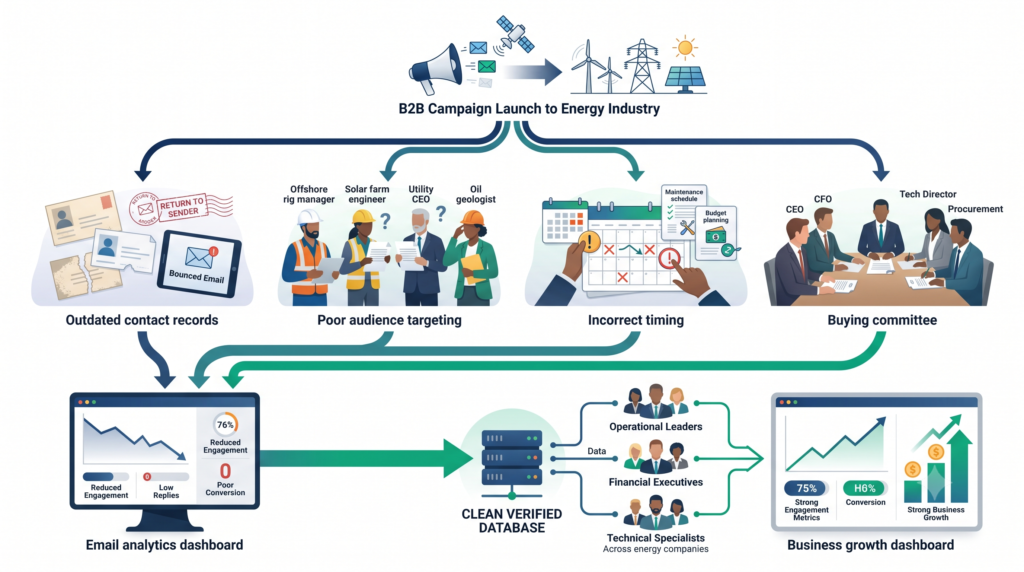
Inaccurate and Outdated Contact Data
One of the biggest challenges is unreliable contact information.
Employees change roles, companies merge, departments are restructured, and new facilities are commissioned regularly across the energy sector. As a result, business contact information quickly becomes outdated, making it difficult for marketers to reach the professionals who currently influence purchasing decisions.
Poor Audience Segmentation
Another common challenge is inadequate segmentation.
The energy industry covers multiple sectors, each with unique operational priorities and business challenges. Sending the same generic message to professionals working in renewable energy, utilities, power generation, and oil & gas is unlikely to produce meaningful engagement.
Effective campaigns begin by understanding who the audience is and what problems they are trying to solve.
Poor Timing
Timing also plays a critical role in B2B marketing.
Many energy companies plan purchases around annual budgets, maintenance shutdowns, capital investment cycles, or long-term expansion projects. Even a highly personalized email may receive little attention if it reaches the prospect outside their procurement cycle.
Recruitment and staffing agencies
Misunderstanding the Buying Process
Many businesses also underestimate how purchasing decisions are made.
Before approving a significant investment, organizations often conduct technical evaluations, procurement reviews, compliance assessments, financial analysis, and executive approvals. Ignoring these stages makes it difficult to position your solution at the right time.
Understanding this buying process allows businesses to approach the right stakeholders with relevant messaging instead of relying on generic sales outreach
Understanding the Energy Industry Buying Committee
One of the biggest misconceptions in B2B marketing is believing that a single person approves every purchase.
In reality, energy companies rely on multiple stakeholders to evaluate new products, technologies, and services before making any significant investment.
Every stakeholder has different responsibilities and priorities. Engineers focus on technical compatibility, operations teams evaluate efficiency and reliability, procurement reviews suppliers and pricing, while finance and executive leadership assess budgets, risks, and long-term business value.
Because of these different perspectives, every stakeholder requires a different communication approach.
A well-segmented Energy Industry Email List simplifies this process by helping businesses identify the professionals who influence purchasing decisions and tailor their messaging to each stage of the buying journey.
What Are the Key Decision-Makers in the Energy Industry Mailing List?
Reaching the right decision-maker is just as important as having the right message. Every organization has its own reporting structure, but several professionals consistently influence purchasing decisions across the energy sector.
Understanding their responsibilities helps businesses personalize outreach and improve campaign performance.
Engineering Managers
Engineering Managers play a critical role in evaluating whether a product or service meets technical requirements and integrates with existing systems. They also ensure that proposed solutions comply with industry standards and operational requirements.
In many organizations, they are among the first stakeholders to review new technologies before recommendations move further through the buying process.
If your business provides industrial software, automation platforms, electrical equipment, monitoring systems, or engineering services, Engineering Managers are one of the most important professionals to target.
Operations Managers
Operations Managers focus on maintaining productivity, equipment reliability, workplace safety, and operational efficiency. Their primary concern is ensuring that a new solution improves day-to-day operations without disrupting existing processes.
When communicating with Operations Managers, emphasize measurable business outcomes such as improved efficiency, reduced downtime, increased productivity, or lower operating costs rather than focusing solely on technical specifications.
Procurement Managers
Procurement teams are responsible for comparing suppliers, negotiating pricing, reviewing contracts, and ensuring vendor compliance. Even when another department recommends a product, procurement often manages the supplier selection and purchasing process.
Without reaching Procurement Managers, many sales opportunities never progress beyond the evaluation stage.
Executive Leadership
Chief Executive Officers (CEOs), Chief Operating Officers (COOs), Chief Technology Officers (CTOs), and Chief Procurement Officers (CPOs) generally become involved when purchases require significant investment or support long-term business objectives.
Although executives may not evaluate products in technical detail, they often approve budgets, assess business risks, and make the final purchasing decision for enterprise-level investments.
For high-value B2B solutions, executive approval is often the final step before a contract is signed.
Why Generic Contact Lists Rarely Work in the Energy Industry
Many marketers purchase broad contact databases expecting immediate results. Unfortunately, a large database alone does not guarantee qualified opportunities.
Consider this example.
A company selling renewable energy software sends the same campaign to procurement managers working in oil and gas exploration. Although both belong to the energy sector, their priorities, regulations, budgets, and operational challenges are entirely different.
Likewise, promoting industrial transformers to engineers specializing in battery storage is unlikely to generate meaningful engagement because the message is not relevant to their responsibilities.
This is why audience segmentation is essential.
An effective Energy Industry Email Database enables businesses to organize contacts by sub-sector, job role, company size, geographic location, and operational focus. Instead of sending identical emails to thousands of professionals, marketers can deliver relevant communication that addresses each audience’s specific needs.
The result is better engagement, higher response rates, and more meaningful business conversations.
Why Accurate Contact Data Matters
Even the most carefully planned marketing campaign can fail if the underlying contact information is inaccurate.
Professionals receive promotions, move to different organizations, retire, or transition into new departments. Companies expand operations, merge with competitors, establish new facilities, and restructure internal teams. These ongoing changes gradually reduce the accuracy of business databases.
An outdated Energy Industry Mailing List often leads to hard bounces, lower email deliverability, poor sender reputation, and reduced campaign performance.
For this reason, businesses should prioritize verified contact data that is updated regularly and segmented according to their ideal customer profile.
Instead of spending valuable time researching prospects manually, marketers can focus on building relationships with the professionals who genuinely influence purchasing decisions. A reliable Energy Industry Email List provides that foundation by helping businesses identify and reach qualified decision-makers more efficiently.
What Makes a High-Quality Energy Industry Email List?
Not every contact database delivers the same value. A high-quality Energy Industry Email List should provide more than names and email addresses. The quality of your data determines whether your campaigns reach qualified decision-makers or result in high bounce rates and poor engagement.
When evaluating an email database, consider the following factors.
1. Verified Contact Information
Data accuracy is the foundation of every successful outreach campaign. Decision-makers frequently change roles, companies merge, and departments are restructured, causing contact information to become outdated over time.
A reliable provider regularly verifies business email addresses, direct phone numbers, job titles, and company information to improve deliverability and reduce hard bounces.
2. Industry Segmentation
The energy sector consists of multiple industries, each with unique operational priorities and purchasing requirements.
A quality Energy Industry Email Database should allow businesses to segment contacts across sectors such as:
- Oil and Gas
- Renewable Energy
- Electric Utilities
- Power Generation
- Solar Energy
- Wind Energy
- Battery Storage
- Smart Grid Technologies
- Energy Equipment Manufacturing
This level of segmentation enables marketers to create highly relevant campaigns instead of relying on one generic message for every prospect.
3. Rich Data Fields
An email address alone is rarely enough for effective B2B outreach.
A comprehensive database should include valuable business information such as:
- Full Name
- Job Title
- Business Email Address
- Direct Phone Number
- Company Name
- Company Website
- Industry Classification
- Revenue
- Employee Size
- Geographic Location
- LinkedIn Profile
- NAICS and SIC Codes
The more detailed the information, the easier it becomes to personalize communication, qualify prospects, and prioritize high-value opportunities.
4. Compliance and Data Quality
Businesses should ensure their contact data complies with applicable email marketing regulations.
Permission-based contact data helps protect sender reputation while supporting compliance with GDPR, CAN-SPAM, and other applicable privacy regulations.
Choosing a trusted provider also reduces the risks associated with outdated or unverified contact information.
5. Regular Data Refresh
Business data changes continuously.
Professionals receive promotions, move to new organizations, retire, or transition into different roles. Companies expand operations, acquire competitors, and establish new facilities.
A reliable Energy Industry Mailing List should be refreshed regularly to maintain data accuracy, improve deliverability, and support long-term campaign performance.
Common Mistakes to Avoid
Business data changes continuously.
Professionals receive promotions, move to new organizations, retire, or transition into different roles. Companies expand operations, acquire competitors, and establish new facilities.
A reliable Energy Industry Mailing List should be refreshed regularly to maintain data accuracy, improve deliverability, and support long-term campaign performance.
Get Your Energy Industry Email List
Conclusion
Success in the energy sector depends on more than offering a great product or service. It requires a clear understanding of how purchasing decisions are made, who influences those decisions, and how to engage the right professionals with relevant communication.
A verified Energy Industry Email List helps businesses improve audience targeting, personalize outreach, and connect with decision-makers across different energy sectors. Combined with accurate data, proper segmentation, and a well-planned marketing strategy, it becomes a valuable asset for generating qualified B2B opportunities.
If your business is looking for reliable contact data, ContactMetrix’s Energy Industry Email List offers verified B2B contacts with 95% data accuracy, refreshed every 30–45 days, and maintained in compliance with GDPR and CAN-SPAM standards. A trusted Energy Industry Email Database helps you reduce prospecting time, improve campaign performance, and build meaningful relationships with energy industry decision-makers.
Frequently Asked Questions
1. What is an Energy Industry Email List?
An Energy Industry Email List is a verified database containing contact information for professionals working across the energy sector, including oil and gas companies, renewable energy firms, power generation companies, electric utilities, and energy equipment manufacturers. It helps businesses connect with decision-makers through targeted B2B marketing campaigns.
2. Why is selling to the energy industry different from other industries?
Energy companies typically involve multiple stakeholders before making purchasing decisions. Engineering, operations, procurement, finance, and executive leadership often evaluate vendors before approving investments, making personalized outreach far more effective than generic campaigns.
3. What information should an Energy Industry Email Database include?
A quality Energy Industry Email Database should include verified business email addresses, job titles, company names, direct phone numbers, company websites, industry classifications, employee size, revenue, geographic location, and other firmographic details that support targeted marketing.
4. Why is audience segmentation important in energy marketing?
Different sectors within the energy industry have different operational priorities and purchasing requirements. Segmenting contacts by industry, job role, and company type helps businesses deliver more relevant communication and improve campaign performance.
5. How often should an Energy Industry Mailing List be updated?
Because professionals frequently change roles and organizations, an Energy Industry Mailing List should be updated regularly to maintain data accuracy, improve email deliverability, and reduce bounce rates.
6. How can businesses improve outreach in the energy sector?
Businesses can improve outreach by using verified contact data, segmenting their audience, personalizing communication, understanding the industry’s buying process, and regularly updating their prospect database.
