
Agriculture is a $2.87 trillion market by 2030, according to Mordor Intelligence — growing at 3.48% annually across commodities, AgTech, agrochemicals, seeds, and livestock nutrition. A FAO-led study confirms that agrifood systems directly employ 1.23 billion people worldwide. North America alone holds over 41.3% of the global agribusiness market share in 2025.
The opportunity is real. The problem is execution.
Most B2B vendors approach agriculture the same way they approach every other industry. Generic email campaigns, wrong timing, farming terminology that doesn’t match the buyer’s actual role. Agriculture buyers are operationally focused people running complex, time-pressured businesses. They have no patience for outreach that clearly wasn’t written for them.
This guide breaks down who the real decision-makers are, why agriculture B2B marketing is structurally different, and what makes an agriculture B2B email list actually worth using.
What Is an Agriculture Industry Email List?
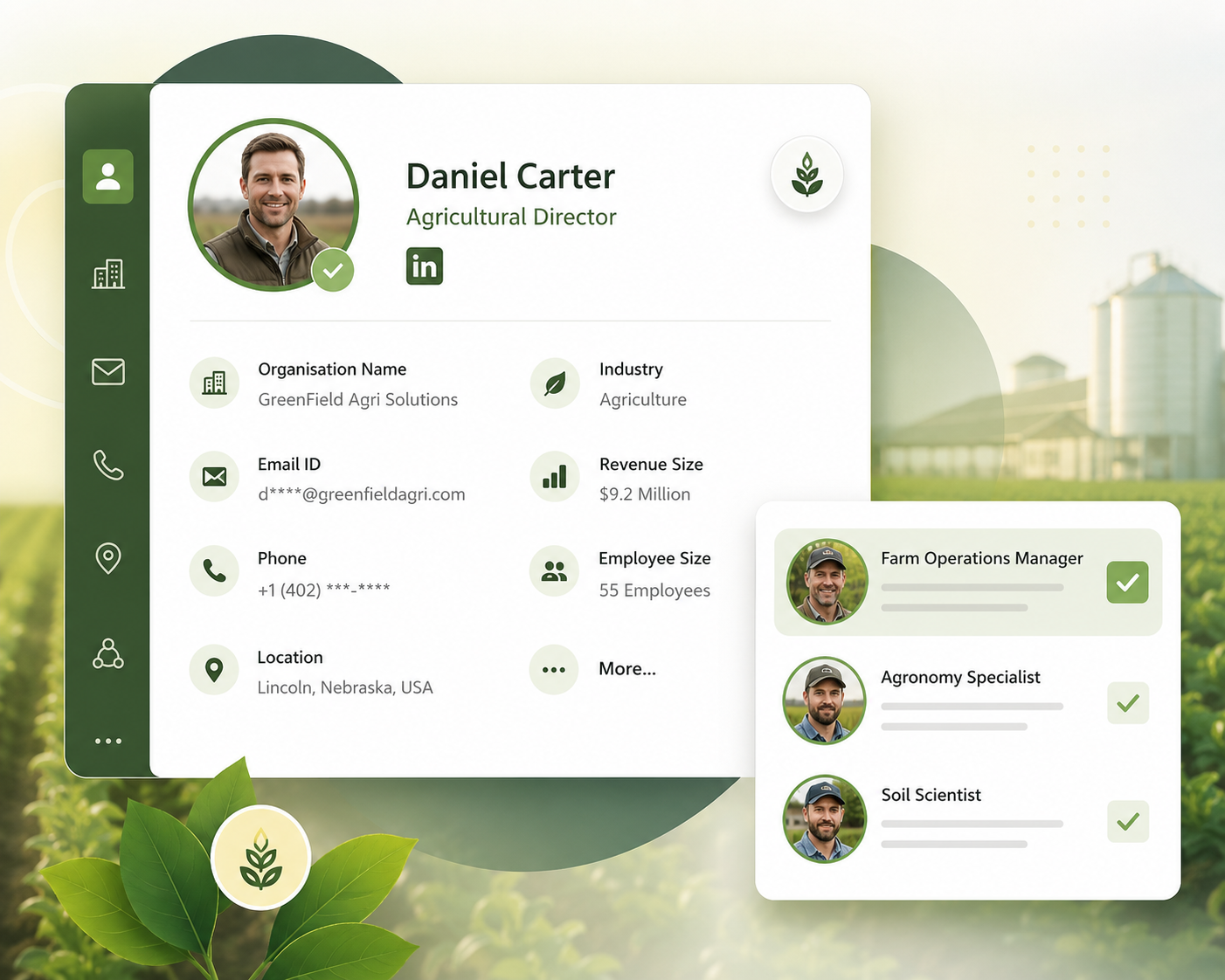
An agriculture industry email list is a verified database of decision-makers across the agricultural supply chain — farm owners, cooperative managers, procurement heads at agribusiness companies, R&D leads at seed companies, supply chain directors at food processors, and AgTech buyers at large farming operations.
It’s used by equipment suppliers, seed companies, AgTech vendors, agrochemical distributors, crop insurance firms, food processing equipment manufacturers, cold chain logistics providers, and B2B recruitment agencies placing agricultural specialists.
The distinction from a general B2B list matters. A generic database might label someone as an “agriculture professional” without specifying whether they’re a dairy farmer in Wisconsin, a commodity trader in Chicago, or a procurement manager at a food processing plant in Iowa. Those three buyers have nothing in common. An agriculture mailing list built for B2B outreach separates them before your campaign starts.
Why Agriculture Is One of the Harder B2B Markets to Crack
Agriculture doesn’t operate like other B2B sectors. The decision-making structure is fragmented in ways that aren’t obvious from the outside.
At small independent farms, the owner is simultaneously the procurement function, the operations manager, and the technology evaluator. At large agribusiness operations, those roles separate — and the person you need depends entirely on what you’re selling. Many agricultural supply chains still have limited digital visibility, making it hard for potential vendors to identify the right contact without sector-specific data.
Procurement in agriculture also relies more heavily on personal relationships than formal centralized outreach. A cold email to a farm owner who has bought from the same seed supplier for 15 years needs to do a lot of work to get noticed. Relevance — to their crop type, their region, their current operational challenge — is what earns attention.
Data Decay in Agriculture — Why Contact Lists Go Stale Fast
In most B2B sectors, contact data decays at around 30% annually. In agriculture, the rate is higher and the causes are more varied.
Farm managers retire. Procurement leads at food processing companies move after industry mergers. Cooperative administrators change when board leadership cycles. The USDA’s February 2026 Land in Farms report confirmed 15,000 fewer farms in 2025 compared to 2024, with total farmland dropping by 2.51 million acres. Every closed or transferred farm is a dead contact on someone’s agribusiness email database.
The practical consequence is visible in campaign results. Static agriculture contact lists — built once and used for years — produce bounce rates that damage sender domain reputation with email providers, not just individual send performance. A verified agriculture industry mailing list refreshed every 30 to 45 days is the operational standard that keeps outreach deliverable.
Who Are the Real Decision-Makers in Agriculture?
Getting to the right person matters more in agriculture than in most B2B sectors. Here’s who actually controls purchasing decisions across the supply chain:
Farm owners and managers are the traditional decision-makers for equipment, seeds, crop protection products, and insurance. At smaller operations, these are the same person. They’re most reachable in winter, when they’re planning the following year’s budget and vendor relationships.
Family members and co-owners are a factor that most B2B outreach completely ignores. Farming is often a multigenerational family operation where land and purchasing decisions are co-owned across household members. In many agricultural regions, a pitch directed exclusively at one decision-maker misses the person who actually signs off.
Agribusiness and technology buyers at larger integrated operations decide on precision agriculture technology adoption, seed variety selection, chemical inputs, and modern machinery. These are increasingly data-driven buyers who respond to technical specificity rather than general product promotion.
Agronomists and crop scientists use digital tools to monitor soil moisture, nutrient levels, and pest activity. They influence purchasing decisions on inputs, testing equipment, and farm management software. For AgTech vendors especially, reaching the agronomist before the procurement manager often moves things faster.
Food processors and distributors — procurement managers and supply chain directors at processing plants — are active buyers of raw agricultural commodities, packaging, logistics services, and compliance solutions. This segment has formal procurement processes and defined vendor evaluation cycles.
R&D directors and lead scientists at seed companies and crop science organizations buy laboratory equipment, chemical inputs, and testing services. These are technical buyers with long evaluation cycles and specific qualification requirements.
The Seasonal Buying Cycle: Timing Is Everything in Agriculture B2B
Agriculture runs on seasons. Most B2B sectors don’t. This is the insight that separates vendors who get consistent responses from those who wonder why their campaigns go quiet for months at a time.
Winter (December to February) is the primary decision-making window. Farmers are indoors, reviewing the previous season, planning next year’s budget, and evaluating new vendors. Most farm equipment purchases are decided between January and early March. For B2B agricultural marketing, this is when campaigns earn the highest response rates. Miss this window and you’re likely waiting 12 months for the next one.
Spring (March to May) is the worst time for new outreach. Planting is underway. Farmers are in the field before sunrise. A multi-paragraph email about precision agriculture software during planting season gets deleted before it’s opened. If you must reach out during spring, one sentence and one link is the maximum that will get any engagement.
Summer (June to August) works for service-related outreach — parts suppliers, maintenance contracts, repair services, and equipment support. Livestock operations run year-round and have consistent purchasing needs regardless of crop season. New product introductions during summer rarely land.
Autumn (September to November) is harvest season — a dead zone for new vendor introductions. Late October is when post-harvest planning begins. Short, forward-looking messages about next season work better than aggressive campaigns during this period.
Understanding this cycle is the difference between a well-timed agriculture B2B campaign and an expensive waste of outreach budget.
What Makes an Agriculture Industry Email List Actually Useful
- Hyper-segmentation by operation type — crop production, livestock, dairy, agrichemicals, food processing, and distribution are genuinely different buyer communities. A list that treats them as a single “agriculture” segment produces irrelevant outreach. Farm email list data segmented by operation type ensures your message reaches buyers for whom it’s actually relevant.
- Geographic filtering — agriculture is geographically concentrated in ways that matter for targeting. Corn producers are in the Midwest. Dairy operations cluster in Wisconsin, California, and New York. Cotton is in the South. Citrus is in Florida. If your product or service only makes sense in specific regions, a national agriculture mailing list without geographic precision includes a large proportion of contacts you can never convert.
- Compliance with data regulations — a compliant agriculture industry email list sources contacts from opt-in channels: trade association directories, cooperative member registries, and trade show registrations. It complies with GDPR, CAN-SPAM, and CASL. Data sourced without opt-in consent creates legal exposure that offsets whatever outreach value the list provides.
- Customization by recipient profile — an email sent to rice farmers should read differently from one sent to dairy producers. The crops are different, the seasonal pressures are different, the purchasing cycles are different. Generic messaging across a diverse agriculture contact list consistently underperforms segmented, role-specific outreach.
- Fresh data with regular refresh cycles — given the 15,000 annual farm closure rate and the constant movement of procurement and management contacts between organizations, agriculture contact data older than 60 to 90 days loses accuracy fast. The refresh cadence of your data provider directly determines whether your outreach reaches active buyers.
Final Thoughts
Agriculture B2B marketing has a genuine opportunity but demands specific execution. Seasonal buying cycles, fragmented decision-making across farm types and operation sizes, and one of the higher contact data decay rates in any B2B sector all mean that generic outreach produces generic results — and often worse.
The vendors who consistently get responses in agriculture are the ones who time their outreach to the winter planning window, segment by operation type and geography, and reach the right decision-maker for their specific product rather than blasting a national farm list and hoping for the best.
If you’re selling into agriculture and want to start with a verified, sub-sector-specific contact database, our Agriculture Industry Email List gives you access to verified decision-makers across crop production, livestock, dairy, agrichemicals, food processing, and distribution — segmented by role, geography, and company size.
