
Your email list fails not because of the tool, email content, or subject line, but because of the data. You buy 10,000 contacts, launch your first email campaign, and bounce rates hit 20%. Six months later, you’re still recovering.
HubSpot studies show that email databases decay at roughly 22.5% per year. A list purchased a year ago has already lost half its value.
The real problem? Buyers obsess over database size and ignore what actually drives ROI: data accuracy, coverage, and compliance.
In 2026, this matters more than ever. Google and Microsoft have stricter rules for bulk email campaigns. Businesses in the US paid $3.42 billion in 2025 for violating the CCPA and GDPR. A list that works today must be updated, verified, and legally compliant.
This guide compares top B2B email list providers across three dimensions:
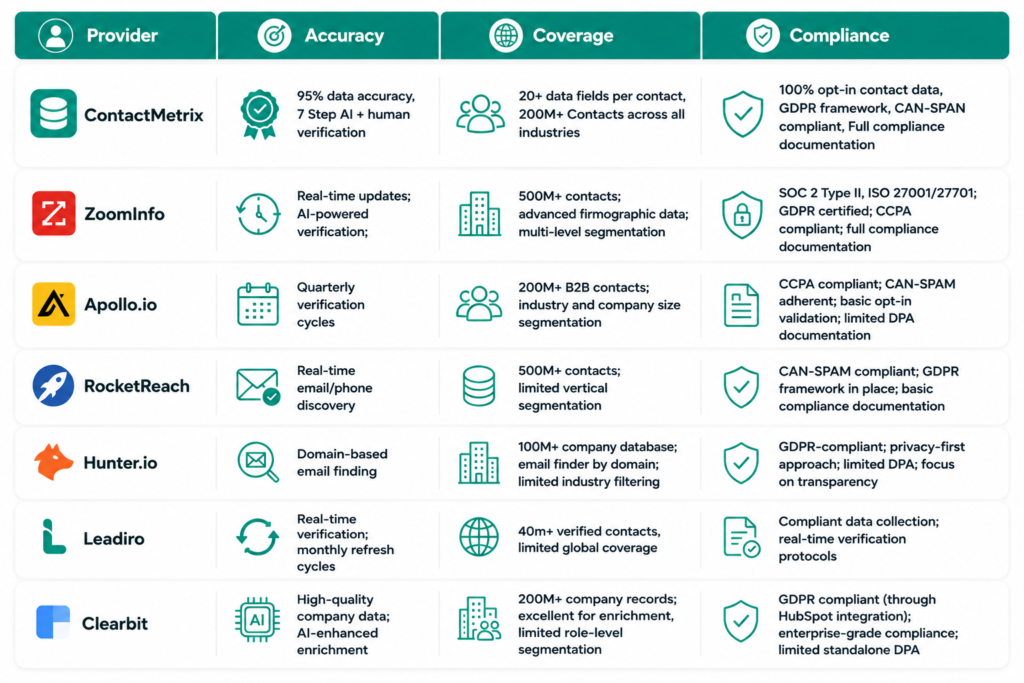
- Accuracy & Verification: Check email delivery rates, the steps taken to verify emails, and how often the data is updated.
- Coverage: Check how complete each contact’s details are, such as email address, job title, company information, and location, for all industries and regions.
- Compliance: Do they provide a data use agreement? Do they follow GDPR, CAN-SPAM, CCPA, and other data privacy rules?
What is an Email List?
An email list is a database of business contacts you can buy instead of finding them one by one. It includes verified work emails, job titles, company names, industry, and revenue—everything you need to reach decision-makers fast.
B2B email lists focus on professional data for B2B outreach. Consumer lists focus on personal information for D2C marketing. They serve different purposes and follow different compliance rules, so this guide focuses only on B2B lists.
Instead of buying outdated spreadsheets, modern providers give you real-time, filtered data through platforms. You can build targeted lists by job title, industry, company size, and location—finding exactly the audience you need, not generic contacts.
Sales teams use lists for prospecting and cold outreach. Marketing teams use them for campaign launches and lead generation. Recruiters use them to find candidates. The main benefit: you get instant access to your target audience instead of spending months manually researching contacts.
What are the Benefits of Buying an Email List?
Building a prospect list by hand costs a lot of time and money. Your sales team might spend weeks looking up contacts on LinkedIn, checking company websites, and finding email addresses. Researching each contact takes about 15 to 20 minutes. For 500 contacts, that adds up to 80 hours and about $2,500 in salary if someone earns $50,000 a year.
And here’s the problem: by the time you finish, your list is already outdated. According to HubSpot, email databases decay at 22.5% per year. Before you launch your first campaign, 10% of your manually researched contacts are wrong—people have changed jobs, titles have shifted, companies have reorganized.
But there’s a better way: Buy a verified email list.
A quality email list instantly eliminates weeks of research. You get verified contacts segmented by industry, company size, job title, and revenue. No guessing. No manual research. No outdated data. You’re ready to launch campaigns immediately instead of spending weeks building a foundation that’s already aging.
Here’s why smart sales teams buy email lists instead of building them manually.
7 Key Benefits of Buying an Email List
1. Access Verified Contacts Immediately
No weeks of research. You get pre-verified contacts with verified email addresses, phone numbers, and company information. Quality providers refresh data every 30-45 days, so you’re always reaching current prospects, not outdated contacts from 6 months ago.
Result: Your sales team starts conversations immediately instead of having to research.
2. Eliminate Data Decay Problems
Manual lists age fast. People change jobs. Email addresses bounce. Your list becomes outdated within months. Email list providers continuously update data, replacing outdated contacts automatically. You don’t maintain the list—they do.
Result: Your pipeline stays active without rebuilding quarterly.
3. Reach Your Exact Target Audience
Quality lists segment by industry, company size, job title, location, and revenue. A generic list of “business emails” fails. A targeted list of “CFOs at manufacturing companies in the US” converts. You can build specific segments that match exactly who you need to reach.
Manual research would take months to build these segments efficiently. A quality list gives you this capability immediately.
Result: Higher conversion because you’re reaching your exact audience.
4. Lower Cost Per Qualified Lead
Manual research costs $1.50-$4.00 per contact when factoring in labor. Email lists cost $0.10-$1.00 per contact.
Real comparison:
- Manual research: 500 contacts × $2 = $1,000
- Email list: 500 contacts × $0.20 = $100
You could buy 10 quality email lists for the cost of one manual research project. That’s 5,000 verified contacts instead of 500.
Result: Dramatically lower customer acquisition cost (CAC).
5. Scale Without Adding Headcount
Manual prospecting scales linearly—hire more salespeople to prospect more contacts. Email lists scale differently. Buy 50,000 contacts and your entire team can work from the same database without hiring. Scale your outreach 10x without adding payroll costs.
Result: Hit revenue targets without inflating headcount.
6. Stay Compliant With Regulations
GDPR fines reach millions in Europe. CCPA penalties add up per record in California. CAN-SPAM requires clear opt-out buttons. Businesses in the US alone paid $3.42 billion in 2025 for violating CCPA and GDPR.
Manual lists have no compliance documentation. You don’t know how emails were sourced. Quality email list providers guarantee opt-in sourcing, provide Data Processing Agreements (DPA), and maintain full GDPR and CCPA compliance.
Result: Avoid regulatory penalties and protect your brand reputation.
7. Multi-Channel Outreach Capability
Quality lists include email + verified phone + mailing address. This enables phone follow-up, direct mail campaigns, and LinkedIn research. Multiple channels mean more touchpoints and higher response rates.
Manual research usually yields just email addresses—sometimes of questionable accuracy.
Result: More ways to reach prospects means more conversations and conversions.
What Makes a High-Quality Email List in 2026
5 Critical Mistakes to Avoid When Buying Email Lists
All the data providers claim that their data is “verified,” but it depends on verification methods. A 6-month-old verified list may have 30% invalid emails because of layoffs, job changes, or domain changes. Quality data providers ensure bounce rates stay under 10% and replace invalid email addresses at no cost. Bad data providers sell you bulk and scrap lists and ghost you when bounce rates spike.
Access to 500 million contacts is useless if you can’t reach out to your ideal customer. Real data coverage means filtering the data by industry, job title, department, company size, and geographic location. A generic email list of 50k contacts campaign can fail, but a targeted list of 2k contacts “CEO” at financial companies in the US can be a successful campaign and generate revenue. Best providers build the targeted list as per your ideal customer profile, who you exactly want to reach.
If you buy lists without checking for compliance, you could face serious risks. In Europe, GDPR fines can reach millions. In California, CCPA penalties add up for each record. CAN-SPAM also requires clear opt-out options. Compliant providers offer signed agreements, transparent data sources, and opt-out systems. Non-compliant providers may vanish if legal trouble comes up. Both your budget and reputation could be affected.
Mistake #1: Buying the Cheapest List Available
If a provider sells 100,000 emails for $99, the data is junk. Cheap lists are outdated, scraped, or full of invalid emails. You’ll waste money on bounces and damage your sender reputation. Good data costs $0.10-$1.00 per contact. If it’s cheaper, walk away.
Mistake #2: Not Asking for a Sample First
Ask for a sample file before you buy a full email list. Use an email verifier such as NeverBounce or ClearOut to check the sample. If over 10% of the emails are invalid, the data provider is not reliable. Make sure to test the sample before you decide to purchase the whole list.
Mistake #3: Ignoring Your ESP's Terms
Your email platform (Mailchimp, HubSpot, Outlook) might forbid purchased lists. Check their terms before uploading. If you violate them, your account gets banned. No email sending = no ROI.
Mistake #4: Not Checking Data Source or Compliance
Unreliable data providers often cannot explain where their data comes from. Some do not have a Data Processing Agreement (DPA) or the required GDPR and CAN-SPAM documentation. This creates a big risk. Always ask how the data was collected. If the answer is unclear, you should be cautious.
Mistake #5: Buying Without Knowing the Verification Date
If your list was last verified a year ago, about 25% of the emails are probably no longer valid. Make sure to ask your data provider, “When was this dataset last verified?” A monthly update is ideal, while quarterly is still acceptable. Using a list older than six months is pretty risky.
Tip: Always try a free sample before you buy.
People who avoid wasting money on bad lists always test them first. Testing a small sample lets you check data quality and bounce rates before making a big investment.
5 Critical Mistakes to Avoid When Buying Email Lists
1. ContactMetrix: Best for precision targeting
ContactMetrix offers access to over 200 million contacts. You can build custom lists by industry, job title, or technology, using verified sources. This is ideal for teams that value precision over sheer volume. Rather than a generic database, you receive a list tailored to your needs. The database is refreshed every 30 to 45 days, so businesses always get updated data and can use it as long as they need after purchase.
Strengths:
- Detailed contact profiles with over 20 data fields help you reach out more precisely.
- You can customize data by industry, job title, revenue, number of employees, location, and more.
- The database includes more than 200 million contacts.
- You can request a free sample file to test before you buy.
Weaknesses:
- ContactMetrix is designed for specific industries, so it is not meant to be a general-purpose database.
Pricing: Custom, based on list size and project complexity: lifetime data usage license, no recurring subscription.
Best for: Sales teams targeting specific industries, marketing teams running ABM campaigns, and teams with a specific list over a generic database.
Sample: Free
Ready to Review the Data Quality First?
2. ZoomInfo: Best for Large Enterprise Sales Teams
ZoomInfo is the largest B2B contact database provider on the market. It is built for enterprise teams that need scale and depth in a single platform. Over 500m+ verified contacts and real-time data updates. It is a GTM tool for businesses with a big budget.
Strengths: Largest available database. Real-time data updates. Integrates with marketing automation tools.
Weaknesses: Only enterprise businesses can afford it due to high pricing.
Pricing: Starts around $15,000+ per year.
Best for: Large enterprises with dedicated budgets and teams that need deep intent data.
Sample: Demo available
3. Apollo.io: Best SMBs and Start-ups
Apollo.io is an online platform with AI-powered tools for B2B sales and marketing teams. It helps teams build lists to build their pipeline. Automate outreach efforts across email and phone in a single workflow
Strengths:
- Combines outreach tools and list building in one platform
- Works well for large outbound campaigns
- Flexible pricing plan
Weaknesses:
- Data accuracy is a big concern.
- Limited data usages
Pricing: $49–$149 per month.
Best for: Small teams working with a low budget
Sample: Free trial
4. RocketReach: Best for SMBs
RocketReach finds verified emails and phone numbers on demand, making it ideal for reps who need a single contact immediately rather than a bulk list.
Strengths:
- Instant email finder
- Verified Phone Numbers
- Good for cold outreach
Weaknesses:
- Expensive per lookup: $1 to $2 per contact
- Not for bulk campaigns
- Limited segmentation
Pricing: $1–$2 per contact lookup.
Best for: Reps doing targeted outreach.
Sample: Free credits available
5. Hunter.io: Startups & Freelancers
Hunter.io finds and verifies emails from a company domain. It is a tool for startups and freelancers who want small lists rather than building large lists.
Strengths:
- Free email access
- Affordable pricing
- API for developers
Weaknesses:
- Low email accuracy
- Small database
- Not for businesses looking for large lists
Pricing: Free plan to $ 400/month
Best for: Individual sales teams, freelancers, researchers who need email lookups in small numbers.
Sample: Free plan available
6. Leadiro: Best for SMBs
Leadiro builds a B2B email list to your exact campaign needs. Teams need a specific database and a one-time list.
Strengths:
- Customize list
- Fast turnaround
Weaknesses:
- Small database
- Limited self-serve tools
Pricing: Custom pricing based on the list size.
Best for: Teams looking for a specific list.
Sample: Free
7. Clearbit: Best for Enterprise
Clearbit isn’t a list provider in the traditional sense — it’s built to enrich contacts you already have, adding company and firmographic data to existing records rather than selling fresh ones.
Strengths:
- Best for enriching existing CRM data
- High-quality firmographic data
Weaknesses:
- High Pricing
- Not for businesses looking to acquire new data
Pricing: Custom enterprise pricing.
Best for: Businesses that already have an existing database and want to enrich firmographic information
Sample: Limited Demo
Want to build a targeted B2B contact list tailored to the industries, job titles, company profiles, and locations relevant to your campaign?
Conclusion
The best email provider isn’t just the one with the biggest list. It’s the one that gives you accurate, verified, segmented, and compliant contacts for your business. As we’ve discussed, accuracy, coverage, and compliance are what really count.
Whether you’re a start-up launching your first campaign or a large company entering a new market, the providers listed above can help. Just make sure you choose based on accuracy, coverage, and compliance—not just price.
Before you decide, check the comparison table and ask for a free sample that matches your target needs. Make sure to confirm how often their data is updated and that it meets compliance standards. Taking these steps can help you avoid months of bounced emails.
If you want to build a targeted list for your next campaign that matches your ideal customer profile, ContactMetrix should be your first stop. Try a free sample before making any decisions.
Your pipeline is waiting. The right partner is just a few clicks away.
Frequently Asked Questions
1. Is buying email lists legal?
Yes, you can legally buy email lists in the US if you follow CAN-SPAM rules. In Europe, you need to meet stricter GDPR requirements. Make sure to buy only from providers who follow these rules.
2. How updated should the list be?
Email lists lose about 22.5% of their accuracy each year. For ongoing campaigns, update your list every 30 to 45 days.
3. Can I integrate email list into CRM?
Yes, you can upload the list into CRM.
4. Can I get a free sample?
A trustworthy provider is usually willing to provide a sample so buyers can evaluate the quality and accuracy of the data
Good answer: “Yes, free sample to test quality.” Bad answer: “No samples available.”
5. How did you verify these contacts?
Ask the provider where they got the email addresses so that you are sure about the sources because a reliable provider should clearly explain how they collect or verify contact information
Good answer: “Industry associations, trade shows, regulatory filings.” Bad answer: “We scraped LinkedIn or random websites”
