
The consulting industry helps organizations solve business challenges, improve operational efficiency, and achieve long-term growth. Consulting firms provide specialized advice and practical solutions across a wide range of business functions, including strategy, technology, operations, finance, marketing, human resources, engineering, healthcare, and public policy.
Unlike many traditional industries, consulting firms operate as knowledge-based organizations. Their value lies in professional expertise rather than physical products. Because of this, purchasing decisions are often influenced by senior leadership, practice heads, technology teams, finance departments, and business development leaders rather than a single buyer.
For businesses selling software, professional services, recruitment solutions, marketing technology, cybersecurity, or financial services, understanding how consulting firms are structured is the first step toward identifying the right prospects. A well-segmented Consulting Industry Mailing List helps businesses connect with verified decision-makers across consulting firms, making lead generation and B2B outreach more focused and effective.
What Makes the Consulting Industry Different for B2B Sellers
The consulting industry consists of firms that provide expert advice and business solutions to organizations, government agencies, and non-profit institutions. Rather than selling products, consulting firms solve business problems by offering specialized knowledge, strategic recommendations, and implementation support.
Consulting services cover a broad range of business functions, including technology transformation, corporate strategy, operations improvement, digital innovation, marketing, pricing, finance, regulatory compliance, engineering, human resources, and organizational development.
Some of the world’s largest consulting firms operate globally, while thousands of boutique firms focus on specific industries or niche areas. Regardless of their size, consulting firms depend on experienced professionals, efficient business operations, and reliable technology to deliver successful client outcomes.
Main Types of Consulting Firms
Understanding different types of consulting firms helps businesses segment prospects more effectively while building a targeted Consulting Industry Contact List.
Management Consulting Firms
Management consulting firms advise organizations on how to run their business more effectively, covering everything from organizational design and operations to change management and performance improvement. These firms often work across multiple departments within a client organization rather than a single function, which means their internal buying committees tend to be larger too. For vendors targeting this segment, a well-built management consulting industry email list makes it easier to reach the Partners, Directors, and Practice Leaders who influence these broader, cross-functional engagements.
Strategy Consulting Firms
Strategy consulting firms advise organizations on high-level business decisions. Their work includes market entry strategies, corporate growth planning, mergers and acquisitions, competitive analysis, and new product development. Clients generally engage these firms when making long-term business decisions that require executive-level expertise.
Big Four Consulting Firms
The Big Four professional services firms provide consulting alongside audit, tax, and advisory services. Their consulting divisions help organizations improve business performance across finance, operations, risk management, supply chain, digital transformation, and regulatory compliance. Because of their global presence and large client base, they often work on complex enterprise-level projects.
IT and Technology Consulting Firms
Technology consulting firms help businesses adopt, implement, and manage digital solutions. Their services commonly include cloud migration, cybersecurity, software implementation, enterprise applications, artificial intelligence, data governance, analytics, automation, and IT strategy. As organizations continue investing in digital transformation, technology consulting remains one of the fastest-growing consulting segments.
Specialized and Boutique Consulting Firms
Boutique consulting firms focus on specific industries or professional disciplines. These may include healthcare consulting, engineering consulting, environmental consulting, legal consulting, human resources consulting, ESG consulting, financial consulting, and education consulting. Although these firms are smaller than multinational consultancies, they often possess deep expertise within their chosen markets.
Different consulting specialties also create different sales opportunities. Businesses that understand these distinctions can target the most relevant prospects instead of treating every consulting firm as part of the same audience.
The Organizational Structure of a Consulting Firm
Connect With Consulting Industry Decision Makers
Consulting firms distribute responsibilities across multiple leadership and operational roles. Understanding this organizational structure makes it easier to identify who influences purchasing decisions and who should be included in a Consulting Industry Mailing List.
Unlike many businesses where procurement alone controls purchasing, consulting firms often involve several departments before making significant investments in software, business services, or technology platforms.
Managing Partner or Chief Executive Officer
The Managing Partner or Chief Executive Officer leads the firm’s overall business strategy and long-term direction. They oversee organizational growth, major investments, expansion initiatives, and strategic partnerships. While they may not approve routine operational purchases, they often participate in decisions involving enterprise software, acquisitions, or high-value vendor relationships.
Partners
Partners are responsible for client relationships, business development, and the profitability of their practice areas. They supervise major client engagements, guide consulting teams, and contribute to strategic business decisions. Since Partners directly influence client delivery, they often recommend solutions that improve productivity, collaboration, and service quality.
Principal or Director
Principals and Directors oversee project delivery while ensuring client satisfaction and maintaining service quality. They work closely with Partners to manage consulting teams, develop business opportunities, and expand their practice areas. Their responsibilities often include evaluating operational improvements and recommending tools that increase efficiency across consulting engagements.
Senior Consultants
Senior Consultants perform detailed business analysis, develop strategic recommendations, and manage significant portions of client projects. They also mentor junior consultants and coordinate day-to-day project activities. Although they may not approve purchasing decisions independently, their technical recommendations frequently influence the evaluation of specialized software and professional services.
Business Development Directors
Business Development Directors focus on expanding the firm’s client base and increasing revenue. Their responsibilities include identifying new business opportunities, managing the sales process, preparing proposals, responding to Requests for Proposal (RFPs), and building long-term client relationships. They often evaluate CRM platforms, sales enablement software, marketing technologies, and lead generation solutions that support business growth.
Understanding these roles provides valuable insight into how consulting firms operate internally. More importantly, it helps businesses identify which professionals are most likely to influence purchasing decisions during different stages of the buying process.
How Purchasing Decisions Are Made in Consulting Firms
Understanding how consulting firms evaluate vendors helps businesses approach the right decision-makers with the right message.
Unlike industries where procurement departments control most purchasing activities, consulting firms generally follow a collaborative buying process. The person using the product or service is often the one who first identifies the business need. Technical teams then evaluate functionality, finance reviews budgets, and senior leadership approves investments that support long-term business objectives.
For example, when a consulting firm plans to purchase a CRM platform, the Business Development team may identify the requirement, the IT department evaluates technical compatibility, Finance reviews the investment, and senior leadership gives the final approval before implementation.
Similarly, cybersecurity software may require approval from the Chief Information Security Officer, while cloud infrastructure projects often involve both technology leadership and executive management.
This collaborative buying process means vendors should understand not only who signs the contract but also who influences the purchasing decision throughout the evaluation process.
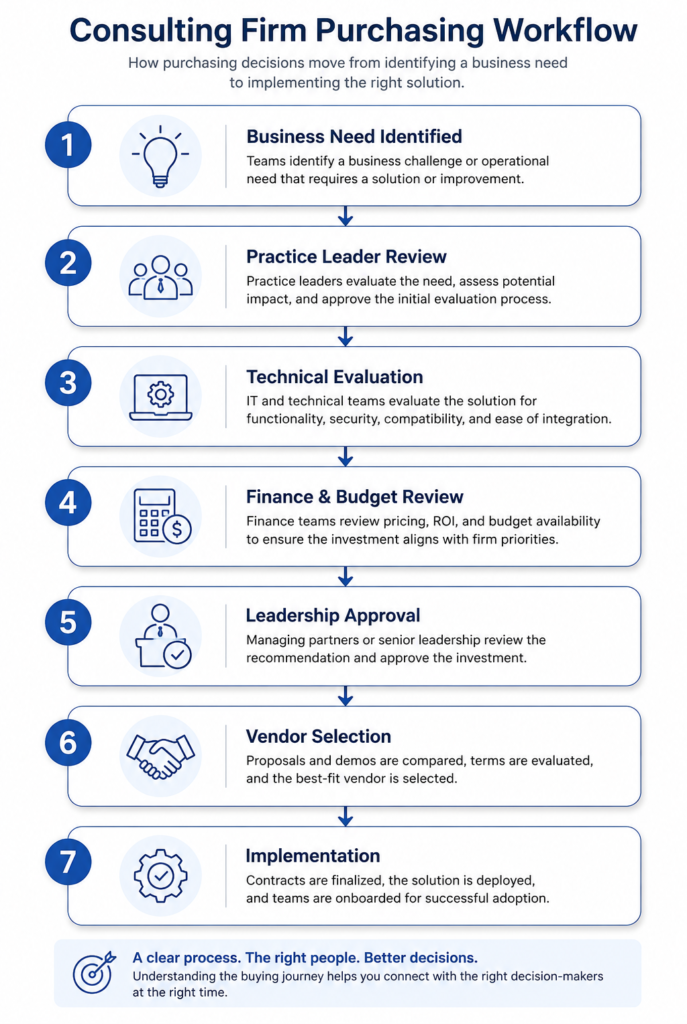
Typical Consulting Firm Purchasing Workflow
The infographic below summarizes how purchasing decisions typically move through a consulting firm, from identifying a business need to selecting and implementing the right solution.
Who to Target in a Consulting Industry Mailing List
Depending on the product or service being purchased, the key decision-makers can include:
- Chief Executive Officers (CEOs)
- Managing Partners
- Chief Operating Officers (COOs)
- Chief Financial Officers (CFOs)
- Chief Information Officers (CIOs)
- Chief Technology Officers (CTOs)
- Chief Information Security Officers (CISOs)
- Practice Leaders
- Business Development Directors
- Procurement Managers
- Operations Managers
Involvement varies by firm size and purchase complexity. Smaller firms often decide through Partners or Managing Directors alone, while larger organizations pull in multiple departments before approving a vendor. Here’s a closer look at the roles most worth prioritizing:
Managing Partners
Managing Partners oversee the firm’s strategic direction and major business investments. They are commonly involved in decisions related to enterprise software, strategic partnerships, mergers, expansion initiatives, and long-term vendor relationships. Businesses selling high-value solutions should consider Managing Partners among their priority contacts.
Practice Leaders
Practice Leaders manage specific consulting divisions such as technology consulting, healthcare consulting, financial consulting, or engineering consulting. Since they oversee service delivery within their practice areas, they frequently recommend specialized software, research platforms, and productivity tools that improve client outcomes.
Chief Information Officer (CIO)
The Chief Information Officer is responsible for managing the firm’s technology infrastructure. They evaluate enterprise software, cloud services, cybersecurity platforms, collaboration tools, and digital transformation initiatives. Organizations providing IT solutions should prioritize CIOs during prospecting campaigns.
Chief Technology Officer (CTO)
Technology-focused consulting firms often rely on Chief Technology Officers to evaluate new technologies that support innovation and client delivery. They assess software architecture, emerging technologies, automation platforms, and technical capabilities before recommending enterprise investments.
Chief Financial Officer (CFO)
Chief Financial Officers review financial feasibility, return on investment, contract value, and budget allocation before major purchases receive approval. Although they may not evaluate product functionality, their approval is essential for significant technology and service investments.
Business Development Directors
Business Development Directors focus on expanding the firm’s client portfolio and generating new revenue opportunities. They frequently evaluate CRM platforms, lead generation solutions, marketing automation software, proposal management tools, and customer engagement technologies that improve sales performance.
Procurement and Operations Managers
Larger consulting firms often establish procurement or operations teams responsible for supplier selection, contract negotiations, vendor management, and purchasing compliance. These professionals ensure purchasing decisions align with organizational policies while supporting cost-effective business operations.
Understanding these responsibilities allows businesses to build more targeted prospect lists instead of sending generic outreach to every executive within a consulting firm. A well-segmented Consulting Company Contacts database helps sales and marketing teams prioritize the professionals most likely to influence purchasing decisions based on their roles and business responsibilities.
How to Find Decision-Makers in Consulting Firms
Identifying decision-makers is often the biggest challenge in B2B prospecting. Consulting firms differ in size, specialization, and organizational structure, making it important to use multiple research methods instead of relying on a single source.
Use LinkedIn for Professional Research
LinkedIn remains one of the most effective platforms for identifying professionals working in consulting firms. Businesses can search using job titles such as Managing Partner, Partner, Practice Leader, Chief Information Officer, Business Development Director, or Procurement Manager.
Advanced filters such as company name, industry, location, and seniority help narrow the search to professionals who are more likely to influence purchasing decisions. Searching by consulting specialization, such as technology consulting, healthcare consulting, or engineering consulting, also helps businesses identify more relevant prospects.
Research Company Websites
Most consulting firms publish information about their leadership teams, service areas, and management structure on their websites. Pages such as About Us, Leadership, Management Team, and Our People often identify senior executives, Partners, Practice Leaders, and Business Development professionals.
Reviewing these pages before reaching out allows businesses to understand the firm’s structure and personalize their communication based on the recipient’s responsibilities.
Attend Industry Events and Conferences
Consulting firms regularly participate in business conferences, leadership summits, technology events, and industry association meetings. These events provide valuable networking opportunities and help businesses connect with Partners, Managing Directors, Practice Leaders, founders, and other senior professionals responsible for business decisions.
Building relationships through industry events often creates stronger opportunities than relying solely on cold outreach.
Use Sales Intelligence Platforms
Sales intelligence platforms help businesses identify consulting firms based on company size, industry, location, consulting specialization, and seniority. Instead of manually researching hundreds of firms, businesses can quickly build targeted prospect lists by filtering decision-makers according to specific business requirements.
These platforms are particularly useful for companies running account-based marketing campaigns or targeting consulting firms across multiple geographic regions.
Use a Verified Consulting Industry Email Database
Manual research works well when targeting a small number of consulting firms. However, it becomes difficult when sales teams need to reach hundreds or thousands of organizations.
A verified Consulting Industry Mailing List provides immediate access to qualified decision-makers across strategy consulting, technology consulting, financial consulting, HR consulting, engineering consulting, and boutique consulting firms. Instead of spending valuable time verifying contact information, businesses can begin outreach using accurate, CRM-ready business data from a reliable consulting industry email database — including our own Consulting Industry Email List At ContactMetrix, our list includes verified business contacts across multiple consulting specialties and leadership roles. Businesses can identify qualified decision-makers, improve prospecting efficiency, and support lead generation, account-based marketing, and email marketing campaigns with accurate business information.
What a Consulting Industry Mailing List Should Include
The quality of a business database directly affects the success of prospecting campaigns. A well-maintained Consulting Industry Contact List should include verified business information that helps sales and marketing teams reach the right professionals.
A quality database should include:
- Full name and job title
- Company name
- Verified business email address
- Direct phone number
- Company website
- Business location
- Consulting specialization
- Company size
- Annual revenue
- LinkedIn profile (where available)
Having complete and verified business information reduces manual research while making prospecting campaigns more targeted and efficient.
Benefits of Using a Verified Consulting Industry Mailing List
Building a prospect list manually requires significant time and effort. Consulting firms operate across different industries, company sizes, and geographic regions, making it difficult to identify the right decision-makers and verify their contact information.
A verified Consulting Industry Mailing List simplifies this process by providing accurate business contacts that allow sales and marketing teams to focus more on outreach and relationship building rather than research.
Reach the Right Decision-Makers
Verified business data helps businesses connect with Managing Partners, Practice Leaders, Chief Information Officers, Chief Financial Officers, Business Development Directors, Procurement Managers, and other professionals involved in purchasing decisions.
Save Time on Prospecting
Instead of spending hours researching consulting firms individually, businesses can begin outreach immediately using pre-verified business contacts. This allows sales teams to spend more time building relationships and less time searching for contact information.
Improve Email Deliverability
Verified business email addresses help reduce bounce rates while supporting a stronger sender reputation. Accurate contact information also improves the effectiveness of email marketing campaigns.
Better Audience Segmentation
A quality Consulting Industry Email Database allows businesses to segment prospects by consulting specialty, company size, annual revenue, geographic region, and job title. Better segmentation supports more personalized outreach and improves campaign performance.
Support Consistent Lead Generation
Reliable business data enables organizations to maintain a steady pipeline of qualified prospects without rebuilding contact lists for every campaign. This helps businesses develop consistent lead generation strategies while improving sales productivity.
Build Your Consulting Industry Prospect List
Final Thoughts
Understanding how consulting firms operate is essential for businesses looking to build meaningful relationships with the right prospects. Purchasing decisions are rarely made by a single individual. Managing Partners, Practice Leaders, CIOs, CFOs, Business Development Directors, and procurement teams all contribute to evaluating vendors depending on the type of solution being considered.
Although manual research remains valuable, identifying and verifying decision-makers across hundreds of consulting firms requires considerable time and effort. A verified Consulting Industry Mailing List helps simplify this process by providing access to accurate business contacts across different consulting specialties, company sizes, and geographic regions.
Whether your business offers software, technology services, recruitment solutions, financial services, marketing platforms, or professional consulting support, combining industry knowledge with verified business data creates a more focused prospecting strategy. Reaching the right professionals at the right time allows sales and marketing teams to improve lead generation, personalize outreach, and build stronger business relationships.
Frequently Asked Questions
1. What is a Consulting Industry Mailing List?
A Consulting Industry Mailing List is a verified business database containing contact information for professionals working in consulting firms. It typically includes Managing Partners, Directors, Practice Leaders, CIOs, CFOs, Business Development Directors, procurement professionals, and other decision-makers involved in business purchasing.
2. Who are the main decision-makers in consulting firms?
The primary decision-makers vary depending on the purchase. Common buying influencers include Managing Partners, Chief Executive Officers, Chief Information Officers, Chief Financial Officers, Practice Leaders, Business Development Directors, Procurement Managers, and Operations Managers.
3. What information should a Consulting Industry Contact List include?
A quality Consulting Industry Contact List should contain verified business information such as full name, job title, company name, business email address, direct phone number, company website, business location, consulting specialization, company size, annual revenue, and LinkedIn profile where available.
4. How can businesses find decision-makers in consulting firms?
Businesses can identify decision-makers through LinkedIn, consulting firm websites, industry events, business directories, sales intelligence platforms, and verified business databases. Combining these sources helps improve the accuracy of prospecting efforts.
5. How does a Consulting Industry Mailing List improve B2B marketing?
A Consulting Industry Mailing List helps businesses reduce prospecting time, improve email deliverability, segment audiences more effectively, and connect directly with professionals responsible for purchasing decisions. Accurate business data supports more targeted lead generation, account-based marketing, and personalized outreach campaigns.
