
Reaching contractors can be challenging, as most work on job sites rather than in offices. Cold calls are often ignored, and paid ads may not reach the intended decision-maker at the right time.
Email marketing addresses this challenge by reaching decision-makers directly in their inboxes. It is cost-effective, persistent, and delivers ongoing value. Unlike ads that disappear quickly, emails remain accessible until read. According to Forbes Advisor, email marketing yields an average return of $36 for every $1 spent. In contracting, where access to decision-makers is limited, this direct and affordable approach is especially valuable.
In this blog, you’ll learn what a contractor’s email list is, what it includes, how to get one legally and effectively, and how to choose a reliable provider.
What Is a Contractors Email List?
A contractors email list, also called a contractor email database or contractor mailing list, is a verified collection of email addresses and contact information for construction professionals. It includes general contractors, subcontractors, project managers, and business owners working in the construction industry.
A legitimate contractor mailing list is typically compiled using official industry classification codes. For instance, general contractors are listed under SIC Code 1542, which includes over 35,000 companies in the U.S. This approach enables precise targeting by trade specialty, company size, licensing status, and location, eliminating guesswork in reaching decision-makers.
Whether you call it a contractors email database, contractors email list, or contractor mailing list, the goal is the same: to deliver you a verified, accurate, and targeted list of contacts you can really reach, not just a scrap list of full names.
What's Included in a Contractors Contact List
A good contractor contact list is more than just a list of email addresses. It includes who the contractor is, where they work, and how to contact them by email and phone. This makes it different from a simple contractor email list. It gives you several ways to connect, not just one. For example, having a contractor’s phone number lets you follow up quickly if your email is ignored. Many salespeople have closed deals because they could call to clear up details or arrange a site visit, while others who relied only on email had their messages overlooked or ignored.
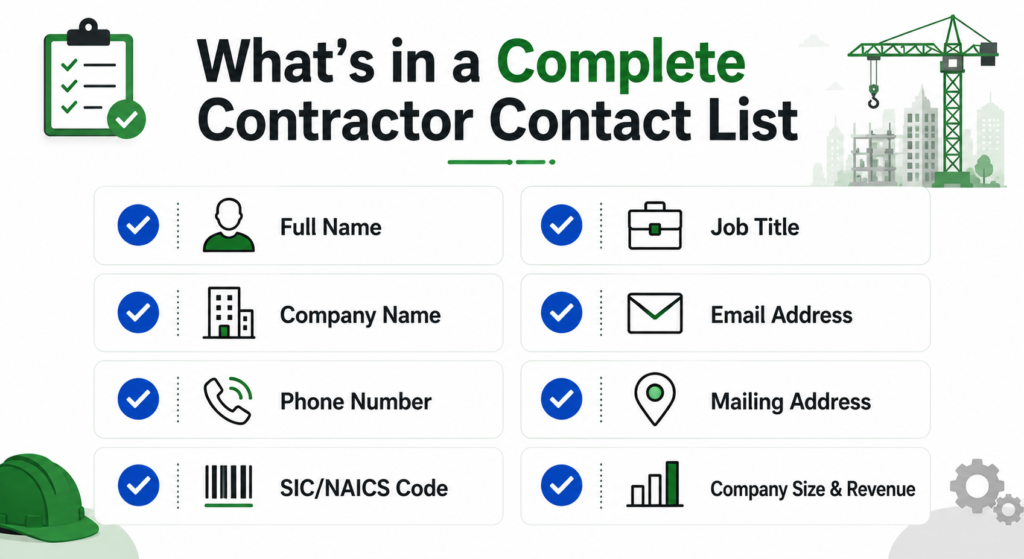
Here’s what a complete list usually includes:
- Full Name: Contractor’s full name, not just the business handle.
- Job Title: Owner, project manager, site supervisor, etc.
- Company Name: The business the contractor works for or runs.
- Contractor Email Address: A verified business email you can use for outreach.
- Phone Number: For calls or SMS follow-ups.
- Mailing address: Useful for direct mail campaigns or targeting specific locations.
- SIC or NAICS code: Shows you the exact type of contracting work they do (roofing, plumbing, general construction, etc.)
- Company Size and Revenue: Indicates whether you are contacting a small local business or a larger company.
An email may prompt an initial response, but additional details such as phone number, address, and industry code ensure you reach the appropriate contractor. For instance, a roofing supplier benefits from filtering out electricians using SIC/NAICS codes. Segmenting your contact list by trade, company size, or location allows you to tailor campaigns to specific audiences, increasing the likelihood of meaningful engagement.
Data quality is essential. While a basic list of names and emails is a starting point, a comprehensive list enables segmentation by company size, trade, or location, ensuring your campaigns reach the intended audience. Keeping your contact data current through regular verification maintains the effectiveness of your outreach.
General Contractor Email List vs. Trade-Specific Lists
Not all contractors do the same work, so not all contractor lists should be the same. A company selling roofing materials doesn’t need a general contractor email list full of electricians; they need roofers. This is where trade codes help. SIC and NAICS codes organize contractors by exactly what they build, so you can reach the right trade instead of emailing everyone in construction and hoping for the best.
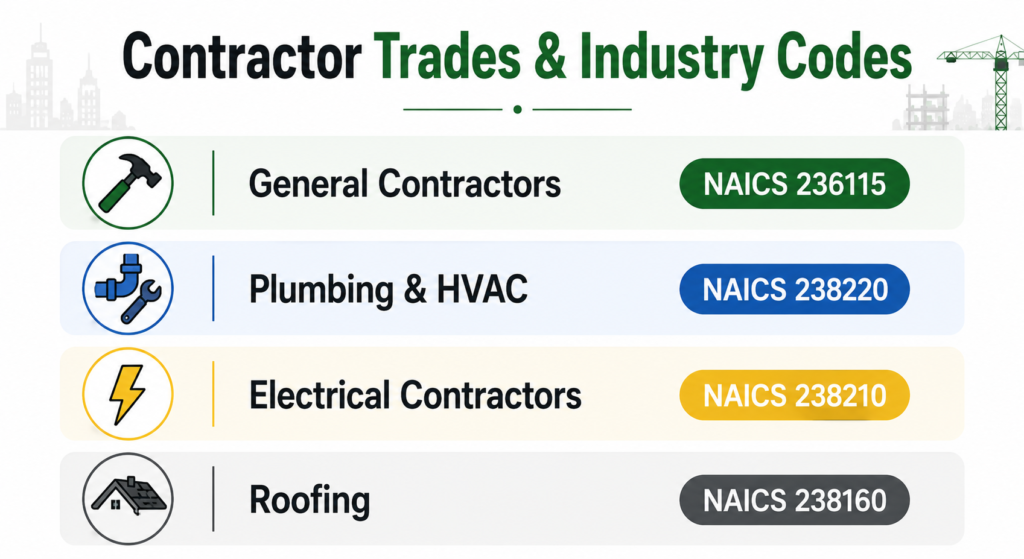
Here’s a quick breakdown of the major trades and their codes:
- General contractors are divided by project type: NAICS 236115 includes builders hired to construct new single-family homes and townhouses. If a contractor builds homes to sell on their own (a “spec builder”), they fall under a different code (236117), not 236115.
- Plumbing and HVAC use the same NAICS code (238220): So if you are making a general contractor email list and want plumbers and HVAC workers specifically, this one code includes both trades.
- Electrical contractors (238210): Covers general wiring work and is broad enough to include newer specialties such as solar and low-voltage systems.
- Roofing has its own dedicated code (238160): Separate from siding and other exterior work, so a roofing-focused list stays clean and trade-specific.
Key takeaway: Before purchasing or building a general contractor email list, determine whether you need a broad list or one focused on a specific trade. Free lists or samples typically provide only basic information, but true value comes from trade-level segmentation, as messaging for electricians differs from that for roofers.
Free Contractor Email List: Is It Worth It?
When searching for a free contractor email list, you will typically encounter three options: small sample downloads, free trial access on paid data platforms, and lists copied from public sources. While these options exist, none are truly free in practice.
Here’s what you’re actually getting with each:
Sample downloads: Usually 5-10 contacts, meant as a small preview of a larger paid database. Good for testing a campaign style, but not enough to do a real outreach effort.
Free trial tiers: Data sites that let you get a limited number of contacts before asking you to pay. The data quality is usually okay, but the amount is intentionally limited.
Scraped directories: Lists sourced from business directories, association websites, or public listings. These are the least reliable, as they are unverified, lack permission, and are often outdated upon distribution.
The real cost of “free”
A free contractor email database may appear cost-effective, but it presents significant drawbacks
The data gets outdated quickly: Business contact info becomes wrong at about 22–30% per year, mostly because people change jobs. Research shows it goes bad at about 2.1 percent each month. A free list that hasn’t been updated recently might already have many invalid addresses before you even send your emails.
Bounce rates harm your sender reputation: Free and scraped lists are often unverified and contain incorrect or misspelled addresses. High bounce rates not only waste your efforts but also signal potential spam activity to email providers, which can negatively impact future campaign deliverability.
Risk of complaints increases: Recipients on free or scraped lists have not consented to receive your messages, resulting in a higher likelihood of spam complaints. Such complaints can quickly lead to your domain being flagged or blocked.
So, is it worth it?
For testing purposes—such as refining subject lines, offers, or outreach processes—a small free sample or trial can be useful. However, for full-scale campaigns, a free contractor email list is rarely effective. A small, verified paid list typically outperforms a large, unchecked free list, as more emails are delivered successfully.
How to Get a Contractor Email Address - 3 Realistic Options
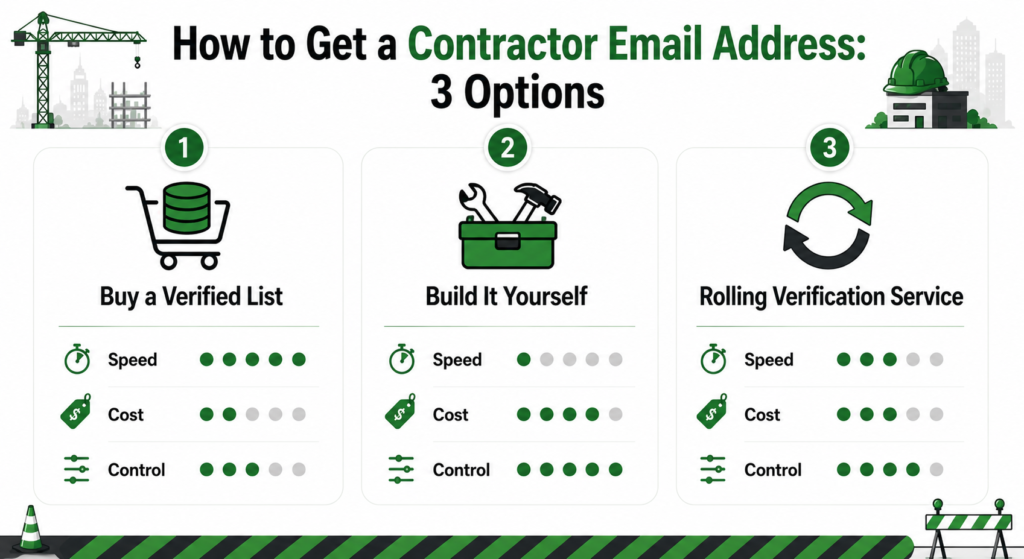
There is no single best method for obtaining contractor email addresses; your approach depends on budget, available time, and desired control over the data. The three most common methods are:
1. Get a verified list.
A data provider supplies a ready-made list filtered by trade and location. This is the fastest option, but quality varies significantly between sellers. Always verify how recently the data was updated before purchasing.
2. Build it yourself
Gather contacts from state contractor licensing boards, trade association lists, and public business directories. This method is cost-free but time-intensive, and it is best suited for smaller lists, as it becomes inefficient for larger volumes.
3. Make use of a provider that carries out rolling verification
Some platforms offer continuously verified data, regularly updating contact information to maintain accuracy over time. While this option is more expensive than a one-time purchase, it prevents the need to buy new lists frequently. This approach is ideal for large-scale or ongoing outreach, while building your own list is better for small-scale needs and limited budgets.
Is It Legal to Email Contractors? CAN-SPAM & GDPR, Side by Side
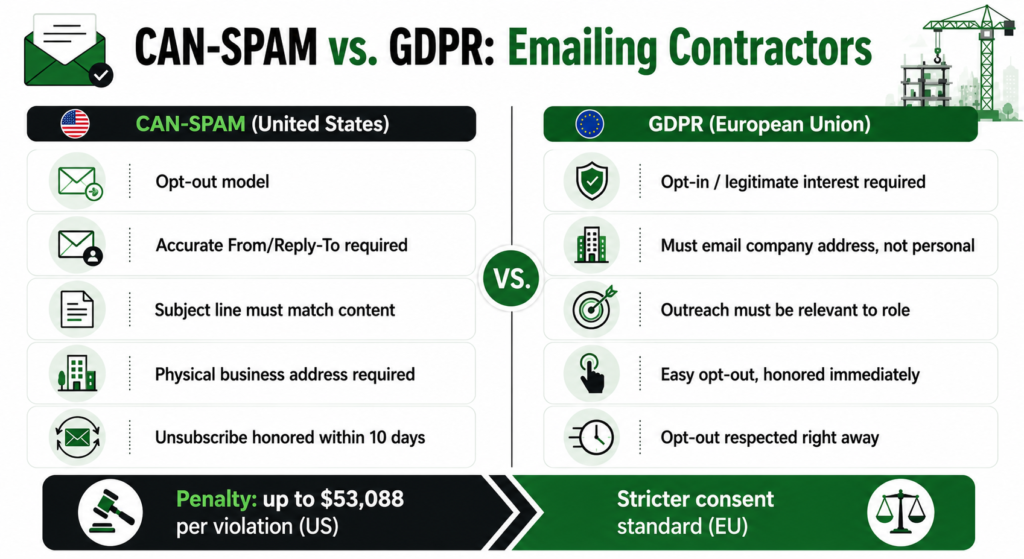
In short, the answer is yes, you are legally allowed to email contractors – though the rules vary depending on their country of origin. The following is a comparison of the two primary laws.
When you send emails to contractors in the United States, CAN-SPAM comes into effect.
CAN-SPAM allows B2B cold email without advance approval, but it comes with strict rules you must follow on every email:
- Identify yourself honestly: Accurate “From” and “Reply-To” info, no misleading sender details.
- When writing the subject line: Be honest, since the email’s content must match it.
- Give a genuine physical address: Your business address, not a PO box.
- Include a functional unsubscribe link: One that is easy to find and which, in fact, works.
- Once a person has unsubscribed: Honor their opt-out within ten business days by ceasing to send them emails.
The fines are very high and should be taken seriously: civil fines can reach $53,088 per email that violates the rules, based on the FTC’s 2025 numbers, and business-to-business emails are not exempt. The fines apply to each email, not just each campaign, so even if regulators rarely impose the full amount, sending emails to thousands of incorrect recipients can still lead to big fines.
When you send an email to contractors in the EU, the GDPR applies.
GDPR works differently. Instead of allowing people to opt out, as CAN-SPAM does, GDPR requires you to obtain consent (or have another valid reason) before sending emails. For B2B emails, most companies use ‘legitimate interest’ as that reason, meaning you can say there is a real business purpose for contacting them, as long as you:
- Email a company mailbox (like info@ or a named work email), not someone’s personal address
- Make sure that the outreach is directly relevant to their business or role.
- Make it easy to opt out and respect that opt-out right away.
The short version
CAN-SPAM allows you to send emails first and provides an easy way to comply with the rules. GDPR, however, requires a good reason before sending emails and prefers that you contact business addresses rather than personal ones. When building a Contractors Email Database for EU contractors, you should treat GDPR as the stricter rule and apply it to all contacts—this is easier than changing the rules for each person.
How to Choose a Reliable Contractors Email List Provider
Not all database providers are reliable. Some issues only become apparent after purchase. Consider the following when evaluating providers:
- Email verification method: If a provider can’t tell you how they verify emails are real and working, assume they don’t.
- List refresh cycle: Contact information quickly becomes outdated. If they can’t tell you how often the list is updated, you are probably buying old contacts.
- Sample data: A reputable provider will offer a sample before purchase. If not, this is a significant warning sign.
- Data sources: If a provider cannot clearly explain their data sources, this raises concerns about trustworthiness and compliance. Vague statements such as “trusted sources” are insufficient.
- Data compliance: Data is compliant with GDPR, CCPA, and CAN-SPAM
A quick trust check before you buy
Ask providers three key questions: How is the data verified? How often is it updated? Can I review a sample? Reliable providers answer these directly. Vague responses or high-pressure sales tactics often indicate the list may not meet your needs.
Best Practices for Emailing Your Contractor List
After you get your list, how you send your emails is just as important as who is working on it. Here are five basics to remember:
- Check your list before sending: Use a tool that verifies email addresses to find and remove invalid ones, so you avoid unnecessary bounces.
- Organize your list by type of work before writing your emails: For example, roofers and electricians need different messages. Write content that fits each group.
- Make the first two lines personal: Avoid generic openers. Mention their trade, location, or something specific to their business. This can be the difference between your email being read or deleted.
- Always include a working unsubscribe link: Make sure it’s easy to find and actually works. This is required by law and helps keep your list full of people who want your emails.
- Watch your sender reputation: Start by sending emails in small groups, keep an eye on how many emails bounce back or get complaints, and don’t send to your whole list at once. Sending slowly helps protect your domain over time. Get these five steps right, and everything else – open rates, replies, booked calls – gets easier.
Need Contractor Email List for Your Next Campaign?
Conclusion
A good contractors email list is more than just a list of addresses; it includes accurate contact details, is sorted by trade type, and is updated often so your messages reach the right people. Whether you get a checked contractors email list, build your own from licensing boards, or use a service that regularly checks the contacts, the goal is the same: to send the right message to the right contractor without harming your sender reputation.
Want to contact contractors who respond? Get a checked contractor mailing list, organized by trade for your campaign – Get Your Free Sample List.
Frequently Asked Questions
1. What is a contractor’s email list?
It’s a database of contact details for people working in construction and contracting — names, job titles, company info, and contractor email addresses, often including phone numbers and trade codes.
2. Is it legal to buy a contractor’s email list?
Yes, in the US, buying and emailing a B2B list is legal under CAN-SPAM as long as you identify yourself honestly and include a working unsubscribe link. If you’re emailing contractors in the EU, GDPR rules apply and are stricter.
3. How much does a contractor’s email list cost?
Prices change based on the seller, the number of contacts, and how the data is checked. Business contact information usually costs a few cents to more than a dollar per contact, depending on how specific and accurate it is.
4. Can I get a free contractor email list?
Yes, you can find free contractor email lists, but they are often outdated or not verified. These are okay for testing, but not reliable for real campaigns.
5. How do I find a specific contractor's email address?
Look at their company website, LinkedIn profile, or state licensing board listing. But if you need to contact many contractors, a verified mailing list is much easier than searching for each one separately.
