
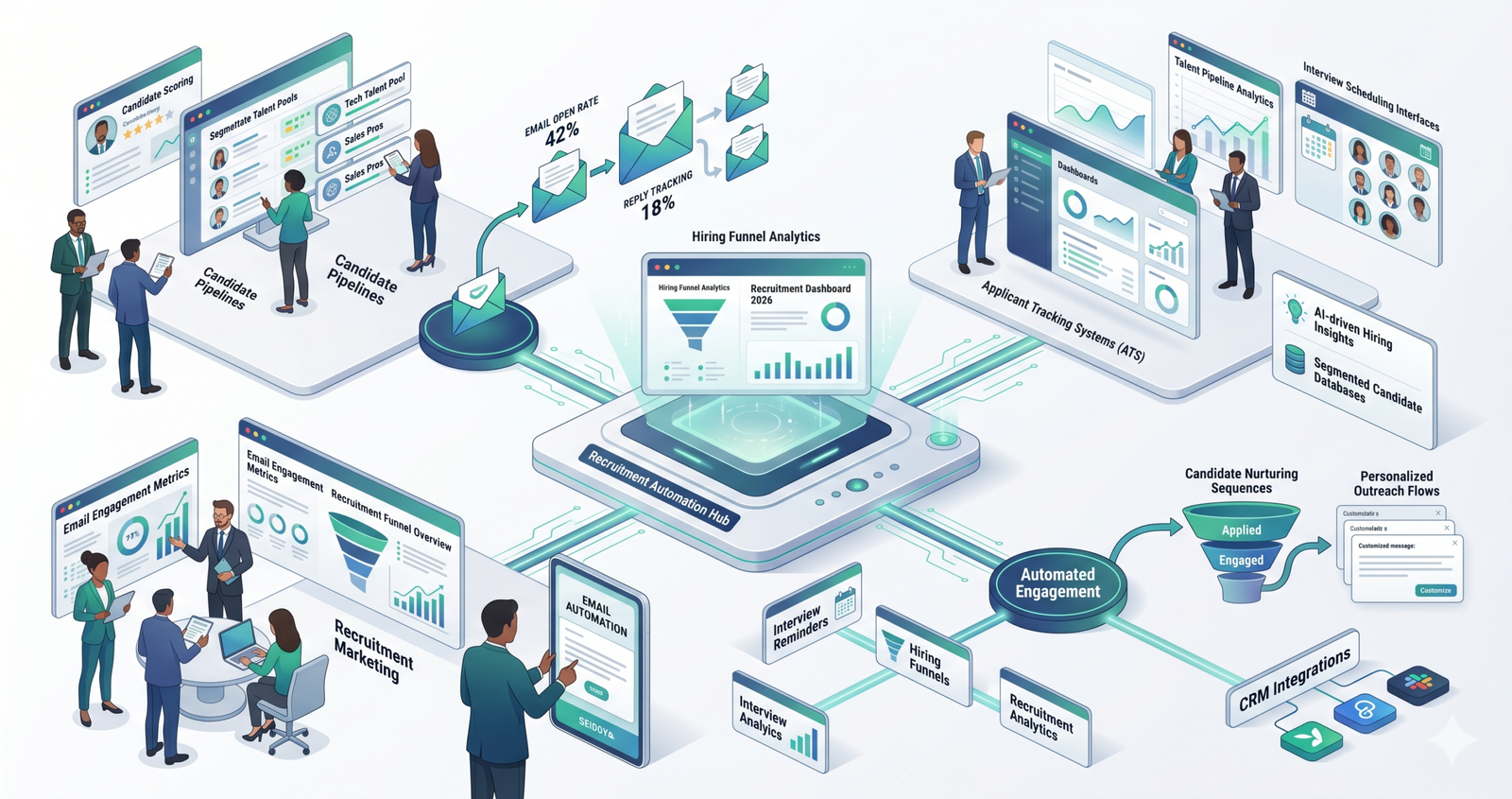
The talent acquisition landscape in 2026 presents a paradox. Nearly three-quarters of employers report difficulty filling roles, while candidates face fiercer competition than ever before. In this environment, recruitment teams need every advantage they can get. Email marketing has emerged as one of the most powerful tools in the modern recruiter’s arsenal, delivering an average ROI of $36 to $42 for every dollar spent while providing direct access to over 4.6 billion email users worldwide.
But email marketing for recruitment is no longer about sending mass job postings to your entire database. Success in 2026 demands a sophisticated approach that combines candidate nurturing, personalized outreach, automation workflows, and strategic segmentation.
This comprehensive guide explores how staffing agencies and talent acquisition teams can leverage email marketing to build talent pipelines, engage passive candidates, and accelerate hiring outcomes.
Why Email Marketing Matters for Recruitment in 2026
Email remains the most cost-effective, high-impact channel in recruiting.
Unlike social media platforms where algorithms determine visibility, email provides direct access to candidates who have already expressed interest in your opportunities. This owned channel means you don’t have to compete with constantly changing platform rules or pay for each impression.
The data tells a compelling story.
Email marketing campaigns achieve an average open rate of 22% in the recruitment sector, with personalized campaigns performing significantly better. When you factor in that the average person receives 121 business emails daily, standing out requires more than generic job alerts.
It requires strategic thinking about candidate engagement throughout the entire recruitment funnel.
For staffing agencies specifically, email marketing solves three critical challenges:
- It maintains relationships with passive candidates who aren’t actively job hunting but represent future placement opportunities
- It enhances employer branding by keeping your agency top-of-mind when hiring needs arise
- It automates time-consuming touchpoints, allowing recruiters to focus on high-value conversations rather than administrative follow-up
Building a Quality Email List for Talent Acquisition
Your email marketing success starts with list quality, not list size.
A targeted database of 5,000 engaged candidates will outperform 50,000 unqualified contacts every time. Building your recruitment email list should follow multiple channels to ensure diversity and depth.
Start with your existing talent database.
Every candidate who has applied to previous positions, attended recruiting events, or expressed interest in your company represents a potential list member. Ensure you have proper opt-in consent and clearly communicate what type of content they’ll receive.
Place opt-in forms strategically on your career site and job description pages.
Rather than asking for basic information alone, consider offering valuable content in exchange for email subscriptions. A downloadable salary guide, career development resources, or industry insights can incentivize candidates to join your list willingly.
Social media campaigns provide another avenue for list building.
Use LinkedIn, Facebook, and Instagram to promote your talent community, highlighting the benefits candidates receive by joining your email list.
Make the value proposition clear:
- Exclusive job opportunities
- Career tips
- Company culture insights
- Early access to new openings
Partnerships with universities, industry associations, and professional organizations can expand your reach into specific talent pools.
Co-host webinars or virtual career fairs and collect opt-in emails from attendees.
Critical to list health is regular maintenance.
Remove hard bounces immediately and suppress contacts with zero engagement over 90 days. Low engagement damages sender reputation and signals to email providers that your messages aren’t wanted.
Quarterly list cleaning should be standard practice, not an afterthought.
Email List Segmentation for Recruiters
Generic emails to your entire database waste resources and damage deliverability.
Segmentation allows you to send targeted messages that resonate with specific candidate groups, dramatically improving engagement rates. Research shows that segmented campaigns deliver 30% more opens and 50% more clicks than unsegmented sends.
Segment your talent pool across multiple dimensions.
Start with basic firmographic data:
- Industry experience
- Job function
- Seniority level
- Geographic location
A software engineer in Austin has different priorities than a nurse in Boston, and your messaging should reflect these differences.
Behavioral segmentation takes targeting further by tracking how candidates interact with your content.
Monitor:
- Email engagement patterns
- Website visits
- Job application history
- Content downloads
Candidates who frequently open your emails but haven’t applied recently might respond well to personalized outreach highlighting roles that match their profile.
Hiring readiness represents a powerful segmentation criterion.
Active job seekers require different communication than passive candidates who are employed but open to the right opportunity.
Passive candidates benefit from longer nurture sequences focused on:
- Company culture
- Employee testimonials
- Career development opportunities
rather than immediate job openings.
Skills-based segmentation matches candidates to roles based on validated competencies rather than credentials alone.
With 39% of core skills expected to become obsolete by 2030, focusing on transferable abilities and learning capacity opens larger talent pools.
Create dynamic segments that update automatically based on candidate behavior and profile changes.
When a passive candidate suddenly visits multiple job pages in one session, your CRM should automatically move them to an active job seeker segment triggering appropriate follow-up sequences.
Looking for an Email List to Connect with Recruiters
Recruitment CRM Integration and Workflow Automation
Modern recruitment email marketing requires integration between your CRM, applicant tracking system, and email platform.
Disconnected systems create data silos that prevent effective segmentation and waste recruiter time on manual data entry.
The best recruitment CRMs in 2026, including platforms like Recruiterflow, Bullhorn, and Gem, offer native email marketing capabilities with segmentation tools, automated workflows, and performance analytics.
These systems allow you to build sophisticated campaigns triggered by candidate actions and lifecycle events.
Workflow automation handles repetitive touchpoints that maintain candidate engagement without manual effort.
Set up automated sequences for common scenarios:
- Thank you emails after applications
- Interview confirmation and reminders
- Post-interview follow-ups
- Re-engagement campaigns for dormant candidates
One particularly effective workflow is the automatic nurture sequence for candidates who applied but weren’t selected.
Rather than letting these qualified professionals disappear from your pipeline, enroll them in a long-term engagement campaign.
Send monthly newsletters with:
- Career advice
- Industry insights
- Relevant job opportunities
When a better-fit position opens six months later, you’ve maintained the relationship and can reach out with context rather than starting from scratch.
Staffing agency automation should also address client communication.
Automated campaigns can:
- Share candidate shortlists
- Request feedback
- Provide hiring process updates
without manual email composition for every interaction.
The key distinction between effective and annoying automation lies in personalization.
Even automated emails should reference candidate-specific information like:
- Their name
- Target roles
- Skills
- Recent interactions with your agency
AI-powered personalization tools can dynamically insert relevant content based on candidate profiles and behavior.
Personalized Candidate Outreach at Scale
Personalization in recruitment email marketing goes far beyond inserting a first name into the subject line.
Candidates in 2026 expect messages that demonstrate you understand their career goals, recognize their unique skills, and can articulate why a specific opportunity aligns with their aspirations.
Research consistently shows that personalized emails deliver:
- 29% higher open rates
- 41% higher click-through rates
compared to generic versions.
For recruitment specifically, personalization impacts response rates even more dramatically.
A candidate receiving a message that references their specific experience, mentions a relevant project from their portfolio, or acknowledges a recent career achievement is significantly more likely to engage.
Develop email templates for different candidate personas, industries, and job levels, but treat templates as starting points rather than final copy.
The most effective recruiters customize at least three elements in every outreach message:
- The opening hook that demonstrates research
- The value proposition tailored to candidate priorities
- The call to action aligned with where the candidate sits in their job search journey
For passive candidates, lead with the role’s impact and growth potential rather than company information.
These candidates are already employed and need a compelling reason to consider a change.
Subject lines like:
“Reducing compliance costs for mid-market CFOs”
outperform:
“Amazing opportunity at growing company.”
AI-powered personalization tools can help scale this approach.
Modern platforms analyze:
- Candidate resumes
- LinkedIn activity
- Engagement history
- Interview notes
to automatically craft emails that reference specific details.
While AI handles the heavy lifting, human review ensures messages maintain an authentic voice and avoid awkward phrasing.
Candidate Nurturing Email Campaigns
Not every candidate is ready to apply today, but that doesn’t mean they won’t be valuable in the future.
Candidate nurturing campaigns maintain relationships over time, keeping your agency top-of-mind when circumstances change.
Drip campaigns work exceptionally well for awareness and engagement stages of the recruitment funnel.
A well-designed nurture sequence might include:
- An initial welcome email introducing your agency and value proposition
- Company culture content showcasing employee testimonials and workplace environment
- Career development resources
- Industry insights
- Relevant case studies demonstrating successful placements
The timing and frequency of nurture emails require careful calibration.
Sending weekly emails risks overwhelming candidates, while quarterly contact allows your agency to fade from memory.
Most successful recruitment teams settle on:
- Bi-weekly cadences
- Monthly cadences
with content variety preventing fatigue.
Engagement scoring helps identify when nurtured candidates transition from passive to active job seekers.
When a candidate who typically opens one email per month suddenly clicks through to three job postings in one week, trigger a personalized outreach from a recruiter rather than continuing automated nurture.
Re-engagement campaigns revive dormant candidates who haven’t interacted with your communications in 90+ days.
These sequences often perform better with a changed approach:
- Pause existing nurture
- Wait 30 days
- Send a re-engagement email offering valuable content or highlighting what’s new at your agency
Give recipients an easy way to update their preferences or opt out entirely.
Paradoxically, providing a clear exit option often re-engages candidates who appreciate the respect for their inbox.
Staffing Agency Email Campaign Best Practices
Subject lines determine whether your recruitment emails get opened or ignored.
Keep subject lines under 50 characters to ensure full visibility on mobile devices, which account for the majority of email opens in 2026.
Personalize with company-specific or role-specific details rather than just first names.
Example:
“Senior Data Engineer opportunity at fintech scaling to Series B”
outperforms:
“John, we have an exciting opportunity for you.”
Avoid spam trigger words like:
- “Urgent”
- “Apply now”
or excessive punctuation.
Research shows that more than three punctuation marks significantly increases spam folder placement.
Test different subject line approaches through A/B testing, measuring not just opens but click-through rates and application completions.
Email design should prioritize:
- Mobile responsiveness
- Scannability
Most candidates read emails on smartphones, so:
- Single-column layouts
- Large tap-friendly buttons
- Concise copy
perform best.
Every email should include a clear call to action, whether that’s:
- Applying for a role
- Scheduling a call
- Updating profile information
Plain text emails often outperform heavily designed HTML messages in recruitment contexts.
Candidates perceive plain text as more personal and less promotional, leading to higher response rates for cold outreach.
Reserve designed templates for newsletters and mass communications while using plain text for one-to-one candidate outreach.
Timing matters more than many recruiters realize.
Send recruitment emails:
- Tuesday through Thursday
- Between 9 AM and 11 AM
- In the recipient’s time zone
These windows capture candidates when they’re checking email at work but before afternoon meetings and end-of-day fatigue set in.
Avoid:
- Monday mornings
- Friday afternoons
when attention levels are lower.
Measuring Email Marketing Performance in Recruitment
Track metrics that connect to hiring outcomes rather than vanity metrics.
Open rates provide a baseline but don’t indicate campaign effectiveness on their own, especially given Apple Mail Privacy Protection artificially inflating this metric through email prefetching.
Focus instead on click-to-open rate, which measures the percentage of people who clicked a link after opening your email.
This metric indicates:
- Message relevance
- Call-to-action effectiveness
For recruitment emails, aim for click-to-open rates above 20%.
Reply rate represents the gold standard for cold outreach.
When candidates respond to your emails, engagement is genuine and qualified.
Track:
- Positive reply rates
- Automated out-of-office messages
- Unsubscribes
separately.
Quality cold outreach should generate 20%+ reply rates from warm candidates.
Application completion rate measures how many email recipients who clicked through actually completed an application.
Low application rates despite high click-through suggest:
- Friction in your application process
- Misalignment between email promises and actual job requirements
Time to hire and quality of hire provide ultimate email marketing validation.
If candidates sourced through email campaigns close faster and perform better than other channels, your strategy is working.
Track source attribution rigorously to demonstrate email marketing ROI.
Engagement scoring across your entire database reveals which segments respond best to different message types.
Use these insights to continuously refine:
- Segmentation
- Personalization
- Content strategy
Compliance and Best Practices
Email marketing for recruitment must comply with regulations including:
- GDPR in Europe
- CAN-SPAM in the United States
- CCPA in California
Always obtain explicit consent before adding candidates to your email list.
Never purchase email lists or scrape contact information from websites, as this violates privacy regulations and damages sender reputation.
Include a clear unsubscribe mechanism in every marketing email, and process opt-out requests within 10 business days, though best practice is instant removal.
Respect candidate preferences about:
- Email frequency
- Content types
when provided.
Maintain accurate records of:
- How and when you obtained each email address
- What communications candidates consented to receive
This documentation protects your agency if consent is ever questioned.
Technical compliance matters just as much as legal compliance.
Implement:
- SPF
- DKIM
- DMARC authentication
for all sending domains to ensure deliverability.
Senders without proper authentication see inbox placement rates drop to 44% compared to 89% for fully authenticated domains.
Are you looking to grow your email list for recruitment purposes?
Conclusion
Email marketing for recruitment in 2026 is about building relationships, not broadcasting job postings.
The most successful talent acquisition teams treat email as a precision tool for candidate engagement, combining:
- Strategic segmentation
- Personalized outreach
- Automated workflows
- Valuable content
to create a consistent pipeline of qualified candidates.
Success requires:
- Quality data
- Integrated technology
- A commitment to treating candidates as individuals rather than database entries
When executed properly, recruitment email marketing delivers measurable improvements in:
- Time to hire
- Cost per hire
- Quality of hire
while building an employer brand that attracts top talent organically.
The fundamentals outlined in this guide provide a roadmap for staffing agencies and internal talent acquisition teams ready to elevate their email marketing from tactical job blasts to strategic candidate relationship management.
Start with:
- Proper list segmentation
- Recruitment CRM integration for workflow automation
- Personalized candidate outreach at scale
- Measuring what matters
Ready to supercharge your recruitment email marketing with accurate, verified contact data?
Businesses looking to improve recruitment outreach and candidate targeting can explore ContactMetrix for high-quality contact data and advanced segmentation capabilities that support personalized hiring campaigns and smarter talent acquisition strategies.
