

Email marketing is one of the most effective ways to engage prospects and nurture customer relationships. Among the many email marketing metrics, the email open rate is one of the first indicators of whether your campaign has captured your audience’s attention.
Understanding your email open rate helps you evaluate subject lines, sender reputation, audience engagement, and the overall effectiveness of your email campaigns.
Common email marketing metrics include:
- Email Open Rate
- Click-Through Rate (CTR)
- Bounce Rate
- Conversion Rate
- Unsubscribe Rate
According to Benchmark Email, email open rates have become more consistent across industries, meaning even small improvements can significantly impact campaign performance.
What Is Email Open Rate?
An email open rate is the percentage of delivered emails that recipients open.
For example, if you deliver 1,000 emails and 800 recipients open them, your email open rate is 80%.
Many beginner marketers confuse sent emails with delivered emails.
- Sent emails are the total number of emails your platform attempts to send.
- Delivered emails are the emails that successfully reach recipients’ inboxes without bouncing.
A higher email open rate indicates that recipients found your email relevant enough to open. However, an open doesn’t guarantee engagement. Recipients still need to click, interact, and eventually convert.
How to Calculate Email Open Rate
The formula is simple:
Email Open Rate = (Opened Emails ÷ Delivered Emails) × 100
For example:
- Delivered Emails: 500
- Opened Emails: 150
Email Open Rate = (150 ÷ 500) × 100 = 30%
Related Terms
Unique Opens
Unique opens count each recipient only once, regardless of how many times they open the same email.
Total Opens
Total opens include every email open, including multiple opens by the same recipient.
What's a Good Email Open Rate?
Email open rate is an important metric, but it should not be the only measure of email marketing success.
A good open rate depends on several factors, including:
- Industry
- Target audience
- Email type
- Campaign frequency
- List quality
A general benchmark followed by many marketers is:
| Email Open Rate | Performance |
|---|---|
| 20–25% | Below average (needs improvement) |
| 25–35% | Good and healthy |
| 35–50% | Excellent |
| 50–60%+ | Common for highly engaged or transactional emails |
Average Email Open Rates by Industry
According to MailerLite’s 2025 Email Marketing Benchmarks, average email open rates across industries range from 30.10% to 55.71%.
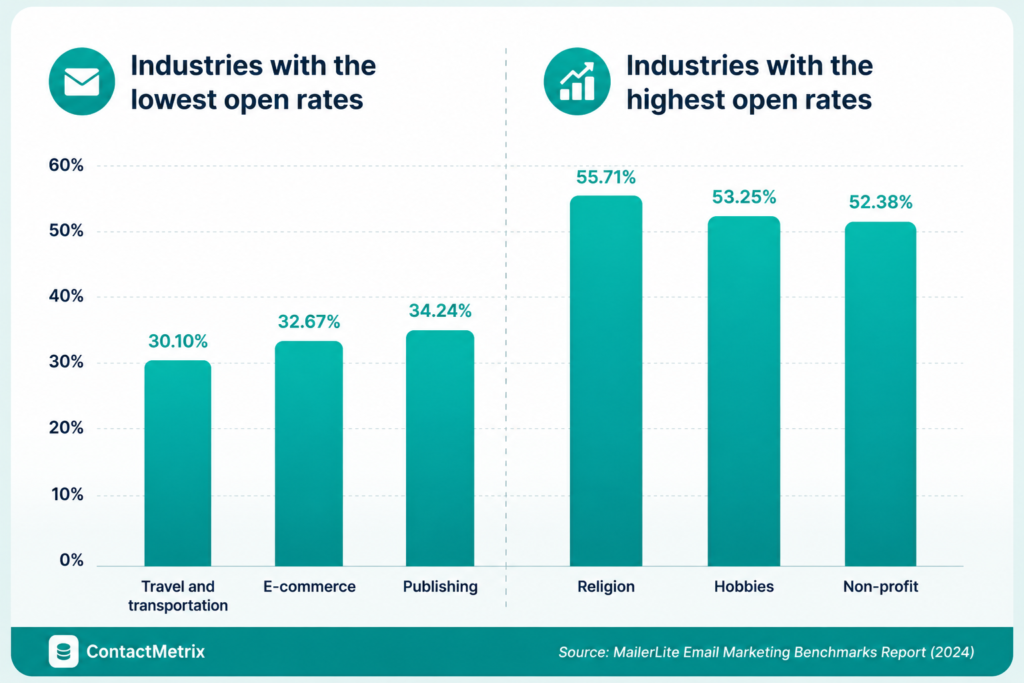
Key Takeaways
Industries with higher open rates generally:
- Deliver educational or value-driven content.
- Have highly engaged subscriber lists.
- Send personalized and relevant emails.
Industries with lower open rates often:
- Target broader audiences.
- Send overly promotional messages.
- Lack proper audience segmentation
How to Improve Your Email Open Rate
If your email open rate is below your industry’s benchmark, several proven strategies can help improve it.
1. Write Better Subject Lines
Your subject line is the first thing recipients see. A compelling and personalized subject line encourages more opens.
Keep subject lines concise—ideally 20–40 characters—and clearly communicate the value of opening the email.
2. Maintain Sender Reputation
Your sender reputation directly affects inbox placement.
Use a verified business email address, monitor your domain reputation regularly, and authenticate your domain using SPF, DKIM, and DMARC to improve deliverability.
3. Segment Your Audience
Not every subscriber has the same interests or buying intent.
Segment your email list using firmographic, demographic, technographic, or behavioral data to deliver more relevant and personalized content.
Better segmentation typically leads to higher engagement and open rates.
4. Optimize Send Time and Frequency
The timing of your email influences whether it appears near the top of the recipient’s inbox.
For B2B audiences, 9:00 AM to 11:00 AM on business days often performs well because professionals typically check their emails at the start of the workday.
Maintaining a consistent sending schedule also helps build familiarity without overwhelming subscribers.
Optimize for Mobile Devices
Many recipients read emails on smartphones.
Use responsive email designs, avoid excessively long subject lines, fix broken layouts, and ensure emails load quickly to provide a better mobile experience.
Important Caveat
Although email open rate is a valuable metric, it should never be evaluated in isolation.
Privacy features such as Apple Mail Privacy Protection (MPP) can automatically register some email opens, making open rates less precise than they once were.
To measure campaign success more accurately, monitor additional metrics such as:
- Click-Through Rate (CTR)
- Conversion Rate
- Bounce Rate
- Unsubscribe Rate
- Revenue Generated
- Return on Investment (ROI)
Conclusion
Email open rate is an important indicator of campaign performance, but it is not the ultimate measure of success. A high open rate shows that recipients are opening your emails, but it doesn’t necessarily mean they are clicking, converting, or generating revenue.
The most successful email campaigns focus on the complete customer journey. Along with improving open rates, track metrics such as click-through rate, conversion rate, unsubscribe rate, and ROI to understand the true impact of your email marketing efforts.
