
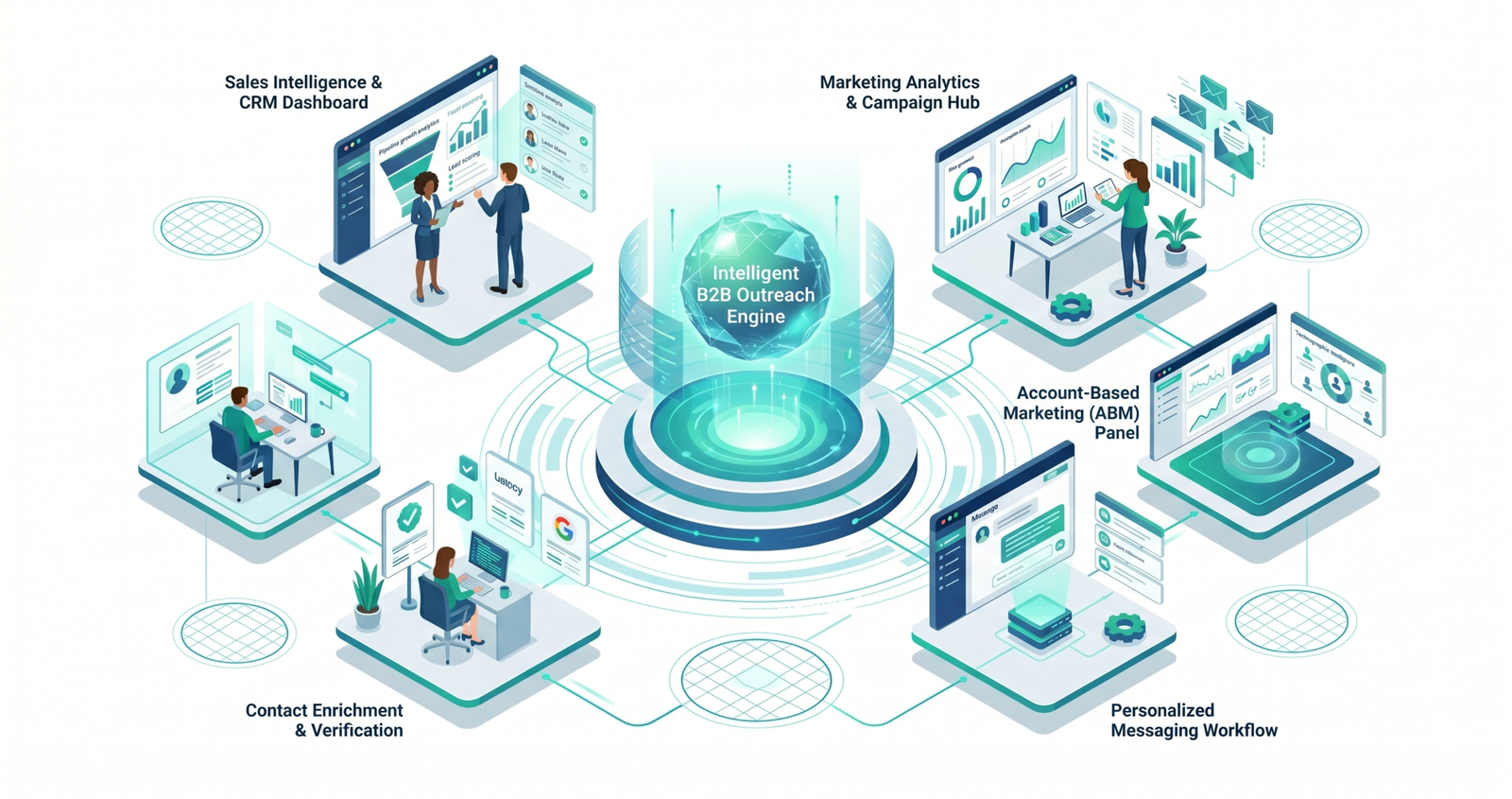
B2B outreach has become more competitive than ever. Buyers receive countless cold emails, LinkedIn messages, calls, and marketing campaigns every day. Generic outreach no longer delivers the same results because decision-makers expect relevance, timing, and value from the first interaction.
This is where quality B2B data becomes essential.
Strong B2B data helps businesses identify the right accounts, reach accurate decision-makers, personalize messaging, and improve overall campaign performance. Instead of wasting time contacting companies that are not a fit, sales and marketing teams can focus on prospects that align with their ideal customer profile.
Companies using accurate business data often see better engagement rates, lower bounce rates, stronger lead qualification, and more efficient outreach processes. Technographic and firmographic insights also help businesses understand how prospects operate, which makes conversations more relevant and valuable.
In this guide, we’ll explore how businesses can improve B2B outreach with quality B2B data and why data quality plays a major role in modern sales and marketing success.
What Makes B2B Data Important for Outreach?
B2B outreach depends heavily on accuracy and relevance. If your contact database contains outdated emails, incorrect job titles, or companies outside your target market, your campaigns will struggle from the beginning.
Quality B2B data helps businesses:
- Reach verified decision-makers
- Build accurate prospect lists
- Improve email deliverability
- Personalize outreach campaigns
- Reduce wasted sales effort
- Increase conversion opportunities
Modern B2B data goes beyond basic contact details. Businesses now use several data types to improve targeting:
Firmographic Data
Includes:
- Industry
- Revenue
- Company size
- Employee count
- Location
This helps businesses identify companies that match their ideal customer profile.
Technographic Data
Technographic data shows the software, platforms, and technologies companies currently use. This helps sales teams tailor messaging based on a prospect’s technology stack and business environment.
For example:
- A cybersecurity company may target businesses using older infrastructure
- A SaaS company may focus on organizations using competing tools
- A CRM provider may prioritize businesses already investing in sales automation
Contact Data
Verified:
- Email addresses
- Phone numbers
- Job titles
- Departments
- LinkedIn profiles
This ensures outreach reaches the correct people instead of generic inboxes.
High-quality B2B data allows businesses to shift from broad outreach to highly targeted campaigns that generate better engagement and stronger pipeline opportunities.
Start With the Right Target Accounts
One of the biggest outreach mistakes businesses make is targeting everyone instead of targeting the right companies.
Effective outreach starts with building focused target account lists.
Before launching campaigns, businesses should clearly define their Ideal Customer Profile (ICP). This includes identifying:
- Industries served
- Company size
- Geographic markets
- Revenue range
- Technology environment
- Business maturity
- Buying behavior
A clear ICP improves both sales efficiency and marketing performance.
For example, if a software company primarily serves mid-sized healthcare organizations in the United States, targeting small retail businesses would waste time and resources.
High-quality B2B databases help businesses segment accounts based on:
- Industry
- Employee size
- Annual revenue
- Technology usage
- Department structure
- Geographic region
This creates cleaner prospect lists and stronger campaign alignment.
Many businesses also use technographic data to improve targeting precision. Technographic insights allow teams to identify companies using relevant tools or platforms, making outreach more contextual and valuable.
For instance:
- A Salesforce consulting company may target organizations already using Salesforce
- A cloud migration provider may prioritize businesses using legacy infrastructure
- An AI software vendor may focus on companies actively investing in automation tools
Businesses that target well-qualified accounts often experience:
- Higher response rates
- Better sales conversations
- Shorter sales cycles
Improved ROI from outreach campaigns
Use Intent Data to Reach Buyers at the Right Time
Timing plays a major role in B2B outreach success.
Even highly relevant messaging can fail if the buyer is not actively researching solutions or planning changes.
Intent data helps businesses identify companies showing interest in specific topics, products, or services. This data is often collected through:
- Content consumption
- Research activity
- Search behavior
- Topic engagement
- Website visits
Intent signals help sales teams prioritize accounts that may already be in the buying process.
For example:
- A company researching CRM migration may be more likely to respond to CRM vendors
- Businesses consuming cybersecurity content may be evaluating new security solutions
- Organizations searching for cloud storage tools may be planning infrastructure upgrades
Intent data allows outreach teams to focus on buyers who are already demonstrating interest instead of relying entirely on cold prospecting.
This improves:
- Outreach timing
- Email engagement
- Meeting conversion rates
- Pipeline quality
Although some businesses use intent platforms directly, many combine intent signals with strong B2B databases and technographic insights to create more targeted outreach strategies.
The key advantage is relevance. Buyers are more likely to engage when outreach aligns with their current business priorities.
Want to Build High Quality B2B Data
Improve Engagement With Personalized Messaging
Personalization has become one of the most important elements of successful B2B outreach.
Decision-makers can quickly identify generic emails that lack relevance. Personalized outreach stands out because it addresses the prospect’s specific business environment, challenges, or goals.
Quality B2B data makes personalization much easier.
Instead of sending the same message to every company, businesses can tailor outreach based on:
- Industry
- Company size
- Technology usage
- Job role
- Geographic market
- Department responsibilities
For example, a marketing automation platform might send:
- Different messaging to healthcare companies versus SaaS companies
- Different pain points to marketing directors versus sales leaders
- Different solutions based on the technologies currently used by the prospect
Technographic data is especially useful for personalization because it helps sales teams understand a company’s existing software ecosystem.
This allows outreach to become more consultative instead of generic.
Businesses using personalization effectively often see:
- Higher open rates
- Better click-through rates
- Increased reply rates
- More meaningful conversations
Personalization also improves trust because prospects feel the outreach is relevant to their business needs.
However, personalization only works when the underlying data is accurate. Incorrect names, outdated job titles, or irrelevant messaging can damage credibility quickly.
That is why data quality remains critical throughout the outreach process.
Organize and Score Leads More Effectively
As outreach campaigns scale, managing leads becomes more difficult without proper organization.
Many businesses struggle because their CRM contains:
- Duplicate contacts
- Outdated records
- Unqualified leads
- Incomplete company information
Poor CRM organization creates confusion for both sales and marketing teams.
Quality B2B data helps businesses maintain cleaner systems and improve lead prioritization.
Lead scoring is one of the most effective ways to organize outreach efforts. Lead scoring assigns value to prospects based on characteristics and engagement signals.
Common scoring factors include:
- Company size
- Industry fit
- Technology usage
- Website engagement
- Email interactions
- Seniority level
- Geographic relevance
This helps sales teams focus on the highest-value opportunities first.
For example:
- A Director-level contact at a large enterprise may receive a higher score
- Companies already using complementary technologies may rank higher
- Businesses actively engaging with marketing content may become priority accounts
A well-structured CRM also improves:
- Sales forecasting
- Campaign reporting
- Pipeline management
- Team collaboration
Many businesses enrich CRM systems with external B2B data providers to improve accuracy and completeness.
For example, ContactMetrix provides B2B contact data, company insights, and technographic information that businesses can use to improve prospect targeting and CRM enrichment. Their datasets include verified business emails, company details, job titles, and technology-related insights for outreach and segmentation.
Accurate CRM data helps businesses make better decisions and improve outreach efficiency over time.
Business analytics teams use B2B data to analyse market trends and competitors’ strategies — informing decisions that improve sales performance and overall growth. One company conducted thorough research on its highest-value customers and found that 80% were mid-sized technology firms in the northeast. Using that technographic and firmographic insight they reallocated their sales territory and saw win rates improve within a single quarter.
Monitor Campaign Performance and Improve ROI
Successful outreach does not end after sending emails or launching campaigns.
Businesses need to continuously monitor performance and optimize their outreach strategies based on real data.
Important outreach metrics include:
- Open rates
- Reply rates
- Bounce rates
- Meeting bookings
- Conversion rates
- Pipeline contribution
- Revenue impact
Tracking these metrics helps businesses understand:
- Which industries respond best
- Which messaging performs strongest
- Which account segments convert faster
- Which channels generate the highest ROI
For example:
- High bounce rates may indicate poor data quality
- Low response rates may signal weak targeting
- Strong open rates but poor conversions may suggest messaging issues
Businesses should also test:
- Subject lines
- Call-to-actions
- Audience segments
- Personalization approaches
- Outreach timing
Data-driven optimization improves campaign performance over time.
Many high-performing sales organizations continuously refine their prospect lists, messaging strategies, and segmentation models based on campaign analytics.
This creates a feedback loop where outreach becomes more efficient with every campaign.
Key Challenges Businesses Face With Poor Data
Poor data quality creates major problems for B2B outreach teams.
Even strong sales strategies can fail when contact information is inaccurate or outdated.
Common problems caused by poor B2B data include:
High Bounce Rates
Invalid email addresses damage deliverability and sender reputation.
Low Engagement
Generic or inaccurate targeting reduces response rates.
Wasted Sales Effort
Sales teams spend time contacting companies that are not qualified buyers.
Poor CRM Performance
Duplicate records and incomplete profiles create reporting problems.
Weak Personalization
Outdated company information makes outreach less relevant.
Missed Revenue Opportunities
Businesses may fail to identify high-fit accounts because their data lacks depth or accuracy.
B2B data naturally decays over time because:
- Employees change jobs
- Companies grow or shrink
- Technology stacks evolve
- Businesses relocate
- New decision-makers emerge
That is why businesses must regularly:
- Clean databases
- Verify contacts
- Enrich records
- Remove outdated information
- Update segmentation models
Companies investing in ongoing data maintenance often achieve stronger outreach performance and more reliable pipeline growth.
Looking for Verified B2B Data
Final Thoughts
Improving B2B outreach requires more than strong messaging or aggressive prospecting. Success depends heavily on the quality of the data behind every campaign.
Businesses that invest in accurate B2B data can:
- Build stronger target account lists
- Reach the right decision-makers
- Personalize outreach effectively
- Improve CRM organization
- Increase campaign performance
- Generate better ROI
Modern outreach strategies increasingly rely on firmographic, technographic, and behavioral insights to create more relevant and timely engagement.
While intent data helps identify active buying interest, strong B2B and technographic data providers help businesses understand who their buyers are, how they operate, and which technologies they use. This creates a stronger foundation for targeted outreach and long-term sales growth.
As competition continues to increase across B2B industries, businesses that prioritize data quality will be better positioned to improve engagement, strengthen relationships, and drive more consistent pipeline results.
Businesses looking to strengthen their outreach strategy with verified B2B contact data and technographic insights can explore ContactMetrix for targeted business data solutions designed to support sales and marketing campaigns.
