
Imagine a startup called Company X with ambitious growth goals. Its sales and marketing teams invest significant time and effort into generating revenue. They experiment with different strategies to avoid wasting time on low-quality leads and reduce conflicts between sales and marketing.
However, they overlook one fundamental solution: lead scoring. Identifying which leads are most likely to generate revenue and which are unlikely to convert is the key to building an efficient sales process and maximizing revenue.
In this article, you will learn what lead scoring is, the top benefits of it, and how to build a lead scoring model from scratch.
What Is Lead Scoring?
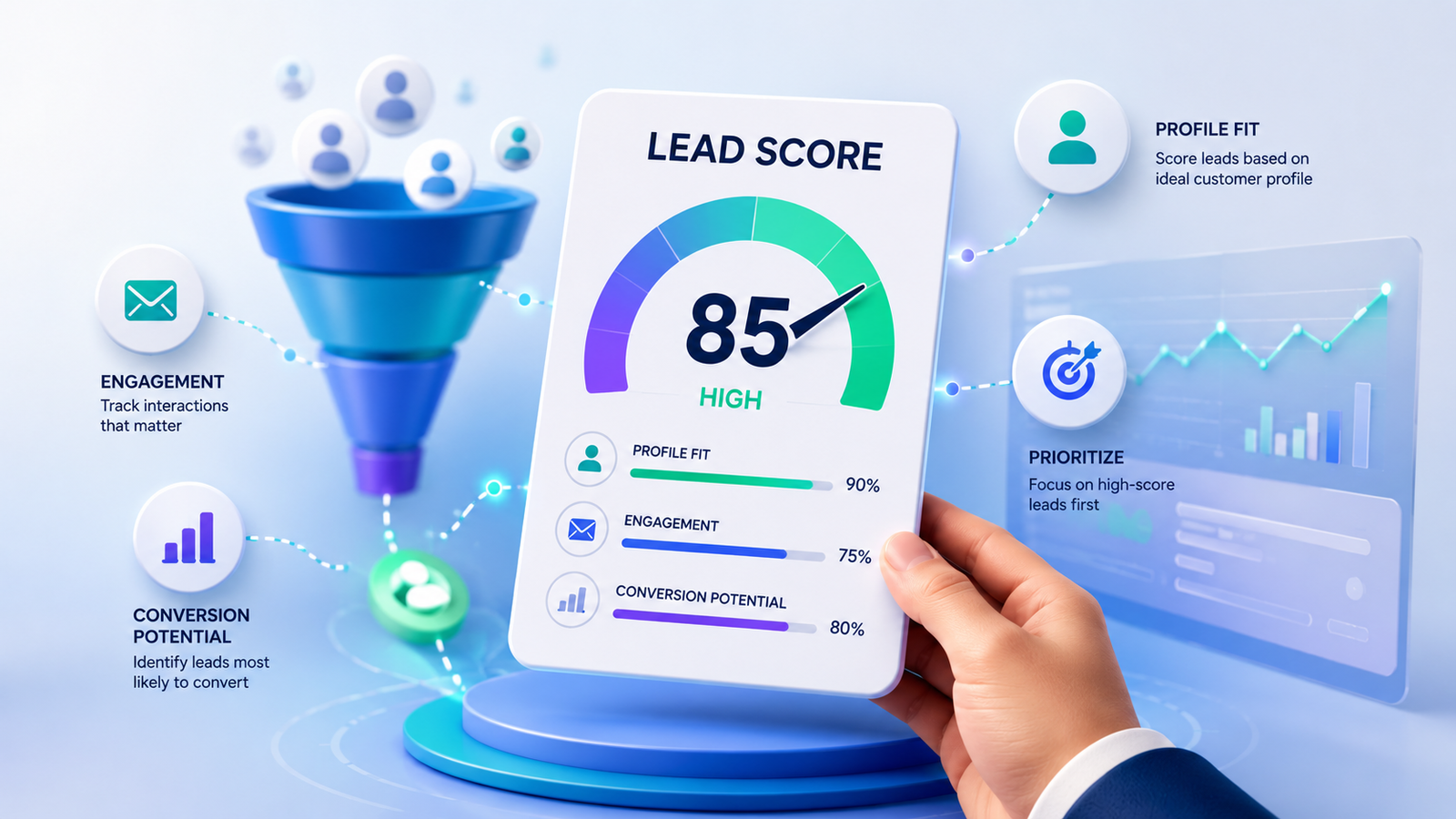
Lead scoring is a strategy used by sales and marketing teams to evaluate and rank prospects based on how well they match the Ideal Customer Profile and how quickly they progress through the sales funnel.
Lead scoring helps teams determine which leads deserve immediate attention, how much time and effort should be invested in each prospect, and which leads are most likely to convert into customers.
Different activities by a prospect are considered when giving scores. Website activity, downloading a guide, social media engagement, and opening a promotional email are all part of the lead scoring process.
A successful lead scoring model starts with alignment between sales and marketing teams.
4 Lead Scoring Benefits
1. Collaboration between sales and marketing teams
A small amount of interest shown by a prospect does not automatically qualify them as a lead. Unqualified leads only increase sales volume without improving conversion rates. When sales and marketing teams align on the lead scoring definition, the handoff from marketing to sales becomes smoother and more productive.
2. Check the effectiveness of marketing efforts
B2B lead scoring indicates which marketing strategies are working and which should be dropped. It gives marketing teams a clear signal about where their efforts are generating real pipeline.
3. Make the sales process smoother
When market-qualified leads are passed to the sales team, the ROI of the business is likely to surge. Sales representatives can work on the leads most likely to convert first rather than guessing where to focus.
4. Help in allocating marketing channel investment
A startup cannot afford a high marketing budget that does not contribute to lead generation. Lead scoring helps in identifying the right channels where the highest quality of leads can be generated.
What Are the Top Lead Scoring Criteria?
Lead scoring criteria are broadly categorized into two types. Explicit lead scoring criteria include firmographic and demographic data — they tell you what the lead is. Implicit lead scoring criteria include behavioral data — they tell you what the prospect has done.
A. Explicit Lead Scoring Criteria
Explicit leads are confirmed by information the lead provides directly. Common explicit data points include:
- Company size and industry
- Annual revenue
- Job title
- Technology stack
- Geography
- Role of primary contact
B. Implicit Lead Scoring Criteria
Implicit lead scoring signals are taken from the online behavior of prospects. Key behavioral signals include:
- Pricing page visits
- Email clicks
- Content downloads such as reports, playbooks, guides, and case studies
- Webinar registrations
- Form submissions with key information
B2B Lead Scoring Criteria Example
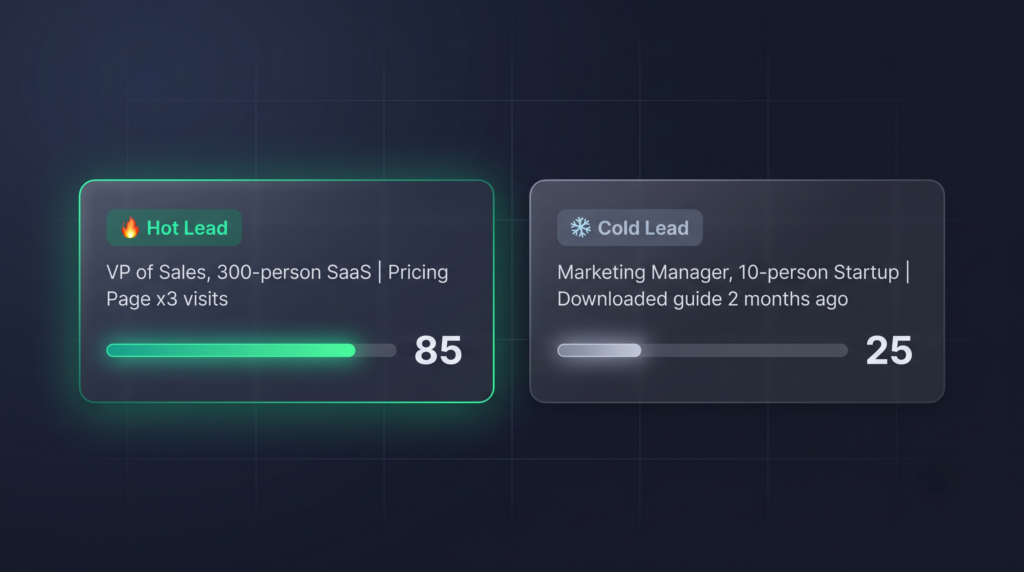
Consider a prospect who is a VP of Sales at a 300-person SaaS company — a strong firmographic fit — and has visited the pricing page three times in the last week. These attributes place them well ahead of a marketing manager at a 10-person startup who downloaded one piece of content a few months ago. The first prospect scores significantly higher on both explicit and implicit lead scoring criteria.
How to Build a Lead Scoring Model From Scratch
Step 1: Define your Ideal Customer Profile
Before assigning any score, identify your Ideal Customer Profile. Which industry are they from? What is their company size? Which geographic location are they based in? This sets the foundation of firmographic lead scoring and ensures every scoring decision is filtered through a clear definition of your best-fit customer.
Step 2: Identify your scoring attributes
Review the source of your leads. Understand how leads are being generated and whether they come from explicit lead scoring attributes or implicit B2B lead scoring signals. Identifying patterns in your existing data will help determine which attributes deserve higher scoring weight.
Step 3: Assign point values and set a threshold
Give more points to behaviors associated with closed deals or near-closed deals. Each behavior, whether explicit or implicit, should not receive the same score. A demo request deserves the highest point value, whereas a passive action like opening an email warrants a lower score.
Decide at what total score a lead becomes sales-ready and set the MQL threshold based on the average score for successful conversions. Sales and marketing teams must agree on this number together.
Step 4: Test and review your lead scoring model
Before fully deploying the model, test it against data from the last 90 days. Check whether the leads your model identifies as Marketing Qualified Leads are the same leads that actually became customers. If the results do not match, adjust the scores and weights to improve accuracy.
Lead scoring is not a one-time task. It needs to be reviewed every few months because as the business expands, the original scoring criteria can become inaccurate over time.
Why Do Most B2B Lead Scoring Models Fail?
1. Building the foundation on bad data
If a lead scoring model is built on inaccurate data, the model will collapse. A high lead score carries no real value when it is weighted with incorrect information — missing job titles, outdated company sizes, and invalid email addresses. In simple terms, data decay has occurred and the model is scoring a version of the prospect that no longer exists.
2. No clear ICP
Most teams build scoring models before defining what a good customer actually looks like. The result is a model that rewards engagement without filtering for fit. Scoring without a defined Ideal Customer Profile produces high-scoring leads that sales teams reject.
3. Scoring activity instead of intent
A prospect who downloaded a free guide two months ago is not the same as a prospect actively comparing solutions today. Intent data tells you which leads are in the market right now — and that distinction matters more than historical activity alone.
Predictive Lead Scoring vs Traditional Lead Scoring
Traditional Lead Scoring
Traditional lead scoring, also called manual lead scoring, is built on predefined rules. Rules are set around actions and characteristics. For example, a lead might earn a strong score if their title is VP of a company and they recently visited the sales page three times. When these signals combine to meet the predefined threshold, the lead is qualified for the sales team. Traditional lead scoring works well for smaller organizations with a manageable volume of leads.
Predictive Lead Scoring
Predictive lead scoring removes the manual scoring system and human judgment from the process. It is powered by AI and machine learning. The model is trained on data from both successful and unsuccessful leads and then analyses hundreds to thousands of signals to identify which leads are most likely to convert. Predictive lead scoring works best for organizations with a large contact database and the historical data needed to train the model accurately.
Which lead scoring is better, Predictive Lead Scoring or Traditional Lead Scoring?
Predictive lead scoring is generally more accurate, adaptive, and effective at identifying your best customers, but traditional lead scoring is often the smarter choice for smaller teams or businesses that lack the massive, clean datasets and technical investment that predictive models demand. Predictive wins on performance, while traditional wins on accessibility and simplicity.
Ultimately, the right choice depends entirely on your business’s size and data volume.
Conclusion
Company X’s problem was not their strategy. It was the foundation their strategy was built on.
Lead scoring gives sales and marketing teams a shared language for what a good lead looks like. But that shared language only works when three things are in place: the data behind the model is accurate, the Ideal Customer Profile is clearly defined, and the scores are reviewed and updated regularly. Without those three pillars, even the most carefully designed lead scoring criteria will produce results that sales teams do not trust.
A lead scoring model is only as reliable as the data feeding it. Outdated contacts, missing firmographic attributes, and decaying records do not just reduce the accuracy of your scores — they undermine the entire alignment between sales and marketing that lead scoring is supposed to create.
Frequently Asked Questions
1. What is lead scoring?
Lead scoring is a method used by sales and marketing teams to rank prospects based on explicit attributes such as job title, company size, and industry, and implicit attributes such as website behavior and content engagement. It tells teams which prospects are most likely to become customers so they can prioritize their time and effort accordingly.
2. What is an example of lead scoring?
A VP of Sales at a 300-person SaaS company who has visited your pricing page three times in the past week would score highly on both explicit lead scoring criteria — strong firmographic fit — and implicit criteria — active buying behavior. A marketing manager at a 10-person startup who downloaded one piece of content months ago would score significantly lower. The gap between those two scores tells your sales team exactly where to focus first.
3. What are three common lead scoring methodologies?
The three common lead scoring methodologies are explicit lead scoring, which uses firmographic and demographic data; implicit lead scoring, which uses behavioral signals; and predictive lead scoring, which uses AI and machine learning to analyze patterns across hundreds of signals simultaneously.
4. What is the benefit of predictive lead scoring?
Predictive lead scoring delivers better accuracy than manual methods because it removes human judgment from the process and learns continuously from both successful and unsuccessful lead data. It saves sales teams time and can process large volumes of data points every month — making it particularly effective for organizations with a large and growing contact database.
5. What is lead scoring in CRM?
Lead scoring in CRM means the system automatically qualifies leads based on predefined scoring criteria. When a lead completes a specific action or reaches a certain score, the CRM updates the record automatically. When the score crosses the agreed threshold, the lead is flagged for the sales team without any manual intervention.
The key requirement is that the contact data in the CRM is accurate, complete, and regularly refreshed. A lead scoring system in a CRM is only as reliable as the records it is reading from.
