

Identifying potential customers is the fundamental principle of any business. This is especially true when an organization wants to build a strong market position, establish brand value, and generate consistent revenue. The strategy that makes this possible is built around sales qualified leads.
In this guide, you will learn what a sales qualified lead is, how to qualify sales leads using proven frameworks, and how to increase the volume of SQLs your team receives.
What Are Sales Qualified Leads?
Sales qualified leads are prospects who have met certain lead qualification criteria and have a high chance of converting into customers. They have moved beyond the initial engagement stage and are actively considering a product or service.
Not every sales qualified lead will convert, but the conversion rate for SQLs is significantly higher than for general qualified leads. If your CRM is filled with sales qualified leads, your sales representatives have a much stronger foundation to work from when generating revenue.
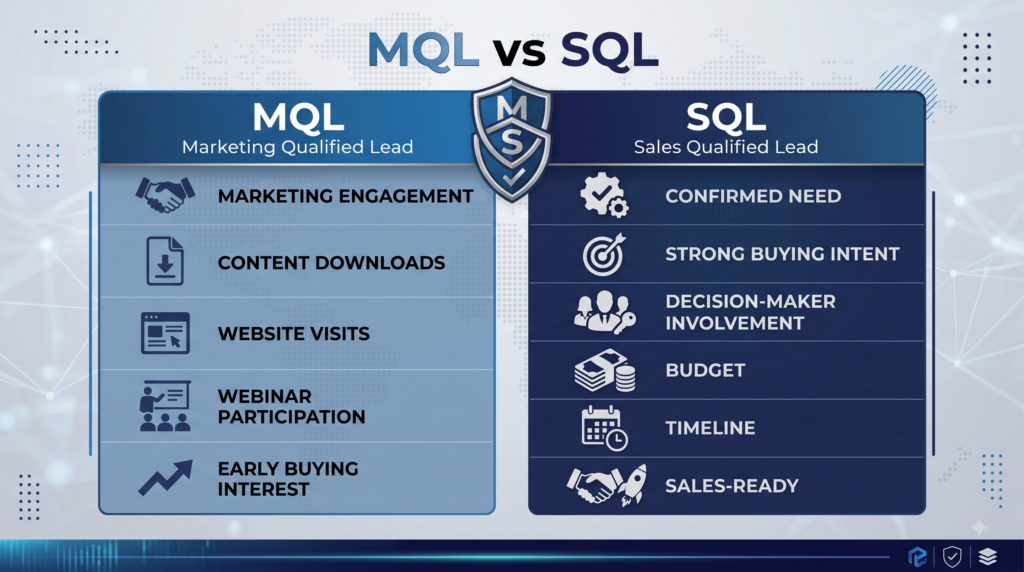
To qualify any lead as a sales qualified lead, it must exhibit certain behaviors and genuine engagement with your business. Common examples include downloading a product case study, visiting pricing pages multiple times a week, or attending webinars and industry events. These interactions signal a real interest in exploring what the business can offer.
SQL vs MQL vs SAL: The Lead Progression Explained
Marketing Qualified Leads (MQLs)
Marketing qualified leads show an initial stage of interest in products and services. They need further nurturing to progress through the sales funnel. At this stage, lead ownership belongs to the marketing team.
Sales Accepted Leads (SALs)
Sales accepted leads are handoff-stage leads that the marketing team passes to the sales team. The sales team reviews them against certain criteria — commonly company size, budget, and decision-making ability — before formally accepting them. This stage exists to improve overall lead quality and prevent misaligned leads from entering the sales pipeline.
Sales Qualified Leads (SQLs)
At this stage, prospects have already moved through multiple layers of engagement. They are ready to discuss pricing, request a demo, or explore specific solutions. These are the hot leads, and ownership belongs fully to the sales team.
Need Verified B2B Data to Generate SQL for Sales Teams?
The BANT Framework: How to Qualify a Sales Lead
The BANT framework is one of the most widely used lead qualification strategies in B2B sales, and it stands out for its simplicity and high success rates. With BANT, you can quickly assess how well a prospect fits your business and how ready they are to buy.
1. Budget
Does the prospect have sufficient budget to purchase the product or service? If the budget is tight, are the decision-makers willing and able to allocate funds from other sources if necessary? Budget conversations should happen early rather than at the end of the qualification process.
2. Authority
Is the person you are speaking with authorized to make purchasing decisions? In enterprise organizations, buying authority rarely sits with one individual. Identifying the full decision-making committee early prevents wasted time on conversations that stall at the approval stage.
3. Need
Does the prospect have a genuine business problem that your solution can solve? This is one of the most critical factors in the BANT framework. A prospect without a real need will not convert regardless of budget or authority.
4. Timeline
How soon is the prospect likely to make a purchasing decision? An indefinite or vague timeline significantly reduces the chance of near-term conversion. When no urgency exists, the sales representative’s role is to surface the business impact of delaying the decision.
How to Qualify Sales Leads
1. Define your lead qualification criteria
Before engaging with a single lead, define exactly what qualifies them as worth pursuing. Ask three questions:
- Does this lead match your Ideal Customer Profile?
- Can your product or service solve their specific problem?
- What is the business potential of this account?
2. Ask structured qualifying questions
Ask relevant, targeted questions to understand the lead’s real challenges. Start with budget — a lead without budget cannot move forward regardless of interest. Then identify the decision-maker and understand whether the lead is actively comparing solutions or simply exploring the market without real intent. A well-structured question always delivers more useful information than a generic one.
3. Identify buying signals
High-quality leads consistently show buying signals. Learning to recognize them separates productive conversations from wasted ones. Common buying signals include:
- Specific questions about ROI, features, and measurable outcomes
- Requests for a product demo
- Asking for pricing details or a free sample
- Repeated visits to high-intent pages such as pricing or case study pages
4. Disqualify low-fit leads early
Ten leads that convert are worth more than one hundred leads that go nowhere. Filtering out bad leads removes friction from the sales pipeline and frees up your team to focus on genuine opportunities.
Common disqualifiers to watch for:
- Insufficient budget or no budget at all
- No decision-makers involved in the conversation
- An indefinite timeline with no clear business driver behind it
How to Use Intent Data to Identify Sales Qualified Leads
Intent data captures the online research behavior of prospects — what content they are consuming, what topics they are searching for, and what review platforms they are visiting. When these behavioral signals align with a prospect that already matches your Ideal Customer Profile, you have a sales qualified lead before they have ever filled out a form or responded to an outreach email.
Three intent signals that indicate a prospect is approaching sales readiness:
- Multiple visits to pricing or vendor comparison pages within a short window
- Downloads of bottom-of-funnel content such as case studies and ROI calculators
- Activity on platforms like G2 or Capterra where they are actively comparing vendors in your category
Using intent data to identify in-market prospects allows your sales team to prioritize outreach at the moment when conversion chances are highest.
How to Increase Sales Qualified Leads
1. Tighten your ICP definition
A broad ICP produces high lead volume with low SQL conversion. A precise ICP produces fewer leads but a significantly higher proportion of sales qualified leads that your team can actually close.
2. Improve your content for bottom-of-funnel intent
Pricing pages, comparison pages, and case studies attract prospects who are further along the buying journey. These visitors are closer to becoming sales qualified leads than those engaging with top-of-funnel educational content.
3. Use verified B2B contact data for outbound
Outbound campaigns built on verified, accurate contact data consistently produce higher SQL rates than those built on generic or outdated lists. Accurate firmographic filtering ensures outreach reaches accounts that match your SQL criteria from the start.
4. Align sales and marketing on the SQL definition
When sales and marketing use different definitions of what a sales qualified lead looks like, leads arrive at the wrong stage or fall through the gap entirely. A shared, documented SQL definition reduces friction and increases the quality of every lead passed from marketing to sales.
Want to Check B2B Data Quality?
Conclusion
Sales qualified leads are not just a pipeline metric. They are the output of a clearly defined Ideal Customer Profile, clean and accurate contact data, a consistent qualification process, and the right intent signals all working together.
When any one of those inputs is weak — an unclear ICP, outdated contact records, or no behavioral data — the quality of your sales qualified leads drops and your sales team pays the price in wasted time and missed targets.
Generating more SQLs starts with knowing exactly who you are looking for and making sure the data feeding your qualification process is accurate enough to find them. ContactMetrix provides verified B2B contact data that gives your qualification process the accurate foundation it needs to identify and convert the right leads.
Frequently Asked Questions
1. What is a sales qualified lead?
A sales qualified lead is a prospect who has passed certain qualification criteria and is ready for a direct sales conversation. They have shown genuine buying intent through specific actions — such as requesting a demo, visiting pricing pages, or downloading bottom-of-funnel content — and they meet the budget, authority, need, and timeline criteria your sales team has defined as a good fit.
2. What are sales qualified leads in B2B?
In a B2B context, sales qualified leads are prospects from organizations that match your Ideal Customer Profile and have demonstrated intent to buy. They have moved beyond general marketing engagement and are actively evaluating solutions.
3. How do you qualify a sales lead?
The most common method is the BANT framework — Budget, Authority, Need, and Timeline. It checks whether the prospect has the funds, the decision-making authority, a genuine business problem your solution addresses, and a realistic timeline for purchasing.
4. What is the BANT framework in sales?
BANT stands for Budget, Authority, Need, and Timeline. Budget checks whether the prospect has the funds to make a purchase. Authority confirms you are speaking with someone who can make or influence the buying decision. Need establishes whether there is a real business problem your product solves. Timeline assesses how soon the prospect is likely to act. Together these four factors determine whether a lead is worth your sales team’s time and effort.
5. How do you use intent data to identify sales qualified leads?
Intent data tracks a prospect’s online research behavior — the topics they search for, the content they consume, and the review platforms they visit. When these behavioral signals align with a prospect that already matches your ICP, they become a sales qualified lead before they have ever contacted you directly.
6. What buying signals indicate a sales qualified lead?
The strongest buying signals are specific questions about ROI and measurable outcomes, requests for a product demo or free trial, repeated visits to pricing or comparison pages, and direct inquiries about contract terms or implementation timelines.
