
Marketing teams argue they are generating highly qualified leads. Sales teams are not convinced. This mismatch arises from one misunderstood term: marketing-qualified leads.
Not every website visitor is ready to become a customer. Some are just browsing, while others are actively searching for a solution. Some are looking to download an e-book or a recent report, so how do businesses tell the difference?The answer is, again, Marketing Qualified Leads(MQLs) People who show real signs they’re ready to buy. But what exactly makes someone an MQL?
In this guide, you will learn about what separates a true MQL from a casual browser, how to score them correctly, and why your industry determines what qualified means.
What Is a Marketing Qualified Lead (MQL)?
MQL means Marketing Qualified Lead. It’s a person or an organization that has shown interest in a product or service by engaging with a company’s marketing content—downloading a guide, subscribing to emails, filling out a form, or visiting key web pages.
Marketing Qualified Lead status is a qualification checkpoint the marketing team uses before handing a lead over to sales. Once someone earns that status, marketing builds personalized campaigns to guide them further through the funnel. The qualification process usually relies on publicly available information, including the lead’s email domain and whatever details they share when contacting the company.
Not everyone who visits your website or searches for your products is a potential customer; signing up for a newsletter alone doesn’t make someone a future potential customer. It has some criteria that need to be fulfilled.
What Makes Someone a Potential Customer through marketing qualified lead
While many resources describe what makes someone (a potential customer) eligible to go through a Marketing Qualified Lead (MQL) in generic terms, the reality is that every industry has its own qualification signals. SaaS companies, eCommerce businesses, and B2B service providers measure leads differently based on their customer journey. Here’s what those differences look like.
For SaaS Companies: SaaS buyers usually research on their own before they ever talk to sales, so most signals show up as digital behavior rather than a single form fill.
- Repeat pricing page visits: If a person checks your pricing page more than once, that means they are probably thinking about the cost, not just browsing.
- Signing up for a free trial: If a person signs up for a free trial, that means they are not only signing up for a trial, but also using the core features to find out if it works for them. .
- Content engagement journey: When a person moves from the about page to the pricing page, it shows they are getting closer to making a purchase. This progression is a far more meaningful indicator than downloading a single piece of content.
- Requesting a demo: If a person requests a demo, that is one of the clearest buying signals.
For eCommerce Businesses: – Ecommerce buyers usually don’t spend as long researching as SaaS or B2B purchasing. Instead, their interest is revealed through small actions that indicate they’re getting ready to buy
- Adding items to a cart: Leaving items in the cart without completing the purchase is one of the strongest eCommerce buying signals. That’s why abandoned cart emails are among the most effective ways to recover potential customers.
- Signing up for restock alerts: If someone signs up for restock alerts, that means they want to know when the item is back in stock; they were already close to buying.
- Returning through a retargeting ad: If a person visits an e-commerce website once, then leaves the website, and then visits it again a few days later through a retargeting ad, it is a strong indication that a shopper is genuinely interested in buying, rather than just browsing.
- Wishlisting the product: If a person visits an e-commerce website and adds products to their Wishlist or likes them, it signals buying interest.
For B2B Service Businesses: – B2B service providers, including agencies, consultants, and done-for-you businesses, often have longer sales cycles and multiple decision-makers. That’s why marketers focus more on direct signs of interest instead of passive website visits when identifying qualified leads.
- Booking an initial consultation: Just like a customer requests a demo in ecommerce, a service-based business uses a discovery call. If a person books a discovery call, it means they have a strong buying interest and are more likely to become a customer.
- Downloading a case study or white paper: If a person downloads a case study or white paper, they’re likely to become a customer.
- Engaging directly on LinkedIn: When a prospect replies to an outreach email or comments on your social media posts, they’re showing genuine interest. These social signals can be just as important as website interactions when identifying qualified leads.
- Multiple people from the same company visiting your site: When more than one person from the same company visits your site, it usually means a buying group is making a decision, which is common in longer B2B sales cycles.
Marketing Lead Qualification: How the Process Works
The challenge for any business is figuring out which potential customers have a higher chance of conversion, and that’s exactly what marketing lead qualification is all about.
- Keep sales and marketing aligned: Before you can identify qualified leads, the marketing and sales teams need to agree on what makes a good lead. If they don’t, marketing may send leads that sales don’t find useful, and those leads could be ignored. That’s why the first step is to work together and clearly define what a qualified lead looks like.
- Identify your buying signals: Next, identify the factors that indicate a lead is genuinely interested. These can include details such as their job title and company size, along with actions like downloading a guide, requesting a demo, or visiting your pricing page multiple times.
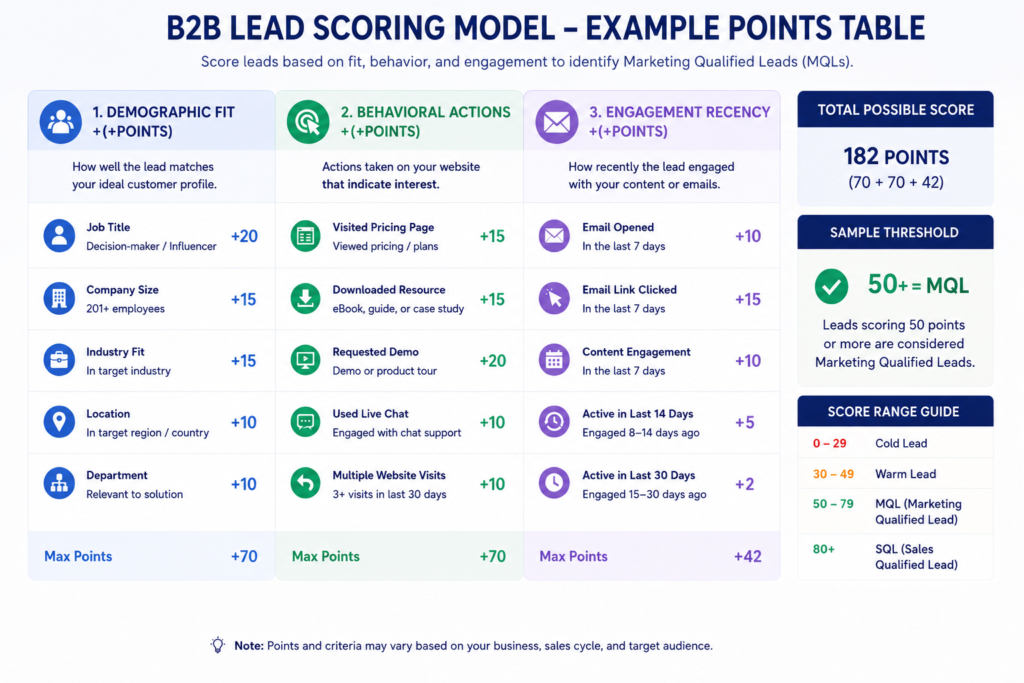
- Rank your leads: Once you’ve identified your buying signals, assign a score to each one based on its importance. For example, a lead who requests a demo should receive a higher score than someone who only reads a blog post. This process, known as lead scoring, helps you prioritize high-quality leads instead of treating every lead the same.
- Set a cutoff score: Next, decide the minimum score a lead must get to be considered qualified. For example, you may decide that any lead with a score of 50 or higher is ready to be passed to the sales team. This score becomes your qualification requirement.
- Hand the lead over to sales: Once a lead reaches a score high enough to qualify, the marketing team passes it to the sales team. They also share important details, such as the actions the lead took to earn that score. This process is usually managed through a Service Level Agreement (SLA), which is a simple agreement between the marketing and sales teams about when and how qualified leads should be handed over.
Marketing Qualified Lead Scoring Model
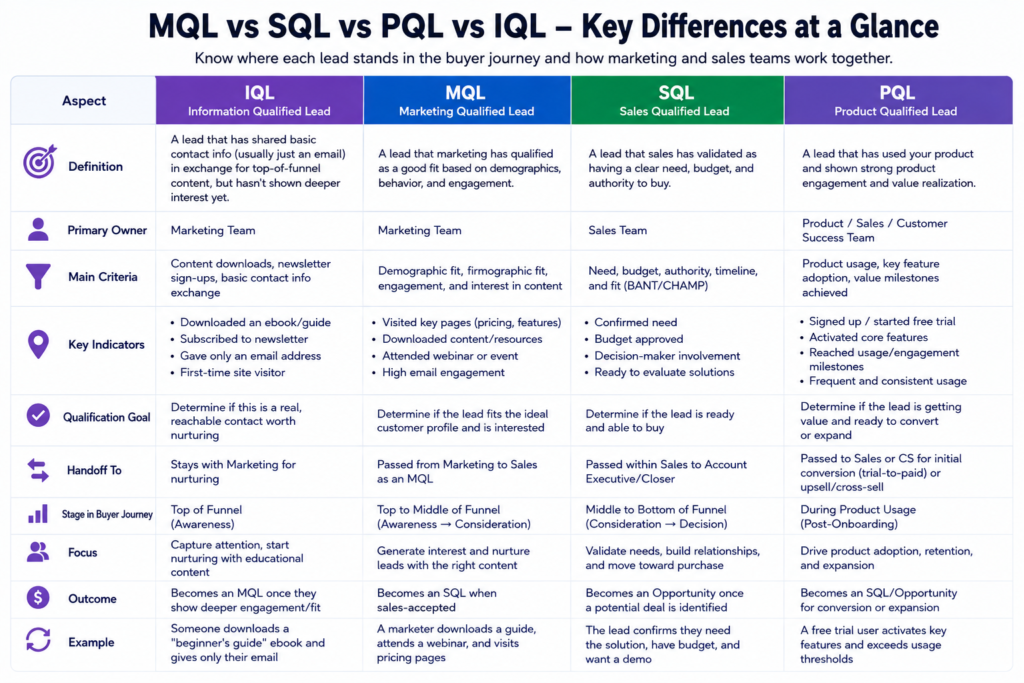
MQL vs SQL vs PQL vs IQL
Looking for Accurate B2B Data Tailored to Your Ideal Customer Profile?
How to Calculate Your MQL to SQL Conversion Rate
Here is the formula: – MQL to SQL Conversion Rate = (Number of SQLs ÷ Number of MQLs) × 100
Let’s say your marketing team generated 500 Marketing Qualified Leads (MQLs) during Q2, and the sales team accepted 90 of them as Sales Qualified Leads (SQLs).
(90 ÷ 500) × 100 = 18%
This means that out of every 100 leads passed from marketing to sales, only 18 were considered genuine sales opportunities. The remaining 82 leads may not have matched your ideal customer criteria or shown enough buying intent; this gap often reveals where the biggest leaks in your sales funnel happen, yet many businesses never measure it.
When calculating the conversion rate, timing is very important. If an MQL usually takes 60-90 days to become an SQL, comparing this month’s MQL with this month’s won’t give you an accurate result.
MQL Benchmarks and Stats: What the Data Reveals
If you are setting marketing qualified leads targets based on gut feeling, you are probably setting them wrong. Here is what the data actually shows.
According to First Page Sage’s sales funnel benchmark research, not every industry converts MQLs into SQLs at the same rate. Built on nearly ten years of client data, shows significant differences between industries. B2B SaaS companies convert about 38% of their MQLs into SQLs, while eCommerce businesses reach 58%. Pharmaceutical companies average 56%, and legal services come in lower at around 35%.
The lead-to-MQL conversion rate can reveal how effective your marketing is at attracting the right audience. Higher education and solar companies convert about 45% of their leads into MQLs, while construction and IT managed service providers typically convert only 17% to 19%. One of the biggest reasons for this difference is the quality of top-of-funnel content, which helps attract serious prospects and filter out casual browsers before they fill out a form.
One pattern worth calling out for your readers: the lowest conversion rate in most funnels sits right at the lead-to-MQL stage. That is actually the healthy part of the system doing its job. It is the point where unqualified traffic gets weeded out before it wastes a sales rep’s time, so a low number here is not automatically bad news.
Separately, channel-level research from B2B SaaS marketing agency Growth Spree points to something worth digging into if your MQL-to-SQL number feels stuck. Their data shows organic search and email nurture leads convert at the highest rates (over 45%), while cold paid social sits well below 20%. The takeaway is not that paid social is useless; it is that a blended MQL-to-SQL rate can hide which channel is actually dragging your average down.
If you want a broader gut check beyond SaaS specifically, financial services convert leads to MQLs at 29% and MQLs to SQLs at 38%, a decent middle-of-the-road benchmark if your industry is not called out by name anywhere else.
The bigger takeaway for readers: benchmarks are useful for a sanity check, not for setting rigid targets. If your MQL-to-SQL rate sits at 25% and you are in B2B SaaS, you are not failing; you are just below average, and that is a signal to look at your lead-scoring criteria before you touch your ad spend.
Sources: First Page Sage, Sales Funnel Conversion Rate Benchmarks Report; GrowthSpree, MQL to SQL Conversion Rate Benchmarks for B2B SaaS.
Common Marketing Qualified Lead Mistakes to Avoid
Most companies don’t have an marketing qualified leads problem. They have an marketing qualified leads definition problem, and it shows up in five ways.
Chasing volume over quality
When marketing focuses only on generating more marketing qualified leads, it’s easy to fill the pipeline with low-quality leads. As a result, the sales team may begin to ignore many of them. A high marketing qualified leads count may look impressive in reports, but it has little value if most of those leads aren’t genuinely interested in buying.
No agreement between sales and marketing on what actually counts
This is one of the biggest mistakes, and it often leads to many other problems. Marketing usually considers a lead as an marketing qualified leads based on engagement, such as downloading a guide or visiting the pricing page several times. However, this is not enough for the sales team. Sales wants to know if the lead has a confirmed budget and a clear timeline to buy before reaching out. When marketing and sales use different definitions of an MQL, misunderstandings happen. Marketing thinks sales is not following up, while sales believe marketing is sending poor-quality leads. In reality, both teams are looking at different signals, so each has its own reasons.
Scoring on Demographics or Firmographics alone
A person’s job title and company size can help you determine whether they’re a good fit, but they don’t guarantee buying intent. If you qualify leads based only on these details, without considering their behavior or level of interest, they’re less likely to convert once they reach the sales team.
Ignoring lead recency and decay
A lead that downloaded a whitepaper eight months ago is not the same today. People’s interests change, budgets also shift, and the person who requested a demo earlier may have already bought from a competitor. Not all marketing qualified leads deserve the same level of attention. If you ignore when a lead last engaged with your business, your sales team may spend valuable time following up with people who are no longer interested.
Letting follow-up speed slide
Even a well-qualified lead can get out of hand if nobody reaches out quickly. Competitors who respond first tend to win the deal, regardless of whose product is actually better.
Working from disconnected data
If your CRM and marketing platform don’t work together, both teams miss valuable insights. Sales lacks visibility into a person’s previous interactions, while marketing can’t track what happens after the lead reaches sales. This disconnect often leads to missed opportunities.
Best Practices to Improve Your MQL Strategy
Generating more marketing qualified leads is easy. The real challenge is attracting qualified leads that are ready to convert. Here are a few strategies that can help.
Build Your Strategy Around a Clear Ideal Customer Profile
A broad targeting strategy can bring in leads that appear to be a good fit but have no real interest in buying. Instead of relying only on industry and company size, consider additional factors like tech stack, hiring trends, and recent buying signals.
Score Leads Based on Both Fit and Buying Intent
Demographic information can tell you whether a lead fits your ideal customer profile, but it doesn’t show whether they’re ready to buy. To identify high-quality leads, combine firmographic data with behavioral signals such as pricing page visits, demo requests, and repeated engagement.
Respond to Leads as Quickly as Possible
Quick follow-up can make a big difference in lead conversion. If a qualified lead waits too long for a response, their interest may fade. Automate your lead routing so qualified leads are assigned to the right sales representative within minutes of meeting your qualification criteria.
Keep your data current:
Contact and company data can become outdated quickly. Within a few months, a significant portion of your database may no longer be accurate. When that happens, even the best targeting strategy can end up reaching the wrong people.
Want B2B Data That Matches Your Ideal Customer Profile?
Conclusion
An marketing qualified leads is someone who has demonstrated genuine interest and is more likely to move forward with the right communication. When you establish clear qualification criteria, monitor the right engagement signals, and refine your process over time, both marketing and sales can focus on the leads most likely to become customers.
Conversion happens when you define and score the leads. ContactMetrix streamlines the entire marketing qualified leads identification process with verified, fresh data. So, your sales team only receives high-intent leads that are ready to convert.
Frequently Asked Questions
1. What does MQL mean in marketing?
MQL stands for Marketing Qualified Lead — a potential customer who shows real interest in a business through actions like filling out a form, downloading a guide, or subscribing to emails.
2. What is a good MQL score?
A good MQL score typically falls between 60 and 75 points on a standard 100-point scale.
3. Is an MQL the same as a lead?
No. A “lead” is anyone who has given you their contact information in any way – filling out a form, signing up for a newsletter, or attending a webinar – regardless of how interested they actually are. An MQL is a specific subset of leads who have shown behaviour indicating real buying intent, such as visiting the pricing page multiple times or requesting a demo. In short, every MQL is a lead, but not every lead is an MQL.
4. How many MQLs does it take to close one customer?
There’s no universal number – it depends on your MQL to SQL and SQL to customer conversion rates. If your MQL to SQL rate is 18% and your SQL to close rate is 25%, you’d need roughly 22 MQLs to close one customer. Use the formula above with your own numbers rather than a generic industry average.
5. Who owns MQL criteria — marketing or sales?
The marketing team is responsible for defining and managing the Marketing Qualified Lead criteria. However, these criteria should be developed together with the sales team to ensure the leads passed on are genuinely qualified.
