
Take the example of Company X. The sales team collects high-scoring leads from the marketing team, but the results are not what they expect. Many of the contacts left the company a long time ago. A few contacts are from competitors doing research. The company budget is too low to afford the products.
The actual problem is not the scoring model. It is what the scoring model measures.
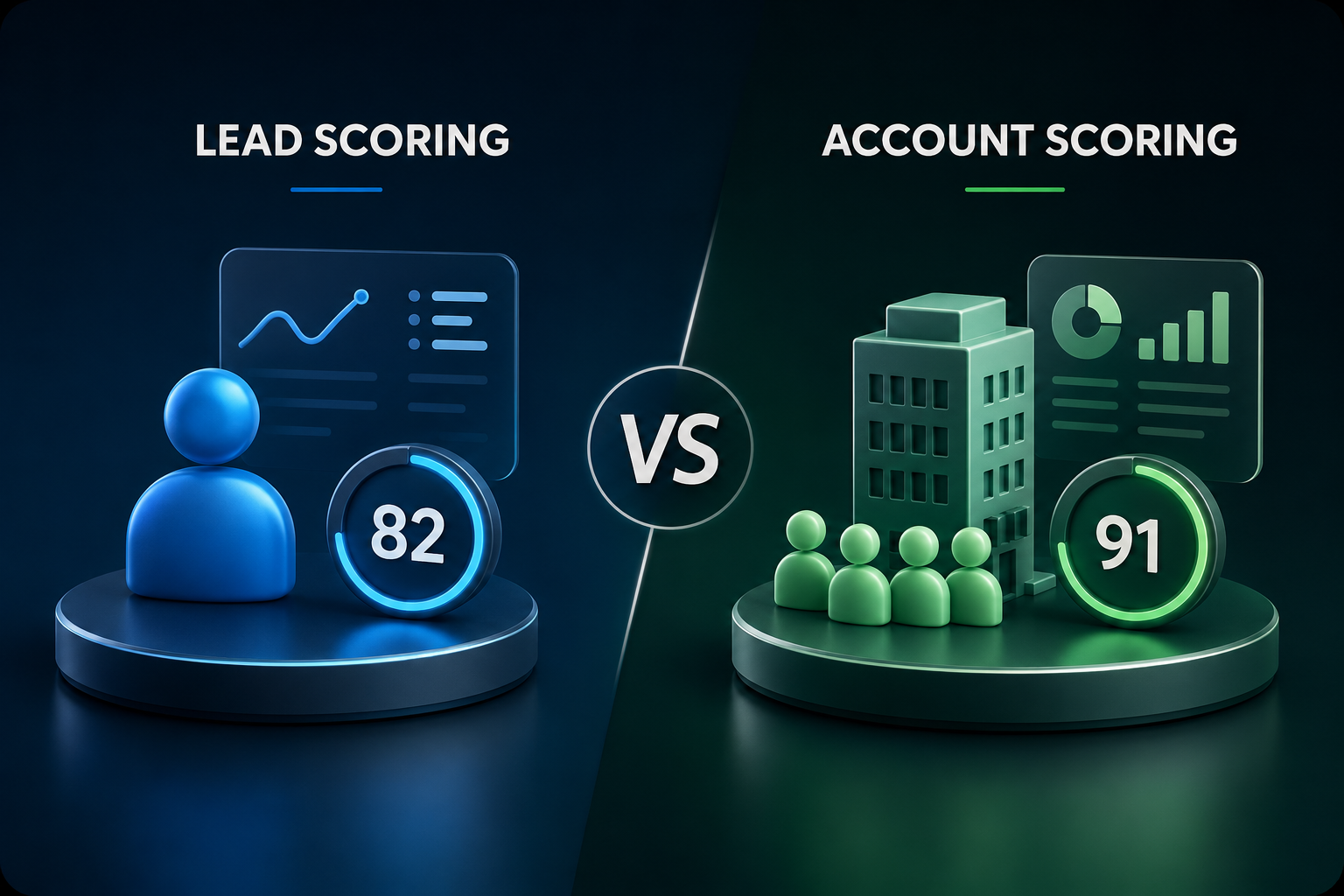
This is the core tension behind the lead scoring vs account scoring debate. Both models exist to help sales teams prioritize their time, but they measure fundamentally different things and work best in different situations. Understanding which approach, or which combination, matches your actual sales motion is what determines whether your pipeline reflects reality or just looks good in a dashboard.
What Is Lead Scoring?
Lead scoring evaluates leads using behavior, recent activities, characteristics, and engagement. It helps sales teams focus on the right leads and nurture the right number as needed.
Lead scoring measures how interested a contact is in your products and services. It gives a systematic score to each lead, typically ranging from 1 to 100.
What Is Account Scoring?
Account scoring is the process of evaluating whether an organization fits the ICP and shows meaningful engagement. This method ranks an entire company rather than individual leads.
Account scoring is particularly suitable for B2B businesses with long sales cycles and multiple decision-makers involved in the buying process.
Lead Scoring vs Account Scoring: The Key Differences
1. Unit of measurement
Lead scoring evaluates individual contacts. It measures one person’s activity. Account scoring ranks the entire company and its decision-makers. In B2B, the unit of measurement directly shapes the sales process and determines whether the team is chasing the right signal.
2. Buying group visibility
Lead scoring focuses on one contact out of ten potentially involved in the decision. Account scoring tracks every contact at a company and everything they do, then turns it all into a single score for that organization.
3. Signal decay
Lead scoring points stay active longer. A contact who downloaded a report six months ago can outrank a contact who is actively researching right now. Account scoring focuses on recent prospect behavior, so the score stays current and does not reward activity that happened months ago.
4. Match with the ICP
Lead scoring evaluates individual fit. Does this contact match the buyer persona? Account scoring goes one step further and evaluates company fit. Does this organization match the Ideal Customer Profile? A strong company fit has a significantly higher chance of closing into a deal.
5. Metrics produced
Lead scoring ranks individuals based on their own activity. Account scoring ranks whole companies by how close they are to buying. Sales teams consistently find the company-level list more practical because it helps them focus on real deals rather than chasing one person who clicked a link a while back.
Is Your Scoring Model Built on Accurate B2B Data?
Quick Comparison
| Criteria | Lead Scoring | Account Scoring |
|---|---|---|
| Focus | Individual leads | Entire organization |
| Key criteria | Website interactions, email engagement, webinar registrations | ICP match, company size, industry, annual revenue |
| Best suited for | High-volume sales with individual decision-makers | Large organizations with buying committees and ABM programs |
When to Use Lead Scoring
Lead scoring works best in a few specific situations:
1. When event volume is high and it is necessary to decide which contacts to engage first and which leads need nurturing.
2. When you run a product-led growth strategy, as this demands moving fast on inbound leads. Lead scoring helps prioritize that speed.
3. When the product is lower in price and the sales cycle is short. Lead scoring is the best fit in this scenario.
4. When you have limited operations teams and need a simple, automated way to rank and route leads without complex infrastructure.
When to Use Account Scoring
1. Account scoring is the right choice when you are selling to enterprise accounts with high Annual Contract Values and a slow, complex buying process.
2. It works best when the deal size is large and involves five or more stakeholders across several departments.
3. Account scoring performs well when it is paired with an ABM targeting list of high-value accounts where personalization and precision matter.
4. It is the preferred approach when the sales cycle is long and complex and involves multiple contacts from the same company moving through the process at different speeds.
Limitations of Lead Scoring
1. It can misread engagement as buying intent. A lead can download an eBook or read a report without any intention of buying. High engagement does not always mean high intent.
2. Individual scoring misses the buying committee entirely. One contact’s activity does not represent the buying intent of the whole account. In B2B, the decision rarely belongs to one person.
Limitations of Account Scoring
1. Outdated data affects score accuracy
Old firmographic data, duplicate accounts, missing fields, or incorrect organization hierarchies produce misleading scores. The model is only as reliable as the data feeding it. This is why maintaining clean, verified B2B contact data is not optional when running account scoring at scale.
2. Account hierarchies complicate scoring
Parent companies, branches, and subsidiaries can make it difficult to determine whether activity belongs to one account or several. This adds complexity to the scoring model and requires clear rules about how the hierarchy is handled before the model is built.
Wan to Target the Right Accounts and Decision-Makers?
Final Thoughts
Lead scoring vs account scoring is not a debate about which model is better. It is a question of which unit of measurement matches how your deals actually close.
If one person makes the buying decision, lead scoring gives you what you need. If a committee of five to ten people across different departments decides together, account scoring is where you start. For most B2B teams, the answer is both working in sequence: account scoring to identify the right companies, lead scoring to identify the right people within them.
Either way, the accuracy of the scores depends entirely on the quality of the data feeding the model. Outdated firmographic data, incorrect contact records, and missing intent signals do not just reduce precision. They make the model unreliable in ways your sales team will notice long before the next pipeline review.
ContactMetrix provides verified, regularly refreshed B2B contact data with firmographic attributes to help sales and marketing teams build scoring models on a foundation that actually reflects reality.
Frequently Asked Questions
1. What is the difference between lead scoring and account scoring?
Lead scoring ranks individual contacts based on their own behavior and fit with your buyer persona. Account scoring ranks entire companies based on how well they match your Ideal Customer Profile and how actively their buying group is engaging. Lead scoring answers which person to contact. Account scoring answers which company to prioritize
2. When should I use lead scoring vs account scoring?
Use lead scoring when you have high inbound lead volume, a short sales cycle, and deals where one person can approve the purchase independently. Use account scoring when you are selling to enterprise accounts, running ABM campaigns, or working deals that involve five or more stakeholders.
3. Can lead scoring and account scoring work together?
Yes. Account scoring identifies which companies deserve your team’s attention. Lead scoring then identifies which contacts within those companies to engage first. This combination is especially effective for ABM programs where you know which accounts to target but need to know which decision-makers to reach inside them.
4. What are the main limitations of lead scoring?
Two limitations stand out. First, engagement does not always equal buying intent. A contact who downloads a report or opens an email is not necessarily ready to buy. Second, lead scoring misses the buying committee. One person’s activity tells you very little about whether the organization as a whole is evaluating a solution.
5. Why does data quality matter for account scoring?
Account scoring is only as accurate as the data feeding it. Old firmographic data, duplicate records, missing fields, and incorrect company hierarchies all produce misleading scores. A model ranking accounts on stale information will confidently point your sales team in the wrong direction. Clean, verified, and regularly refreshed B2B data is the foundation that makes account scoring reliable.
6. What is account scoring in B2B?
Account scoring is the process of evaluating entire organizations rather than individual contacts, combining signals from all the stakeholders at a company into one score that reflects organizational buying readiness. It is particularly suited to B2B sales with long cycles, large deal sizes, and complex buying committees.
