
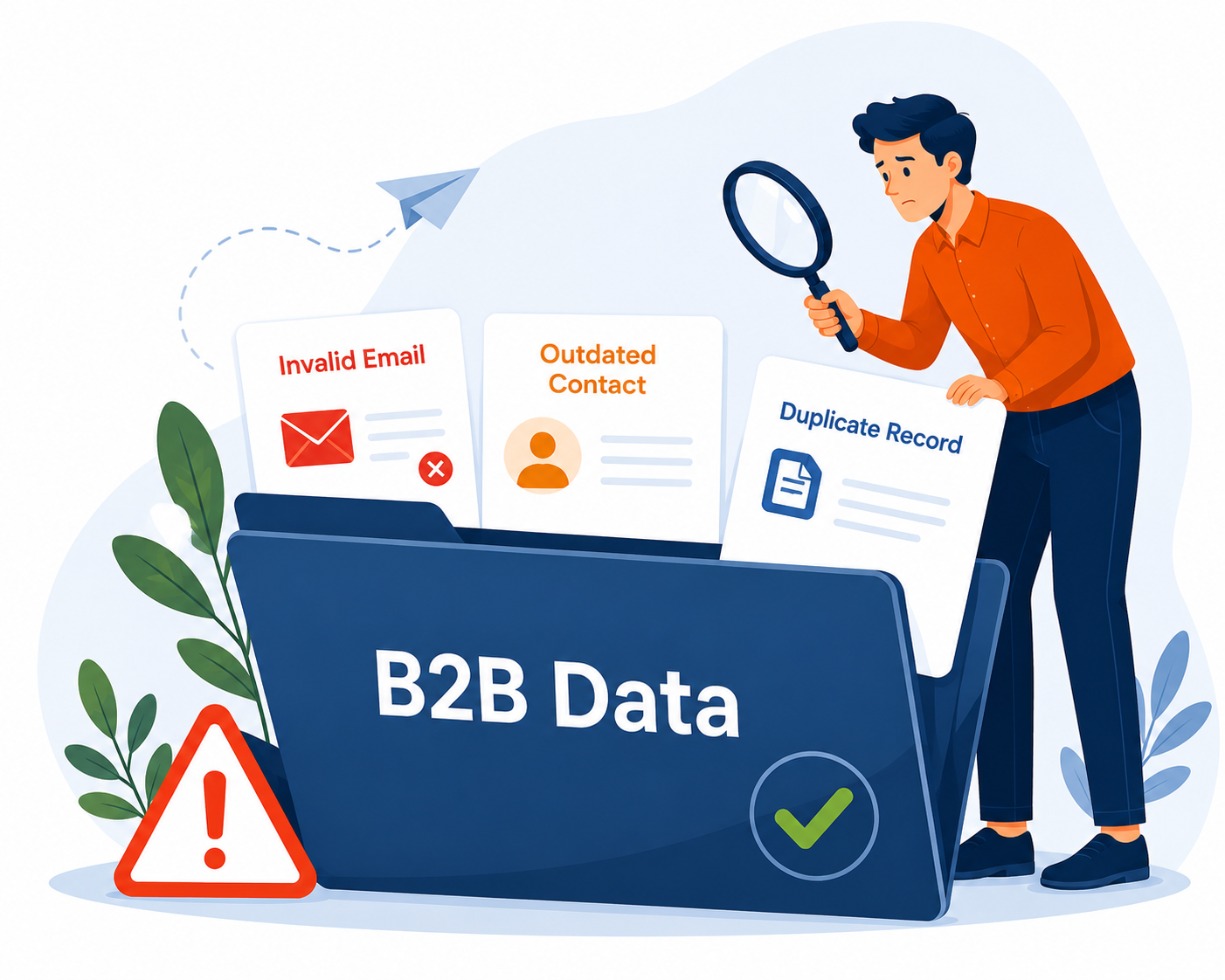
Most B2B sales teams do not have a prospecting problem. They have a data problem.
Bad data drains hours from your sales team’s week, inflates bounce rates, and sends carefully built campaigns straight to spam. Good B2B data does the opposite. It puts your team in front of real decision-makers, in the right roles, at the right companies, with zero cleanup required.
The gap between the two is bigger than most teams realize — and it shows up directly in your conversion rates, your pipeline quality, and your monthly targets.
Here is what that difference looks like across the five factors that matter most.
1. Accuracy
Good B2B data gives you 90%+ verified contacts that connect your team with real decision-makers.
Bad B2B data is full of invalid contacts that inflate bounce rates and waste sales effort before a single conversation starts.
What poor accuracy costs you:
- Outreach sent to people who no longer exist in that role
- Time wasted on contacts that never respond
- Pipeline that looks full but converts nothing
Accuracy is not just a data quality metric. It is the foundation your entire sales process is built on. When your contacts are wrong, everything built on top of them is wrong too.
2. CRM Integration
Good B2B data imports into your CRM in minutes with no manual formatting required.
Bad B2B data demands cleanup, duplicate removal, and field mapping before your team can use it.
Picture this: A salesperson starts Monday morning loading contacts into Salesforce. Five hours later, they have not made a single call. Wrong email addresses mapped to wrong contacts. Duplicate leads created. Incorrect fields everywhere. A salesperson spending their morning on data entry contributes nothing to the pipeline.
What good CRM-ready data looks like:
- Standardized field names that match your CRM layout
- No duplicate records
- Clean formatting with no manual work required
- Import ready in under ten minutes
When your team stops fighting the data and starts working with it, the whole week looks different.
3. Data Freshness
Good B2B data is refreshed every 30 to 45 days so your outreach reaches real people in active roles.
Bad B2B data is built on stale records that quietly reduce campaign performance and response rates over time.
This is where data decay becomes a real problem. Data decay is the gradual degradation of contact data over time as people change jobs, companies restructure, and email addresses get deactivated. B2B data decays at approximately 30% per year. That means nearly one third of your database can become unreliable within twelve months without a single thing going wrong on your end.
Here is what drives that decay:
- Employees leave their roles and move to new companies
- Decision-makers get promoted and lose buying authority
- Email addresses get deactivated
- Companies restructure and departments change
A real example: A sales team started the month with strong targets and a full contact list. Within the first week, a pattern emerged. Leads had left their organizations six months earlier. The wrong decision-makers were being contacted. Follow-up emails were bouncing. The team was working hard. The data was not.
A reliable data provider refreshes records regularly to stay ahead of this decay. When your sales team works with fresh data, monthly targets become something you achieve rather than something you constantly chase.
Get Customzied B2B Data
4. Compliance
Good B2B data is GDPR, CAN-SPAM, and CCPA compliant with verified opt-in contacts throughout the database.
Bad B2B data carries missing consent records that create legal exposure and reputational risk.
Every contact in your database must have agreed to be contacted. This is called opt-in. The three compliance frameworks every B2B team needs to know:
GDPR
Applies in the EU and UK. Requires explicit opt-in consent. Fines reach up to 20 million euros or 4% of global annual turnover, whichever is higher.
CAN-SPAM
Applies in the United States. Requires a clear unsubscribe option in every commercial email.
CCPA
Applies in California. Gives residents the right to request deletion of their personal data from any business database.
Non-compliant data does not just create legal risk. It damages the trust of every company you are trying to reach. Businesses respond better to outreach from organizations that handle data responsibly — and they notice when you do not.
5. Segmentation
Good B2B data lets you filter by job title, industry, revenue, location, and company size so your outreach reaches the right person every time.
Bad B2B data gives you generic lists with little targeting capability. Your message goes to everyone and lands with no one.
Segmentation is what turns a contact list into a targeted campaign. Without it, you are essentially cold calling a phonebook and hoping for the best.
What strong segmentation makes possible:
- Sales teams target only decision-makers in relevant roles
- Marketing sends industry-specific messaging rather than generic campaigns
- ABM campaigns reach the exact accounts that match your ICP
- Personalized outreach that speaks to a prospect’s specific situation rather than a broad audience
The more precisely you can segment, the more relevant your outreach becomes — and relevance is what gets replies
The Silent Campaign Killer: Bounce Rate
A marketing team spent three weeks building an email campaign. They reached 10,000 contacts but 1,500 emails never arrived. That is a 15% bounce rate — and the damage does not stop there.
Two types of bounces:
Soft bounce
A temporary delivery failure due to a full inbox or server issue. The email may reach the recipient once the issue resolves.
Hard bounce
The email address is invalid or permanently deactivated. This contact is unreachable. When hard bounces make up a significant portion of your list, it is a clear sign your data source is outdated and unverified.
Why this matters beyond one campaign:
- Bounce rates above 5% cause Gmail and Microsoft to flag your domain as spam
- Future emails start landing in spam folders even for valid contacts who would have opened them
- One campaign built on bad data damages every campaign that follows
Good B2B data keeps hard bounces close to zero. Bad data turns your domain into a spam risk before your campaign has a chance to perform.
Looking B2B Contact Data for Running Campaign
Conclusion
Good B2B data and bad B2B data are not just different in quality. They produce completely different outcomes for your sales and marketing teams.
Accuracy, freshness, compliance, segmentation, and bounce rate are the five factors that determine whether your campaigns reach real buyers or disappear into the void. Data decay quietly erodes your database over time. Data enrichment is what keeps it sharp and usable.
At ContactMetrix, we provide verified, compliant, and regularly refreshed B2B data to help your team reach the right decision-makers every time. Explore our data solutions and see the difference quality makes.
Frequently Asked Questions
1. How often should B2B data be updated?
Every 30 to 45 days. Without regular updates, B2B data decays at approximately 30% per year, meaning nearly one third of your database becomes unreliable within twelve months.
2. What is data decay?
Data decay is the gradual process by which contact records become outdated and unreliable over time. It happens as employees change jobs, companies restructure, and email addresses get deactivated. B2B data decays at roughly 30% per year, which means a database that was accurate in January can have significant gaps by December. Regular data refresh cycles are the only way to stay ahead of it.
3. What is data enrichment?
Data enrichment is the process of adding missing or updated information to existing contact records. A basic record might only have a name and email address. Enrichment adds job title, company size, industry, revenue, and location — giving your sales team the full context they need to personalize outreach and qualify leads faster. Good B2B data providers build enrichment into their process so every record you receive is complete and ready to use.
4. What are the biggest problems with bad B2B data?
The four most common problems are inaccurate contacts, poor CRM integration, compliance gaps, and high bounce rates. Each one costs your team time, money, or both — and they tend to compound. Inaccurate data leads to high bounce rates, which damages your domain reputation, which reduces the effectiveness of every future campaign.
5. What is a bounce rate in B2B email outreach?
Bounce rate is the percentage of emails that fail to reach recipients. A soft bounce is temporary. A hard bounce means the address is permanently invalid. High hard bounce rates are the clearest sign of outdated or unverified data.
6. What is a healthy bounce rate for B2B email?
Below 2% is healthy. Above 5% puts your domain at risk of being flagged as spam by email providers, which affects every campaign you send going forward — not just the one that triggered the flag.
7. Is buying a B2B email list legal?
Only if the contacts have given opt-in consent. GDPR, CAN-SPAM, and CCPA all have specific requirements around consent and contact rights. Always verify that your data provider meets the compliance standards for the regions you are targeting before using any purchased list.
