
A B2B company runs a campaign for a specific target audience. The subject line is great, the email content is solid, the CTA is clear — but no value comes from it. The reason is simple: they targeted a prospect who left the organization three months ago.
The strategy was right. What was missing is a data practice called data hygiene.
Data hygiene is the practice of keeping data accurate, error-free, and ready to use. Dirty data is either removed, replaced, or renewed in this process. In simple terms, it means identifying and removing duplicate records, correcting errors, standardizing formatting, deleting outdated contacts, and keeping the database relevant over time.
According to Gartner, poor data quality costs organizations an average of $12.9 million per year.
In this article, you will learn what data hygiene means, its key benefits, and the best practices B2B teams can follow to maintain a clean and reliable database.
4 Benefits of Data Hygiene
1. Supports Better Business Decision-Making
High-quality data helps businesses make better decisions. When data is complete and accurate, prospect pain points can be identified and content can be personalized. For example, if a company needs a software upgrade, this is only possible to act on when the dataset has good coverage — including technographic data.
2. Reduces Cost
When the data is complete, outreach is made to actual prospects rather than wasting time, money, and effort on records that are no longer relevant.
3. Improves Productivity
Data teams can focus on strategic tasks rather than manually fixing datasets. Clean data removes the friction that slows every team down.
4. Improves Customer Experience
Accurate, clean data helps businesses interact with customers based on verified information, building long-term trust and genuine satisfaction. Communication with prospects becomes relevant because their complete details are visible and correct.
Example:
Before data hygiene: “David might be a procurement manager.”
After data hygiene: David Peterson | Peterson Logistics, New York | Active since 2023 | Verified number
What Is the Difference Between Data Hygiene and Data Enrichment?
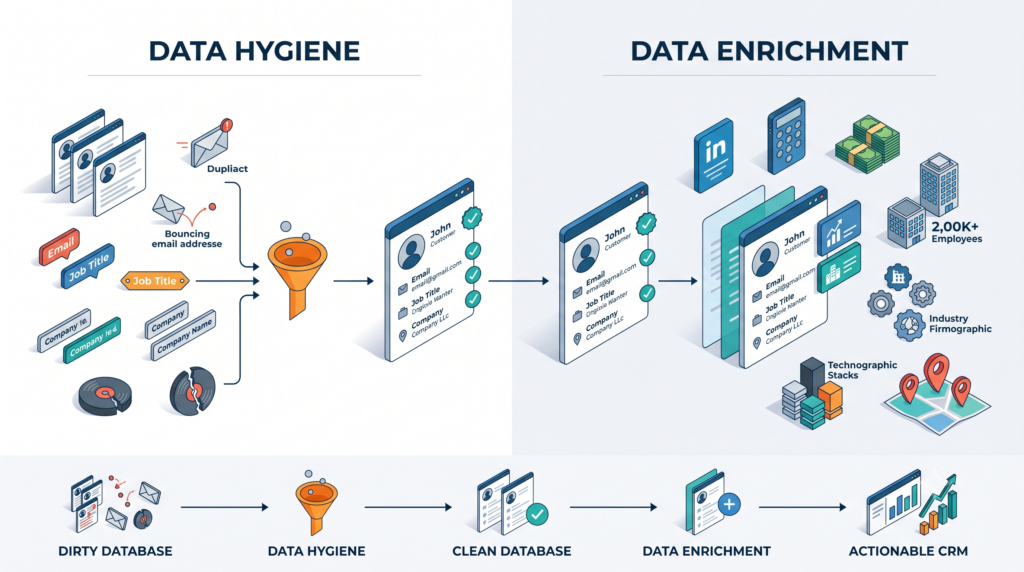
Data hygiene is the first step in maintaining a healthy database. The main goal is to improve the accuracy and reliability of existing data.
Data enrichment is the final stage in fixing a dataset. The main aim is to add completeness and depth to the data.
The best way to understand both is through a practical example.
Think about renovating a house. The first step is fixing broken walls, repairing water pipe leaks, cleaning the floors, and checking for cracks in the roof. All of this is data hygiene — identifying and fixing what is damaged or broken.
The next stage is enrichment. Painting the walls, replacing pipes that are beyond repair, installing modern electrical wiring, and remodeling the kitchen and bathroom to make the space more functional.
The bottom line is that ignoring one stage impacts the entire dataset. Enriching dirty data is like painting a cracked wall — the problem is still underneath.
CRM Data Hygiene: Why Your CRM Is Where It Starts
CRM data hygiene is the continuous process of organizing datasets to keep them accurate, complete, and relevant to your business.
The CRM is the system that keeps the business running. It tracks activity logs, lead stages, deal sizes, previous customer records, and customer properties. When the CRM is dirty, everything built on top of it — lead scoring, ICP filtering, campaign targeting — is compromised.
A practical way to think about it: imagine organizing a bookshelf where every genre is clearly sorted. You know exactly where the thriller books are and where the adventure books sit. You can find what you need immediately. CRM data hygiene does the same thing for your sales and marketing operations.
Key CRM data hygiene practices:
Deduplication
The process of identifying and merging duplicate records into one accurate profile. Multiple copies of the same contact distort pipeline numbers and create repetitive outreach.
Field standardization
Organizing data uniformly across all records. Job titles, company names, and industry classifications should follow a consistent format so the data is comparable and reportable.
Regular refresh cycles
Scheduling automated or manual data verification at consistent intervals to catch changes before they affect campaign performance.
Data Hygiene Best Practices for B2B Teams
1. Audit the Datasets
Evaluate existing datasets to make them error-free. This includes removing duplicate and inaccurate records, checking for spelling mistakes, and identifying missing fields. Regular audits smooth the operational process and improve campaign performance before problems occur rather than after.
2. Standardize Your Data Records
Keep all records in a consistent format across your database. Use the same naming conventions and maintain a uniform format for dates, phone numbers, job titles, and company names. This makes data easier to manage and improves reporting accuracy across every team that uses it.
3. Remove Duplicates Systematically
Duplicate records impact lead scoring, inflate pipeline numbers, and create a repetitive outreach experience. When the same prospect receives two emails from the same sales representative, it damages credibility. Run deduplication checks on a regular schedule rather than waiting for problems to surface.
4. Enrich After Cleansing
Once dirty data is removed, the enrichment process begins. Fill in missing data fields including firmographic data, technographic data, and contact attributes. A clean but thin record is limited. A clean and enriched record is fully actionable.
5. Validate Data Before Every Campaign
Before running any campaign, review your contact list to ensure the information is current, accurate, and relevant to your target audience. This single step prevents the most common and most costly data hygiene failures.
How Often Should You Practice Data Hygiene?
The following refresh intervals are based on typical B2B data decay patterns. Your ideal database hygiene schedule may vary depending on campaign frequency, CRM usage, and how quickly your target market changes.
| Data Type | Recommended Hygiene Frequency |
|---|---|
| Email addresses | Before every campaign |
| Contact data | Every 30 to 90 days |
| Job titles | Every 3 to 6 months |
| Company information | Every 6 months, or quarterly for key accounts |
| Firmographic data | Every 6 to 12 months |
| Full CRM audit | Annually, with quarterly hygiene reviews |
Conclusion
Data hygiene is not actionable when a campaign fails. It is the discipline that prevents failures before campaigns even start.
Dirty data corrupts lead scoring, weakens ICP accuracy, damages sender reputation, and undermines every decision made by the sales and marketing team. The B2B company from the opening of this article had the right strategy, the right message, and the right offer. They only needed clean data to deliver it to the right person.
B2B data hygiene, CRM data hygiene, and data enrichment are not separate tasks. They are connected stages of the same ongoing process. Get into the habit of auditing, standardizing, deduplicating, and enriching your database regularly, and every other part of your B2B operation becomes more effective.
ContactMetrix provides verified, regularly refreshed B2B data that gives your team a clean foundation to work from.
Frequently Asked Questions
1. What is data hygiene?
Data hygiene is the continuous process of maintaining a database to keep it accurate, up-to-date, and free of errors and duplicates. It includes removing outdated records, correcting formatting inconsistencies, eliminating duplicate entries, and ensuring every contact in the database is verified and relevant.
2. What is data decay?
Data decay is the gradual process by which contact records become outdated and unreliable over time. It happens as employees change roles, companies restructure, and email addresses get deactivated. B2B data decays consistently year over year, which is why regular data hygiene practices are essential for keeping any CRM or contact database usable.
3. Can data enrichment replace B2B data hygiene?
No. Enrichment does not fix the underlying problem on its own. Enrichment adds depth and completeness to data, but it works on what is already there. If the existing records are inaccurate, duplicate, or outdated, enrichment only adds layers on top of a broken foundation. Data hygiene must come first.
4. What is an example of data hygiene?
A sales team runs a database audit and finds three duplicate records for the same contact, two with outdated job titles and one with an invalid email address. They merge the duplicates into one accurate record, update the job title to the current role, verify the email address, and add the missing phone number through data enrichment. That entire process is data hygiene in practice.
5. What is CRM data hygiene?
CRM data hygiene is the ongoing process of keeping your CRM database clean, organized, and accurate. It includes deduplication, field standardization, and regular refresh cycles to ensure the records your sales and marketing teams rely on reflect current, real-world information rather than outdated or incorrect data.
6. What are data hygiene best practices?
The key data hygiene best practices for B2B teams are auditing datasets regularly, standardizing all data records for consistent formatting, removing duplicates on a scheduled basis, enriching clean records with missing firmographic and contact attributes, and validating contact lists before every campaign. The frequency of each practice should be aligned with how quickly your target market changes and how often your team uses the CRM.
7. What is data enrichment?
Data enrichment is the process of improving existing contact records by adding missing or updated information. After data hygiene removes errors and duplicates, enrichment fills in the gaps — adding job titles, company size, firmographic data, technographic attributes, and direct contact details to make every record more complete and more actionable.
