

In 2026, most companies are facing a common problem with lead generation. Their strategy is on point and hard work is visible. Still, they cannot generate quality leads. Common reasons for the low number of leads are high competition, technological advancement, and changing customer behavior.
Some companies crack the consumer psychology of their customers. Beyond that, businesses build tactics on a strong foundation made up of accurate, reliable data, a clear Ideal Customer Profile, and the right targeting layer.
In this guide, you will learn what B2B lead generation is, 11 proven strategies that fill your pipeline with leads that convert, and ways to measure lead generation success.
What Is B2B Lead Generation?
B2B lead generation is the systematic process of identifying, targeting, and convincing potential buyers to purchase your products and services. The potential buyer varies from industry to industry. Common buyers are companies, individual buyers, and key decision-makers.
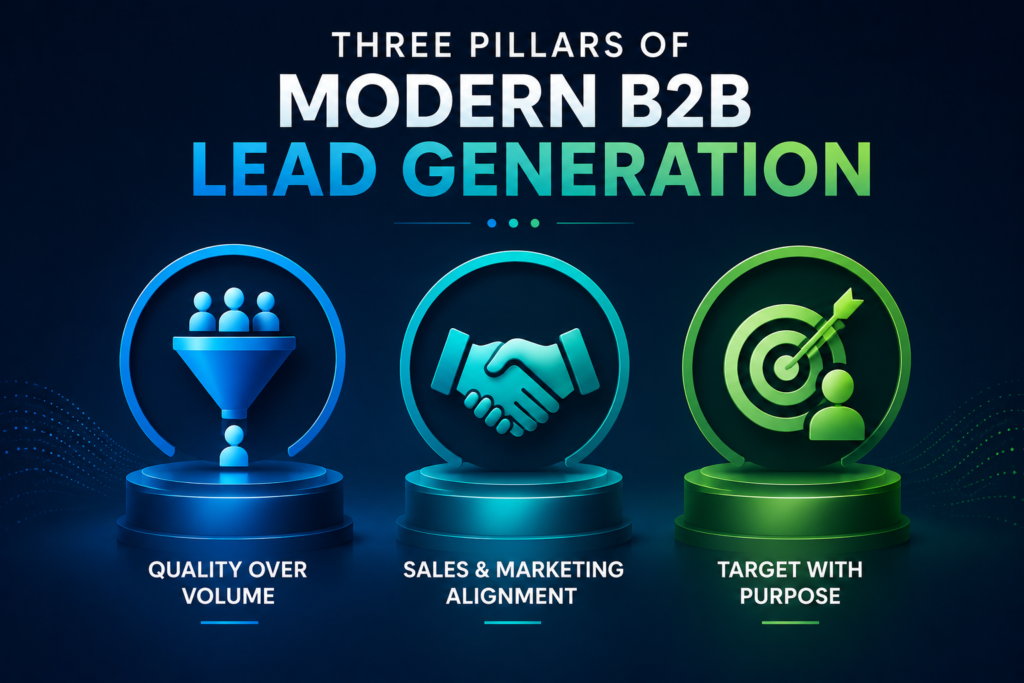
Three pillars of modern B2B lead generation:
1. Lead generation is not about volume. It is better to generate 50 leads and convert most of them than to generate 500 leads with a small conversion number.
2. Lead generation is not a marketing effort alone. When marketing and sales teams work together toward an identical ICP with the same datasets, the quality of B2B leads improves significantly.
3. The ideal marketing team knows who they are targeting and why before every campaign begins.
Why Does B2B Lead Generation Fail?
Most startups struggle to generate leads because their efforts are pointed in the wrong direction. The root causes of failed lead generation are as follows.
Root Cause 1: No Definite ICP
Startups begin generating leads before they have identified an Ideal Customer Profile. The impact is broad, generalized outreach that does not reach the actual audience. The ICP is non-negotiable. It is the filter that separates a good lead from a wasted hour.
Root Cause 2: Bad Data
Campaigns are running on bad data. The data is outdated, irrelevant, and incomplete. Sales representatives are pitching decision-makers who are no longer part of the organization and calling numbers that no longer work. Bad data is the silent campaign killer that most startups realize too late.
Root Cause 3: No Targeting Layer
Startup teams mostly focus on firmographic data while technographic data and intent signals are underutilized assets that reveal which accounts are active in the market right now.
Types of B2B Leads
Not all leads are the same. Each category has specific strategies and nurturing tactics. Here are the common B2B lead types.
1. Marketing Qualified Leads (MQLs)
Marketing qualified leads are in the initial phase of interaction. They have engaged with marketing content and shown genuine interest. Key indicators include downloading content, attending a webinar, downloading a brochure, or filling out an online form. MQLs need further nurturing before they are ready for a buying decision.
2. Sales Qualified Leads (SQLs)
Sales qualified leads show purchasing intent and are prepared for direct sales engagement. They have gone through the engagement stage and have a high chance of conversion. Common characteristics of SQLs include a clear budget, authority, need, and timeline — a framework known as BANT.
3. Data Qualified Leads (DQLs)
Data qualified leads are easy to push through the sales funnel yet underutilized. Prospects are identified through firmographic data, technographic data, CRM records, and intent data as a high fit for your Ideal Customer Profile before they have ever interacted with your brand.
Generate Lead with Verified B2B Data
Inbound vs Outbound Lead Generation: How to Choose the Right One for Your Business
Inbound lead generation
Inbound lead generation means customers are reaching you with a specific pain point. They find you through content, expertise, and brand value visible on digital platforms, or even through word of mouth. The strength of inbound is its long-lasting outcomes. A well-written SEO article can pull customers a year after publishing. The conversion chance of inbound leads is higher and the sales cycle is shorter.
Outbound lead generation
In outbound, the organization takes the initial step and reaches out to prospects that match the Ideal Customer Profile. The customers may not yet be aware of your products or services. Prospects can be reached through cold calling, cold emailing, targeted email campaigns, social media outreach, and webinars. The core strength of outbound lead generation is direct control over your sales pipeline and fast market feedback.
Which one suits your business?
The answer is subjective and depends on several factors.
Inbound works when the organization has established brand value, delivers content regularly, and the target audience is actively searching for a solution.
Outbound works in the early growth stage when you want to build your pipeline quickly and have already identified your Ideal Customer Profile.
Most B2B organizations need both. The question is not which strategy to rely on completely. It is about how to build a system where the two reinforce each other.
The B2B Lead Generation Process: 3 Steps That Actually Work
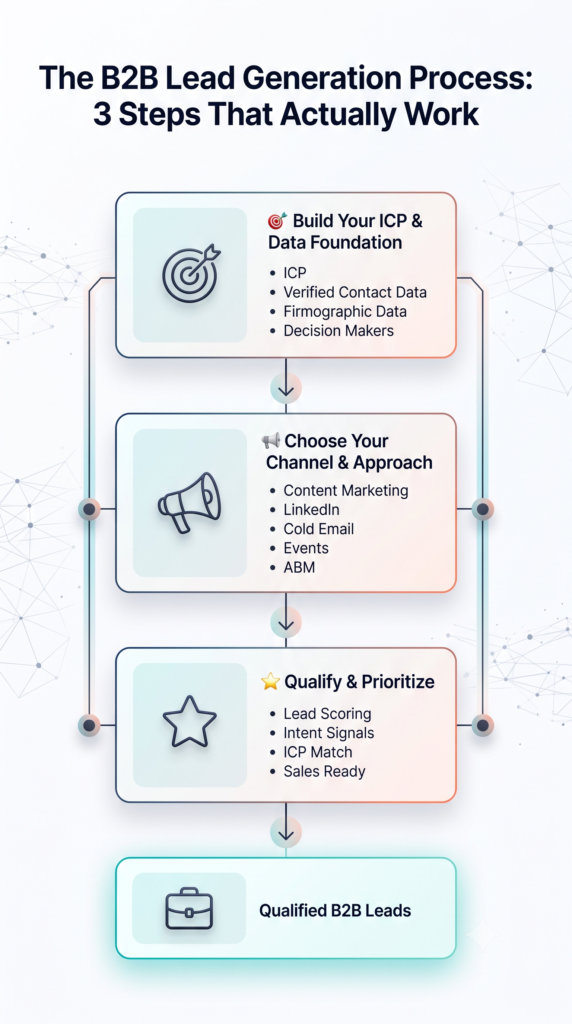
Step 1: Build Your ICP and Data Foundation
The first step is understanding your market size and having a clear picture of your target audience. Building your Ideal Customer Profile means defining industry, job titles, tech stack, and decision-maker titles, along with a thorough understanding of customer pain points. This is the foundation everything else is built on.
Step 2: Choose Your Channel and Approach
Match your lead generation channel to your ICP and your stage of business. For new brands, outbound cold email is essential. For established brands with strong domain authority, content marketing and SEO blog articles are a suitable option. Account-based marketing is a strong choice for teams targeting a specific set of high-value accounts.
Step 3: Qualify and Prioritize
Not every lead deserves equal attention. Use lead scoring based on ICP fit, intent signals, and engagement level to determine which leads your sales team should contact first. Leads with strong intent signals and a perfect ICP match should be fast-tracked.
11 Proven B2B Lead Generation Strategies
These proven strategies help businesses attract, engage, and convert qualified prospects more effectively.
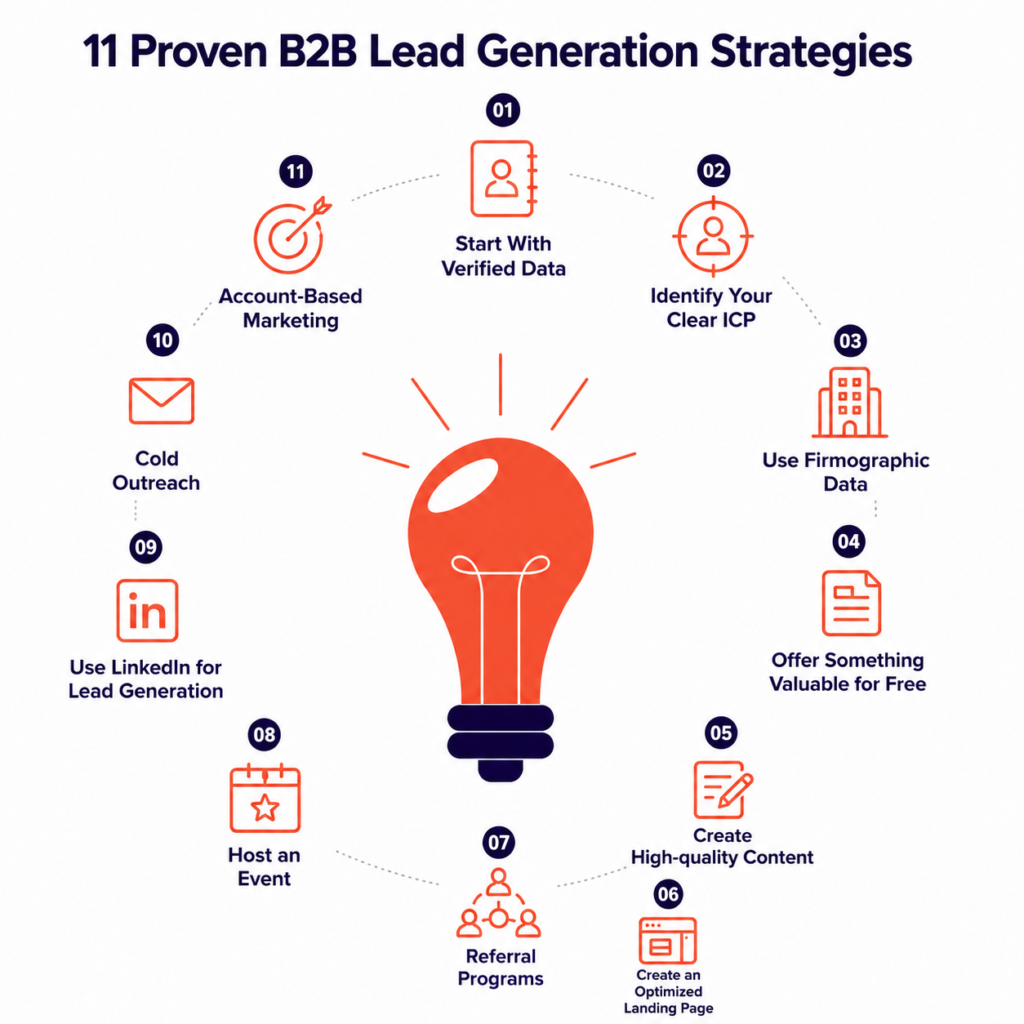
1. Start With Verified Contact Data
Most B2B teams build advanced strategies but overlook the simple foundation of clean contact data. If the contact data is outdated or inaccurate, the outbound campaign will fail before it starts.
2. Identify Your Clear ICP
No tactic will work without a well-defined Ideal Customer Profile. An ICP is built with information such as industry, company size, revenue, geography, and decision-maker title.
3. Use Firmographic Data to Identify Target Accounts
Firmographic data tells you which organizations match your ICP. Use it to build a target account list before any outreach begins rather than approaching the market broadly.
4. Create high-quality content
When a visitor reaches your website to access content, they fill out a form with their name, email address, and contact information. That information can be used to move visitors through the sales funnel.
5. Offer Something Valuable for Free
Freebies are only effective when they add genuine value. This is a proven B2B lead generation strategy where prospects fill out a form in exchange for something that solves a real problem and addresses their pain points.
6. Create an Optimized Landing Page
A high-quality landing page structured around benefits, features, solutions, and a clear CTA increases the chance of conversion. A simple landing page with a clear structure always outperforms a complex one.
7. Referral Programs
Referral programs are one of the most effective ways to generate B2B leads. Conversion chances are higher with referred leads. Build a structured referral program that makes it easy for existing customers to introduce your brand to their network. For every successful referral conversion, the referee can receive a gift card or discount code.
8. Host an Event
Hosting an event is a strong way to generate leads both offline and online. Potential customers gain insight into industry trends, market developments, and solutions to their specific problems. Events not only promote the brand but also establish face-to-face relationships with potential customers.
9. Use LinkedIn for Lead Generation
LinkedIn is the most effective platform for generating high-quality B2B leads. Decision-makers and professionals are active there. Build a business page to share high-value content that resonates with your audience. Start relevant conversations with decision-makers first, then pitch the solution. The pitch should not be salesy but solution-based.
10. Cold Outreach
The two main types of cold outreach are cold calling and cold email. Both remain highly effective in the lead generation process.
Cold email outreach works best with the following structure:
- Personalization: mention the recipient’s name and reference their industry challenges and pain points
- Value: make it valuable with recent industry updates or case studies rather than a generic template
- Subject line: test subject lines built around facts, myth-busting, or a value-driven message and stick with what generates the highest open rate
Cold calling works best when you:
- Have a clearly defined Ideal Customer Profile
- Reach prospects at a time when they are most likely available
- Follow up consistently
- Open with a top-notch line that delivers real value immediately
11. Account-Based Marketing
Account-based marketing targets high-value accounts instead of a broad audience. B2B lead generation with ABM starts with identifying the Ideal Customer Profile, then finding the key decision-makers within those accounts. By combining accurate B2B data with hyper-personalized outreach, relevant content, and alignment between sales and marketing, ABM generates qualified leads with a higher conversion potential.
Common Challenges in B2B Lead Generation
According to HubSpot’s 2026 State of Marketing Report, 29.6% of marketing leaders say generating quality leads is one of their biggest challenges, highlighting that lead quality remains a top priority for modern B2B organizations.
Low quality of leads
- Poor follow-up
- Long sales cycle
- Inconsistent lead nurturing
- Lack of collaboration between sales and marketing
How to fix it
Overcoming these challenges requires accurate data, well-defined lead qualification criteria, timely and consistent follow-up, and regular lead nurturing. Sales and marketing teams should work together by sharing insights, aligning goals, and maintaining clear communication to improve lead quality, shorten the sales cycle, and increase conversion opportunitie
Ways to Measure B2B Lead Generation Success
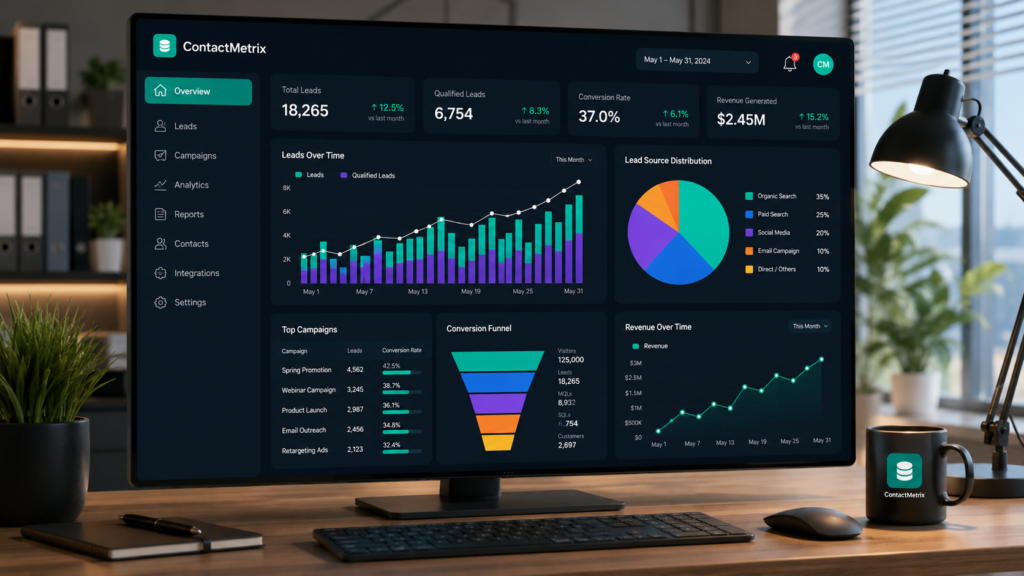
1. Website traffic
Website visitors are most likely to convert. A considerable amount of traffic is a good sign that lead generation methods are working.
2. Lead volume
Track the total number of leads generated in a given time period.
3. Lead quality
The percentage of leads that match the Ideal Customer Profile.
4. Lead velocity
Lead velocity measures the time it takes for a qualified lead to move through the sales funnel from initial qualification to becoming a customer.
5. Cost per lead
Calculated by dividing total lead generation spend by the number of leads generated.
6. Conversion rates
The percentage of leads that convert into closed deals.
7. Average deal size
Measured by total revenue generated across each time period.
Want B2B Data for Lead Generation
Conclusion
The lead generation landscape is evolving as customer preferences change. Companies that adapt to modern strategy will always stay ahead.
Generating a high number of leads does not necessarily mean your lead generation strategy is successful. Success comes from attracting qualified prospects through a well-defined ICP, accurate data, the right lead generation channels, and personalized engagement. Businesses that prioritize lead quality over lead volume build stronger sales pipelines and improve conversion opportunities.
Frequently Asked Questions
1. What is B2B lead generation?
B2B lead generation is the process of identifying, attracting, and engaging potential business customers who may be interested in your products or services. It involves multiple stages, from identifying prospects and qualifying leads to nurturing them until they are ready to become customers.
2. What are the benefits of B2B lead generation?
The key benefits of B2B lead generation include attracting qualified prospects, building a high-quality sales pipeline, increasing brand awareness, improving sales opportunities, and helping businesses establish a stronger presence in the market.
3. Which metrics are used to measure B2B lead generation success?
The important KPIs for measuring lead generation success are lead volume, lead quality, website traffic, lead velocity, cost per lead, conversion rates, and average deal size.
4. What is the difference between marketing qualified leads and sales qualified leads?
The intent of marketing qualified leads is lower than that of sales qualified leads. MQLs have shown interest by downloading an eBook or a brochure, whereas SQLs have shown intent by requesting a live demo or asking for a free sample.
5. What is the most common mistake B2B companies make in lead generation?
They chase volume over quality. Generating thousands of unqualified leads that have no impact on revenue is a waste of time and resources. At ContactMetrix, we help B2B teams build lead generation on a foundation of verified, accurate data so every lead in the pipeline has a genuine chance of converting.
